Flat, fast, no arc. Stephen Ambrose compared the throw to a catcher gunning down a runner at second base. Buck Compton, who had actually been UCLA’s catcher, never made that comparison himself.
Most viewers watch that moment in Band of Brothers and assume it was an actor’s flourish. The version on screen is largely true, and it still leaves out most of his life.
And the man who threw it went on to live one of the strangest lives any Easy Company soldier ever had.
The grenade throw at Brécourt Manor that gave Buck Compton away
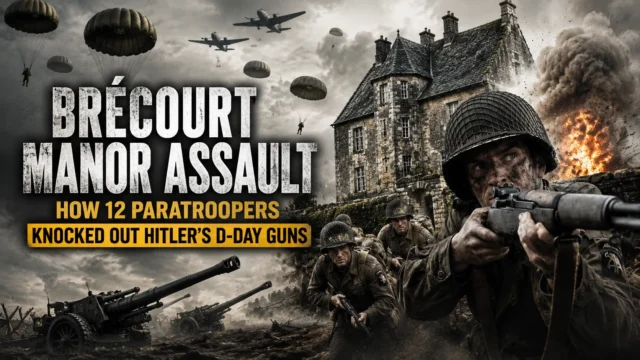
Buck Compton was a Second Lieutenant in Easy Company, 506th Parachute Infantry Regiment, 101st Airborne. On D-Day, June 6, 1944, he helped clear a battery of German 105mm guns at Brécourt Manor in Normandy. During that fight he threw a grenade that killed a fleeing German gunner, and the moment became one of the most talked-about details in the whole series. That part of the show is true.

Stephen Ambrose wrote about it in his book Band of Brothers. According to Ambrose, Compton hurled the grenade on a straight line with almost no arc. The distance to the fleeing German was about the same as the throw from home plate to second base. The grenade came down right on target.
People who love spotting film mistakes often flag that scene as a goof, because the grenade seems to strike the German directly. It is not a goof. It matches what Ambrose recorded about the real assault.
One detail is almost never noted: the baseball comparison belongs to Ambrose, not to Compton. In his own memoir Compton never links the throw to the diamond. He wrote that he threw it reflexively and that he doubts the choice was even conscious. He also recorded that his contact with Ambrose amounted to a single thirty-minute phone call, mostly about Brécourt Manor. The image that made the scene famous came from the historian, not from the man who threw the grenade.
One small correction is worth making. Retellings often describe Compton flicking the grenade with a loose wrist motion. Neither Ambrose nor Compton says that. Ambrose describes a hard, flat throw, and Compton describes throwing without thinking. Here is where his story turns, because that arm came from a place most war fans never expect.
From UCLA catcher to paratrooper: the Jackie Robinson connection

Buck Compton was a college athlete before he was a soldier, and one of his teammates was Jackie Robinson. Compton was the starting catcher on the UCLA baseball team, and Robinson played baseball at UCLA in 1940. The two men shared a dugout before either of them became famous for anything.


UCLA Athletics records the detail that most retellings get wrong. Compton and Robinson were baseball teammates, not football teammates. Compton played offensive guard on the UCLA football team in 1941 and 1942, and he was part of the squad that reached the Rose Bowl on January 1, 1943, according to UCLA Athletics. Robinson had already left campus by then, so the shared ground was the baseball field in 1940.
Compton left UCLA and enlisted in February 1943. He earned his commission as an officer, volunteered for the airborne, and joined the 506th Parachute Infantry Regiment. This is where a common question comes up. People ask whether Compton was a Toccoa man, meaning one of the originals who trained under Herbert Sobel at Camp Toccoa in Georgia in 1942.
He was not. Compton reached Easy Company later, as a young officer joining a unit that had already been forged by that first brutal year of training. That is part of why his bond with the enlisted men stands out. He had to earn their trust rather than inherit it, and he did it quickly.
His fellow officers noticed him fast. Compton was a natural leader who ate with the enlisted men and gambled with them, which some of his superiors disliked and his soldiers loved. Winters valued him for it, and it is the same closeness that made Foy unbearable a year later. First, though, came Normandy, and the fight that earned him a medal.
What Band of Brothers got right about Buck Compton
Most of what the show puts on screen holds up against the record. The show earns high marks on Compton’s combat record. At Brécourt Manor he led an assault element under First Lieutenant Richard Winters, and the small group knocked out a German artillery position that was shelling Utah Beach. For that action Compton received the Silver Star. Winters received the Distinguished Service Cross, and Bill Guarnere also earned a Silver Star.


Compton kept fighting through the Normandy campaign, including the brutal push at Carentan in June 1944. Carentan was a bloody town fight, the kind that grinds a company down street by street, and Easy Company took losses there. He was the kind of officer Winters trusted with hard jobs. In his memoir Winters wrote that Compton did a fantastic job leading his men at Brécourt Manor.
The show could keep the detail without exaggerating it, because the record supports the throw itself. What the record does not support is the reason everyone gives for it.
Then came Operation Market Garden in the Netherlands in the autumn of 1944, the massive airborne operation meant to punch a corridor into Germany. During a firefight, Compton was shot through the buttocks. It was painful and bloody, and it pulled him off the line for a stretch, but he recovered and returned to his men. That wound is often played for a grim joke, yet it was a serious injury for a rifle-platoon leader who kept coming back to lead.
Not everything the show put on screen sat right with the real Compton. One scene in particular made him angry for the rest of his life.
The scene about Buck Compton that got the facts wrong
In the series, a brutal moment shows an American using brass knuckles to smash a surrendering German prisoner in the face, and the show ties that violence to Joe Toye’s character. Compton said the real event happened differently, and it bothered him.
According to Compton’s memoir, the man who hit the prisoner was not Toye at all. Compton described him as a desk jockey from headquarters, a clerk who carried a trench knife with brass knuckles built into the handle. The clerk struck a German who had already surrendered, breaking teeth and probably the jaw. Compton called it senseless, because the prisoner was offering no resistance.
Compton grabbed the man and, in his own words, gave our guy hell. There is a common claim that Compton threatened the clerk with a court-martial. That detail comes from Don Malarkey’s memory, not from Compton. In his book Compton wrote that Malarkey says he threatened a court-martial, but that he does not remember doing it, because he was too mad. It is a small honesty that tells you a lot about the man.
This matters for anyone who wants the true story. The show compressed several men into one and moved the ugliest beat onto a character viewers already knew. The real Compton was the officer who stopped it, not the one who threw the punch. For more on how the series reshaped real events, see our breakdown of the Brécourt Manor assault.
The breaking point: Bastogne, Foy, and why Buck Compton left the line
Buck Compton left Easy Company during the Battle of the Bulge after his two closest friends were maimed in front of him. In the frozen woods near Foy, Belgium, in early 1945, a German artillery barrage tore into the company. Bill Guarnere and Joe Toye were both hit, and both lost a leg. Compton had fought beside those two men since Normandy, and they were about as close as soldiers get.
To understand why Foy hit him so hard, you have to remember who Guarnere and Toye were to him. He had lived beside these two since England, men he gambled with at night and trusted with his life by day. Guarnere was Wild Bill, one of the toughest men in the company. Toye was a rock. Both of them lost a leg in the same barrage, in front of him.
Col. Robert Sink ordered him off the line soon after. He was also suffering from severe trench foot, a crippling cold-weather injury that rotted the feet of men who stood too long in frozen mud, and it alone could end a soldier’s time in the field. The combination sent him back, and he did not return to Easy Company as a combat leader. You can read what that winter did to another Easy Company man in our story on David Kenyon Webster.
The show frames this as a breakdown, with Compton walking away across the snow. He disputed that framing for the rest of his life. In Call of Duty he was blunt about it: “In truth, I did not ‘walk’ off the line. I ran. I ran to go find Dike,” sprinting about fifty yards toward the company command post to get battalion to rush help to the wounded. When he could not find Lieutenant Norman Dike, he exploded in rage, which he believed is what led some men to think he was cracking up. He allowed that Bastogne shook him, but drew a hard line: “I do not believe I was clinically shell shocked, as the series portrays me.” His account is more human, and less tidy, than the screen version.
Compton left the Army after the war, carrying the Silver Star he won at Brécourt, a Bronze Star, the Purple Heart for the wound in Holland, and a French Croix de guerre with palm. Then he did something almost no war story prepares you for. He walked into an entirely different fight.
What happened to Buck Compton after the war
After the war Buck Compton became a Los Angeles police officer, then a prosecutor, and eventually the man who ran the prosecution of Robert F. Kennedy’s assassin. His second life was as dramatic as his first.

Compton joined the Los Angeles Police Department in 1946 and worked his way up to detective. Police work suited a man who had led soldiers under fire. He knew how to stay calm when things went wrong, and he knew how to read people. While carrying a detective’s badge he put himself through Loyola Law School at night and was admitted to the California bar in 1949. In 1951 he moved into the Los Angeles County District Attorney’s office as a deputy prosecutor, and he later rose to Chief Deputy District Attorney, the second-highest post in the office.
In 1969 he ran the prosecution of Sirhan Sirhan for the murder of Senator Robert F. Kennedy, who had been shot in Los Angeles in June 1968. It was one of the most watched trials in American history, and the man supervising the case had once thrown a grenade at Brécourt Manor.
Think about the weight of that assignment. The Kennedy family had already lost one son to an assassin in 1963. Now the man who had to secure a conviction for the second killing was a former paratrooper who knew, better than most lawyers alive, what violent death actually looked like. Compton assigned the courtroom work to deputies John Howard and David Fitts, and the case was won.
In 1970, Governor Ronald Reagan appointed Compton as an Associate Justice of the California Court of Appeal, Second Appellate District. He served on the bench for two decades and retired in 1990. It was on that court, in 1983, that he wrote the opinion in Barber v. Superior Court, a landmark “right to die” ruling that a doctor could not be prosecuted for withdrawing life support from a patient at the family’s request. On the court he was known as a careful, no-drama judge, a long way from the young officer who had thrown grenades in Normandy. In 2008 he told his full story in a memoir written with Marcus Brotherton, titled Call of Duty: My Life Before, During, and After the Band of Brothers. Much of what we know about his own view of the war comes from that book.
Buck Compton died on February 25, 2012, at the age of 90, at his home in Burlington, Washington, from complications after a heart attack. (Some wire obituaries carry a February 26 dateline, but his family, his funeral home, and his Find a Grave record all give February 25.) He was cremated and his ashes were returned to his family; his Find a Grave memorial records his life. The ballplayer who became a paratrooper and then a judge was gone. You can trace more of his generation of officers in our profile of Lewis Nixon, the 2nd Battalion intelligence officer, whose life also ran far past the war.
Buck Compton’s real legacy
Most Easy Company men are remembered for a single chapter. Compton had at least three. He was the athlete who shared a field with Jackie Robinson, the lieutenant who won a Silver Star on D-Day, and the prosecutor who ran the case against a senator’s assassin.
He also spent years quietly correcting the way people remembered him. He did not want to be the man who broke down in the snow. He wanted people to know he had watched his friends bleed and had kept going as long as any human could.
What makes Compton rare is how completely he built a second life. Plenty of veterans came home and found steady work. Very few stood at the center of a national murder trial, then spent twenty years deciding the law from an appellate bench. The same steadiness that let him lead a platoon under artillery let him run a prosecution under the eyes of the whole country.
He spent the rest of his life saying the throw was just reflex. The better story won anyway.
Related Band of Brothers Stories
- Why Dick Winters Really Left Combat Command
- Ronald Speirs: What Band of Brothers Didn’t Tell You
- Herbert Sobel: The Captain Easy Company Feared
Sources
- Stephen E. Ambrose, Band of Brothers (Brécourt Manor grenade throw, p. 97).
- Lynn Compton with Marcus Brotherton, Call of Duty: My Life Before, During, and After the Band of Brothers (2008).
- UCLA Athletics obituary (baseball, football, Rose Bowl, Jackie Robinson).
- Warfare History Network: Buck Compton, One Man’s Call of Duty (memoir quotes).
Frequently Asked Questions
Who played Buck Compton in Band of Brothers?
Neal McDonough played Buck Compton in HBO’s 2001 miniseries Band of Brothers. McDonough later spoke warmly about the real Compton and the friendship the two men formed.
How accurate is the Buck Compton Band of Brothers portrayal?
The combat record is accurate. His Silver Star at Brécourt Manor, the wound in Holland and his return to the line all match the books. Two things do not. Compton rejected the shell-shock framing of his exit at Bastogne in print. And by his own account the brass-knuckles punch on a surrendering German prisoner was thrown by a clerk from headquarters, not by Joe Toye, whose character carries it in the series.
Was Buck Compton really Jackie Robinson’s teammate?
Yes. Buck Compton was the starting catcher on the UCLA baseball team, and Jackie Robinson played baseball at UCLA in 1940. They were baseball teammates, not football teammates, according to UCLA Athletics.
Did Buck Compton prosecute Sirhan Sirhan?
He supervised it. By 1969 Compton was Chief Deputy District Attorney for Los Angeles County, and he assigned the courtroom prosecution to deputies John Howard and David Fitts. Sirhan Sirhan was convicted of assassinating Senator Robert F. Kennedy.
Why did Buck Compton leave Easy Company?
Compton was taken off the line during the Battle of the Bulge after his close friends Bill Guarnere and Joe Toye were both severely wounded near Foy. He was also suffering from severe trench foot. He disputed the show’s portrayal of the moment as a breakdown.
How did Buck Compton die?
Compton died on February 25, 2012, at age 90, at his home in Burlington, Washington, from complications following a heart attack. He was cremated. (A February 26 date appears on some wire obituaries, but his family, funeral home, and Find a Grave record give February 25.)
Correction, October 25, 2026: An earlier version of this article described Lewis Nixon as an Easy Company leader. He served on the 2nd Battalion and regimental staff.