He earned four Purple Hearts, the last for the wound that finally took him out of the war, more than any other man in Easy Company. He had been hit on D-Day, hit again in Holland, and hit a third time at Bastogne, and every time he found his way back to the line. When the shell that cost him his right leg finally came, he was lying in the snow outside a Belgian town that most Americans had never heard of, next to a friend who would lose a leg trying to save him.
His name was Joe Toye, and the men of Easy Company thought he was the toughest soldier among them. The record backs them up.
Who was Joe Toye?
Staff Sergeant Joseph J. “Joe” Toye was an original member of Easy Company, 506th Parachute Infantry Regiment, 101st Airborne Division. He was born on March 14, 1919, in Hughestown, a small coal-country borough in Luzerne County, Pennsylvania, the son of Beatrice Toye and the late Peter Toye, a local baseball catcher. He enlisted in December 1941, days after the attack on Pearl Harbor, was first assigned to the medical corps, and then volunteered for the paratroopers.
By the end of the war Toye was one of the most wounded and most respected enlisted men in the company. He jumped into Normandy on D-Day, fought through Holland, and held the line at Bastogne, where the war ended for him on a frozen morning in January 1945. His commander, Dick Winters, called him “an American hero of the first order,” and Winters did not hand out lines like that.
Toye’s reputation rested on more than his wounds. He was known in the company for a grim, deadpan humor. Before Easy Company shipped to Europe, he liked to say that if he ever got the chance to put a knife across Hitler’s windpipe, Roosevelt would rename Thanksgiving “Joe Toye Day” and pay him ten thousand dollars a year for the rest of his life. Stephen Ambrose recorded the line in Band of Brothers, and it fit the man: eager to get into the fight, and unsentimental about what the fight actually was.


Why did Joe Toye have four Purple Hearts?
Joe Toye earned four Purple Hearts because he was wounded four separate times and kept coming back to the front each time. In Beyond Band of Brothers, Dick Winters lays it out plainly: Toye “was wounded four times: in Normandy, Holland, and twice at Bastogne.” Stephen Ambrose, in Band of Brothers, notes that this was the highest count in the company.
The number only tells part of it. A Purple Heart marks a wound, but it says nothing about what a man does after he is patched up. Toye’s pattern was always the same. He got hit, he got treated, and he went looking for his squad. He was a squad leader, and in his mind his place was on the line with his men, not in a hospital or a replacement depot in the rear.
The same nerve showed when he was not the one bleeding. In Holland, when the battalion needed a German prisoner for interrogation and no one volunteered, the call went to Toye. He picked Corporal James Campbell and one other man, moved out past British and American dead toward a nearby wood, worked his way behind a German soldier, and took him prisoner at the point of his bayonet, as Ambrose recounts in Band of Brothers. Campbell would be among the Easy Company men who did not come out of Holland alive.
That stubborn loyalty is the thread that runs through his whole war. It is also what makes the popular image of Toye, the quiet tough guy who barely speaks on screen, so incomplete.
Joe Toye at Brécourt Manor
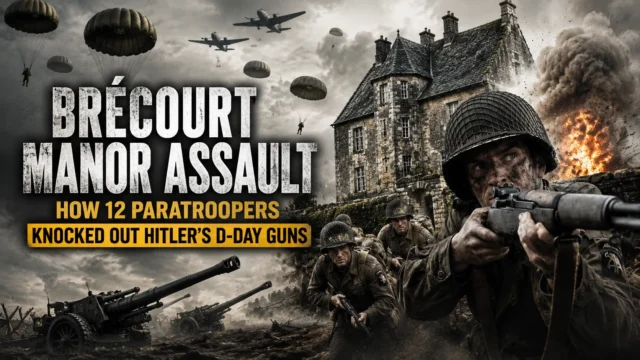
Toye’s war started, like the company’s, on D-Day. On the morning of June 6, 1944, he was part of the small group of paratroopers Lieutenant Dick Winters led against a battery of German 105mm guns at Brécourt Manor, guns that were shelling Utah Beach. Winters’ assault group included Toye, PFC Robert “Popeye” Wynn, and a handful of others, with about a dozen Americans taking on a much larger German force.
In the middle of the fight, a German stick grenade landed in the group. The men scattered, but Toye dropped flat, and the grenade came down between his legs as he lay face-down. It went off while Winters was still shouting at him to move. Somehow Toye got up and kept fighting. He came through the assault, which is still studied at West Point as a model small-unit attack, and was one of the men awarded the Bronze Star for it.
The fight also showed his harder edge. With the guns taken, Toye came across a German prisoner babbling in a panic. He told the man to be quiet, and when that did not work he knocked him down with a brass-knuckle punch to the face. Ambrose kept the moment in Band of Brothers because it fit the man the company knew, and the series put it on screen with Kirk Acevedo throwing the same punch. It was blunt, fearless, and out of patience with the enemy, which was Toye in a single image.
It was an early sign of the luck and the toughness that would define him. Brécourt was the kind of day that should have ended his war, and instead it was only the beginning.
“I want to go back with the fellows”
The single best window into who Joe Toye was comes from Bastogne, in the days right before he was hit for the last time. Winters tells the story in his memoir, and it is worth telling in full.
On New Year’s Day, 1945, the Germans threw their largest air attack of the campaign at the American positions around Bastogne. Toye was hit by shrapnel from a bomb during the raid, his third wound of the war. His platoon sergeant sent him back to the aid station in Bastogne for treatment. That should have been the end of his fighting for a while.
Later that same day, Winters looked across the field to his left and saw Toye walking up the road toward the front, his arm in a sling. Winters went out to meet him. “Where are you going?” he asked. “You don’t have to go back to the line. Take a few days off.” Not Joe Toye. He had met a lieutenant at the aid station who was suspected of shooting himself in the hand to get out of front-line duty, and Toye wanted no part of that company. He was a squad leader, and his place was on the line. He hitched a ride back to the front with the chaplain, Father John Maloney, and told Winters simply, “I want to go back with the fellows.”
Winters knew Toye should not have been on the line with a fresh wound. He let him go anyway, because, as he wrote, he admired the man’s devotion to his squad too much to stop him. It is the moment that earned Toye the line about being a hero of the first order.
How did Joe Toye lose his leg?
Joe Toye lost his right leg on January 3, 1945, in an artillery barrage near Foy, Belgium, during the Battle of the Bulge, the day after he insisted on returning to the line. Easy Company was dug in along the tree line when a heavy German bombardment came down on their positions. Toye was caught out in the open and badly hit, his right leg mangled by shrapnel.
His friend and platoon sergeant, Bill Guarnere, saw him go down and ran out into the falling shells to drag him back to the trees. Before Guarnere could get him to safety, another shell landed beside them and took Guarnere’s leg as well. The two men had jumped into Normandy together on D-Day, and they left the war within minutes and a few feet of each other, each missing a leg.
Even then the toughness held. Guarnere remembered Toye lying in the snow with his leg gone, more furious than frightened, roaring, “What the hell does a guy gotta do to get killed around here?” It was Toye’s fourth Purple Heart, the most of any man in Easy Company.
The damage to Toye’s leg was severe. Doctors first amputated it below the knee, but back in the States they found the knee itself was too badly damaged to save, and the amputation was extended. Toye spent roughly nine months in hospitals, including a chest operation to remove shrapnel lodged in his back, before he came home for good.
What happened to Joe Toye after the war?
Toye went home to Pennsylvania and went back to work. He settled in the Reading area and took a job at Bethlehem Steel, the kind of hard industrial work a one-legged veteran was not expected to do, and did it anyway. He married, raised a family, and lived the quiet postwar life of a man who had already used up several lifetimes of luck by the age of twenty-six.
Joe Toye died of cancer on September 3, 1995, in Reading, Pennsylvania, at the age of 76. He is buried in Gethsemane Cemetery in Laureldale, near Reading, alongside his wife and his son; his Find a Grave memorial records the site. At his funeral, the eulogy was delivered by his old company commander, Major Dick Winters, the same officer who had watched him walk back to the front with his arm in a sling fifty years earlier. In his home coal country, a historical marker on Center Street in Hughestown now honors the hometown paratrooper who became one of Easy Company’s most wounded and most respected men.

Who played Joe Toye in Band of Brothers?
Joe Toye was played by actor Kirk Acevedo in the 2001 HBO miniseries Band of Brothers. His wounding and the loss of his leg are shown in Episode 7, “The Breaking Point,” the episode built around the company’s ordeal in the woods outside Bastogne. On screen, Toye is a man of few words, which is roughly how the veterans remembered him. What the runtime cannot show is the full weight of the record behind those scenes: the four wounds, the four returns to the line, and the day he chose the front over a hospital bed.

Related Easy Company stories
- Bill Guarnere, the friend who lost a leg trying to save Toye
- The Brécourt Manor assault, Toye’s first day of the war
- Dick Winters, the officer who gave Toye’s eulogy
Sources
- Dick Winters with Cole C. Kingseed, Beyond Band of Brothers: The War Memoirs of Major Dick Winters (Berkley Caliber, 2006), for the Brécourt Manor assault, Toye’s four wounds, his return to the line, and the “American hero of the first order” passage.
- Stephen E. Ambrose, Band of Brothers: E Company, 506th Regiment, 101st Airborne from Normandy to Hitler’s Eagle’s Nest (Simon & Schuster, 1992), for the four Purple Hearts, the “Joe Toye Day” remark, and the bayonet-point prisoner capture in Holland with Cpl. James Campbell.
- William Guarnere and Edward Heffron, with Robyn Post, Brothers in Battle, Best of Friends (Berkley Caliber, 2007), for Guarnere’s recollection of Toye after the January 3 barrage.
- “Sgt. Joseph J. ‘Joe’ Toye (1919-1995),” Find a Grave Memorial no. 19055725, for birth, death, and burial at Gethsemane Cemetery, Laureldale, PA.
- “Sgt. Joseph Toye, Wounded Veteran, Is Visiting Here,” Pittston-area newspaper, 1945, for family background, enlistment, and recovery at England General Hospital, Atlantic City.
- Jake Wynn, “Joe Toye: A Coal Region Soldier in the ‘Band of Brothers,'” wynninghistory.com.
Frequently asked questions
How did Joe Toye lose his leg?
Joe Toye lost his right leg on January 3, 1945, in a German artillery barrage near Foy, Belgium, during the Battle of the Bulge. He was caught in the open and badly wounded, and his friend Bill Guarnere lost a leg of his own while trying to drag Toye to safety. Doctors first amputated below the knee, then extended the amputation once they reached the United States.
How many Purple Hearts did Joe Toye have?
Toye earned four Purple Hearts, the most of any man in Easy Company, according to Stephen Ambrose. He was wounded in Normandy, in Holland, and twice at Bastogne, and returned to the front line after each of the first three wounds.
Did Joe Toye and Bill Guarnere both lose a leg?
Yes. During the same artillery barrage near Foy on January 3, 1945, Toye was hit and lost his right leg, and Guarnere lost a leg trying to pull him to cover. The two had jumped into Normandy together on D-Day and were among the closest friends in the company.
Who played Joe Toye in Band of Brothers?
Joe Toye was played by Kirk Acevedo in HBO’s 2001 miniseries Band of Brothers. His wounding at Bastogne is shown in Episode 7, “The Breaking Point.”
When did Joe Toye die?
Joe Toye died of cancer on September 3, 1995, in Reading, Pennsylvania, at age 76. He is buried in Gethsemane Cemetery in Laureldale; his Find a Grave memorial records the site, and his former commander Dick Winters delivered the eulogy.
Did Joe Toye survive the war?
Yes. Toye survived World War II, though the January 3, 1945 barrage near Foy took his right leg and ended his combat service. He recovered through roughly nine months in hospitals, went home to Pennsylvania, worked at Bethlehem Steel, and lived another fifty years before his death in 1995.
What medals did Joe Toye earn?
Toye earned the Bronze Star for the Brecourt Manor assault on D-Day and four Purple Hearts, the most of any man in Easy Company. Some fan sites credit him with a Silver Star, but Winters’ memoir records the Brecourt Silver Stars going to Compton, Guarnere, and Lorraine; Toye’s award was the Bronze Star. As a Toccoa-trained combat paratrooper who fought from Normandy through Bastogne, he also wore the Combat Infantryman Badge and the paratrooper’s jump wings.
What rank was Joe Toye?
Toye was a corporal during the Brecourt Manor assault on D-Day, as Winters notes in his memoir, and rose to staff sergeant with Easy Company. He served as a squad leader through Holland and Bastogne, which is why he kept insisting on returning to the line after each wound.
Did Joe Toye have a family?
Yes. After the war Toye married and raised four children: sons Pete, Steven, and Jonathan, and a daughter, Anita. His son Jonathan died in 1995 at age 36, the same year Toye himself died. Father and son are buried together with Toye’s wife Mary at Gethsemane Cemetery in Laureldale, Pennsylvania.
Was Joe Toye Irish?
Yes. Toye was born into an Irish American family in Hughestown, a coal town in Luzerne County, Pennsylvania. His father Peter was a Pennsylvania coal miner and his mother was Beatrice McTighue Toye. Like many Easy Company men, he came from a working-class immigrant community that sent its sons to war.
Was Joe Toye in The Thin Red Line?
No, but the confusion is understandable. Kirk Acevedo, the actor who played Joe Toye in Band of Brothers, appeared in Terrence Malick’s 1998 war film The Thin Red Line as Private Tella. The real Joe Toye died in 1995, before either production was filmed.
Correction, October 25, 2026: An earlier version of this article implied Joe Toye had four Purple Hearts before his final wound. His fourth Purple Heart was for that wound.