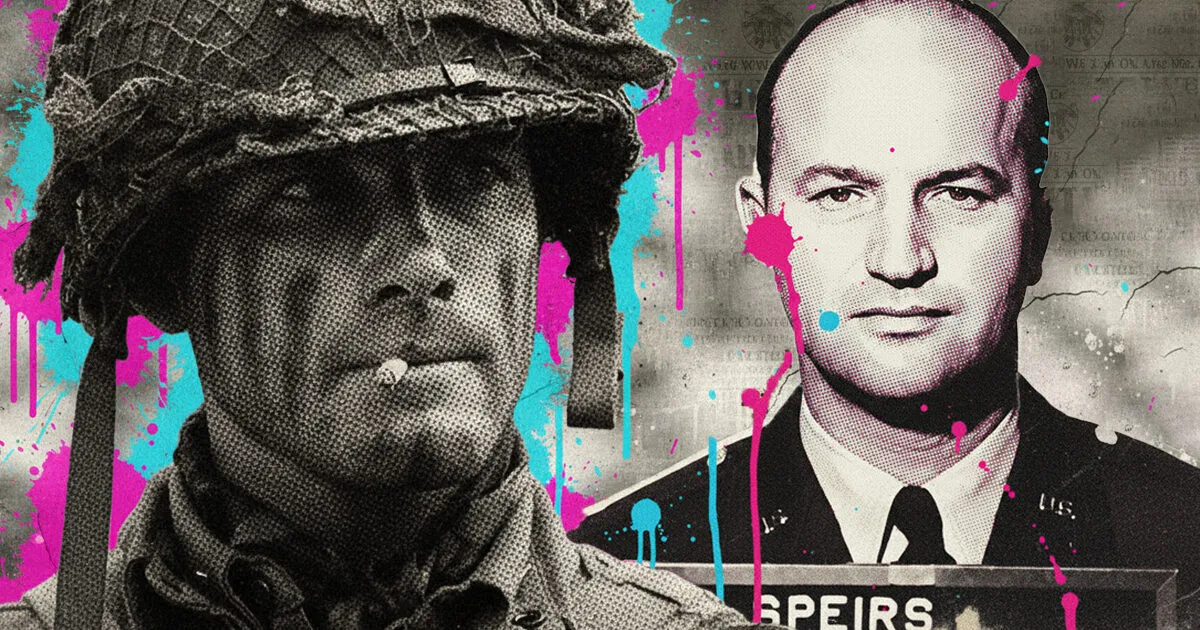
A drunk sergeant reached for his machine gun. The lieutenant didn’t flinch. One burst from a Thompson submachine gun, and the man dropped. The platoon watched it happen without batting an eye.
That wasn’t a scene from HBO. That was June 7, 1944. One day after D-Day. The lieutenant was Ronald Speirs.
Band of Brothers turned Speirs into a legend. The cigarette scene. The Foy run. The rumors whispered between foxholes. But the show barely scratched the surface of who Ronald Speirs actually was, or what he actually did.
The real story is darker than the show depicted, more complicated than the rumors suggested, and stranger than anything a screenwriter could have invented. Eyewitnesses say Speirs killed prisoners and shot one of his own men; he also sprinted through enemy fire on a bet with death, then spent the next two decades guarding Nazis, running covert missions in Laos, and retiring quietly to Montana.
Here’s what really happened.
Did Ronald Speirs Really Kill German Prisoners on D-Day?
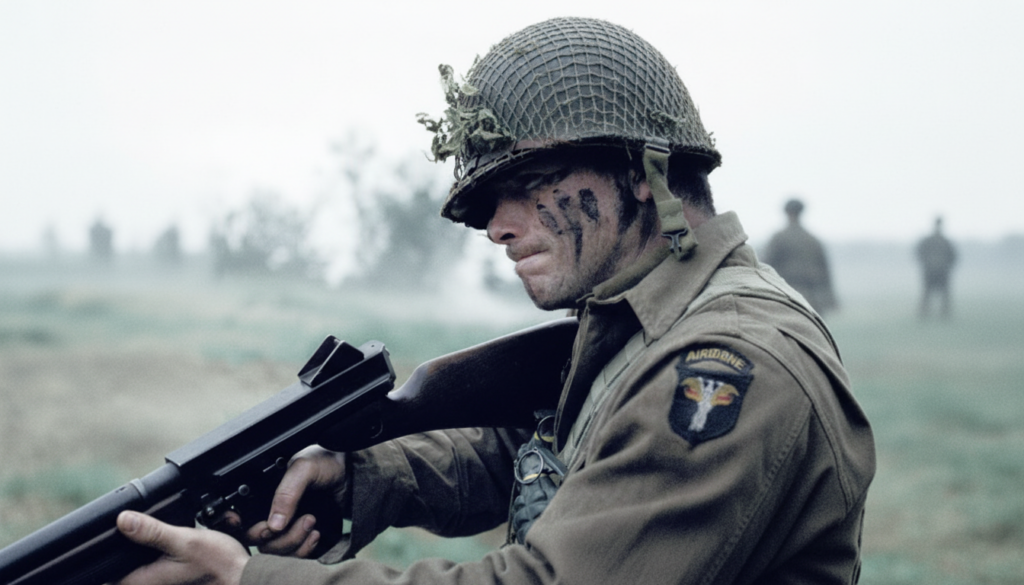
According to accounts collected by historian Jared Frederick in Fierce Valor, including that of Pvt. Art DiMarzio, who was there, Speirs shot seven Germans in two separate incidents on D-Day: three prisoners, then four men trying to surrender. The real events were smaller in scale but more disturbing in detail than the dramatized version in Band of Brothers. The show depicted Speirs casually handing cigarettes to twenty prisoners before mowing them down with a Thompson.
The first incident happened hours after Speirs landed roughly four miles off his intended drop zone. As a platoon leader in Dog Company, 506th Parachute Infantry Regiment, 101st Airborne Division, he was already separated from most of his unit when his small group captured three German soldiers. There was no rear area to send them to. No MPs to hand them off to. The airborne drop had scattered everyone.
Private Art DiMarzio, who witnessed both incidents, later described what happened. Speirs told his men: “We’re going to have to take them out. We can’t take them with us.” Each man shot a prisoner.
The second incident came hours later. Speirs encountered four more unarmed German soldiers and shot them himself. No order to subordinates this time. No discussion.
Context matters here, though it doesn’t excuse the act. General Maxwell Taylor had allegedly instructed his paratroopers before the drop to “take no prisoners” because captives would “handicap our ability to perform our mission.” Multiple units received similar orders on D-Day. The chaos of the scattered airborne drop meant there was genuinely no infrastructure to handle POWs in the first hours.
A 1946 Boston Globe article would later state that Speirs “was awarded the Bronze Star for singlehandedly killing 13 Nazis after parachuting into Normandy on D-Day.” The number thirteen likely combines both prisoner incidents with combat kills.
Years later, when Stephen Ambrose’s publisher feared lawsuits over including these allegations in the book Band of Brothers, Dick Winters telephoned Speirs directly. Speirs didn’t deny it. He casually admitted the stories were true and provided written confirmation to satisfy the publisher.
But the show inflated the scene. There was no group of twenty, and Speirs wasn’t smirking while he did it. According to Art DiMarzio, the prisoners in the first incident were in fact offered cigarettes before they were shot, so the series relocated a real detail into a colder, larger set piece rather than inventing it whole.
The Sergeant Shooting: What the Show Changed
Ronald Speirs shot and killed an American sergeant from his own platoon on June 7, 1944, in the Normandy fighting near Brucheville. The incident was not a cold execution over a refused patrol, as Band of Brothers implies. It was a split-second act of self-defense during active combat that his entire platoon witnessed.
The show’s version has soldiers gossiping: “The guy was drunk and refused to go on a patrol.” That’s a simplified version of what happened. The real sequence of events was more dangerous.
Speirs had ordered his platoon to hold their defensive position during a coordinated artillery barrage. A replacement sergeant, not a veteran member of the unit, was heavily intoxicated. He refused the order. He cursed at Speirs. Then he reached for his machine gun and raised it toward the lieutenant.
At that point, it stopped being disobedience. It became armed mutiny in the middle of combat.
Speirs fired a burst from his Thompson into the man’s chest. PFC Art DiMarzio witnessed the entire thing. What DiMarzio remembered afterward complicates the cold-blooded image the show built: Speirs wiped away a tear and said quietly, “I had to take him out. I had to take him out.” Speirs then reported it to his commanding officer, Captain Jerre S. Gross, who deemed the shooting justifiable self-defense.
Captain Gross was killed in action the following day, near Sainte-Come-du-Mont. The matter was never formally investigated, never brought before a tribunal, and never mentioned again by the chain of command.
In a 1993 letter to Dick Winters, Speirs wrote about the incident with characteristic bluntness: “The sergeant, by the way, was a replacement. The platoon saw it happen without batting an eye.”
Winters offered his own assessment in Chapter 10 of Beyond Band of Brothers: “In doing so, Speirs probably saved the lives of the rest of the squad.”
Was the sergeant shooting justified?
By military law, a drunk soldier raising a loaded weapon at an officer during combat constitutes a lethal threat. Speirs had legal authority to respond with deadly force. The fact that Gross, his commanding officer, immediately ruled it justifiable, and that the entire platoon witnessed it without objection, suggests the threat was real and immediate. The show’s version, which frames it as a cold punishment killing, misrepresents the actual circumstances.
The Run Through Foy: January 13, 1945
Ronald Speirs sprinted through the German-occupied village of Foy, Belgium, on January 13, 1945, crossed enemy lines, coordinated with Item Company on the other side, and then ran back through the same kill zone. The event is confirmed by multiple eyewitnesses, and it happened almost exactly as Band of Brothers depicted it.
The backstory is what makes it extraordinary. Easy Company had been ordered to assault Foy, which the Germans held in strength. First Lieutenant Norman Dike was leading the attack. And he froze. In the middle of an open field, under heavy fire, Dike stopped giving orders. The attack stalled. Men were exposed and dying.
Captain Dick Winters, now serving as battalion executive officer, watched the disaster unfold from the tree line. He was under strict orders from Colonel Sink to stay in the rear. But he couldn’t watch Easy Company get slaughtered.
Winters screamed at the first officer he saw. “Get yourself over here! Get out there and relieve Dike and take that attack on in!”
That officer was Ronald Speirs. And he didn’t hesitate.
Speirs sprinted across the open ground, took command from Dike, and restarted the attack. But another platoon, still following Dike’s last orders, had no radio contact and no idea what was happening. So Speirs did the unthinkable. He ran straight through the German-held center of Foy, emerged on the other side, found Item Company, relayed his orders, and then ran back through the village.
Carwood Lipton witnessed the entire run. During a 1991 visit to the former battlefield, he recalled: “He just kept on running right through the German line, came out the other side, conferred with the I Company CO and ran back.”
After Foy was secured, Speirs was permanently assigned as Easy Company’s commanding officer. He held that post from January 13 to November 30, 1945.
Winters wrote in Chapter 10 of his memoir: “Without Speirs’s intervention, however, the casualties would have been excessive.”
How did Speirs survive the Foy run?
Speed and shock. German soldiers likely didn’t expect an American officer to sprint directly through their defensive positions. In the chaos of the ongoing battle, many may not have registered what they were seeing until Speirs was already past them. He zigzagged, moved fast, and relied on the element of disbelief. It wasn’t a plan. It was instinct.
The Part Nobody Talks About: Speirs After the War
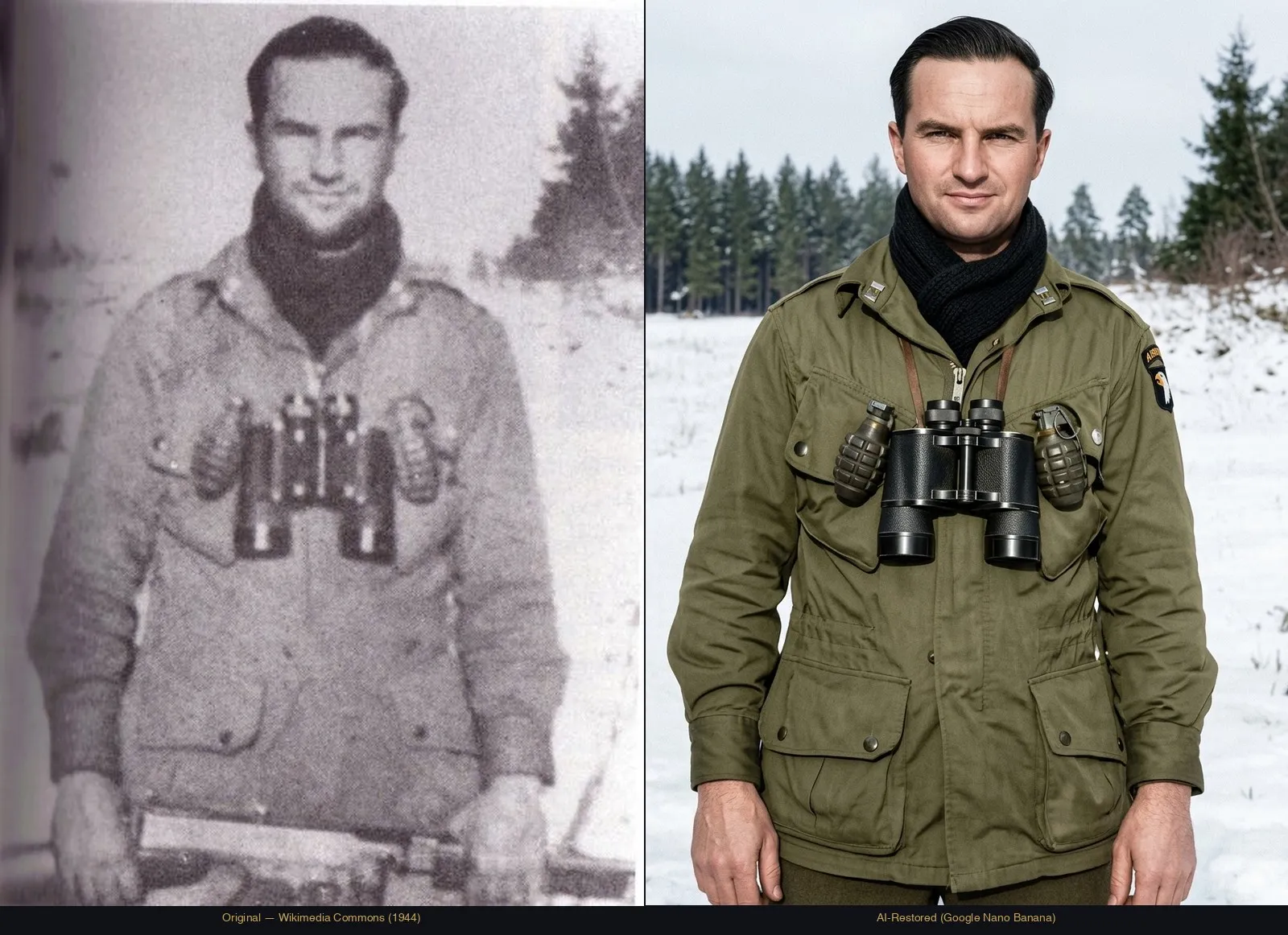
Ronald Speirs’ military career didn’t end in 1945. He served for another nineteen years across three wars and some of the Cold War’s most sensitive assignments. That’s a fact that almost no Band of Brothers coverage mentions. His post-war career may be even more remarkable than his wartime service.
Speirs returned to the United States alone in December 1945 after a painful divorce from his English wife, Edwyna. He chose to stay in the Army when most of his comrades were racing home to civilian life.
Did Ronald Speirs serve in Korea?
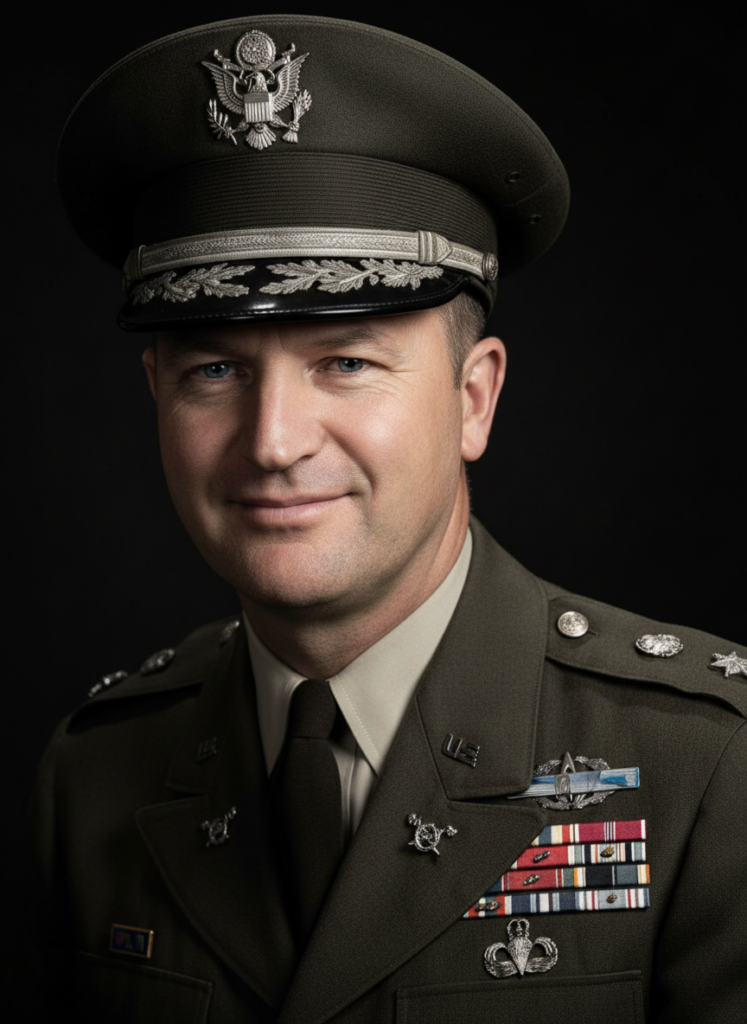
Yes, and he jumped into it twice. On October 20, 1950, Speirs parachuted with the 187th Regimental Combat Team into Sukch’on, north of Pyongyang, in an operation to cut the enemy’s rail and road links. Then on March 23, 1951, he made a second Korean combat jump during Operation Tomahawk into Munsan-ni. Counting Normandy and Holland, that gave him four combat jumps across two wars, a tally almost no Easy Company veteran matched. In Korea he served as both a rifle company commander and a staff officer.
In 1956, the Army sent him to a Russian language course. He was then assigned as a liaison officer to the Red Army in Potsdam, East Germany, deep in the Soviet occupation zone during the height of the Cold War. The man who had killed German prisoners on D-Day was now conducting intelligence work in a divided Berlin.
Then came Spandau.
In 1957, Speirs took over as the American governor of Spandau Prison in West Berlin, where the last convicted Nazi war criminals were held. He was promoted to lieutenant colonel there in February 1958. By the time he arrived, only three inmates remained: Rudolf Hess, Albert Speer, and Baldur von Schirach. The irony is staggering. A man who had shot prisoners himself was now guarding the most infamous prisoners in the world.
Albert Speer, one of the Spandau inmates, later described Speirs in his book Spandau: The Secret Diaries as a “hard-nosed, irritating American Commandant.” Coming from a man convicted at Nuremberg, that reads more like a compliment.
Speirs left his own verdict on Hess. “He pretended to be insane. He pretended to be psychotic. I really don’t think he was,” he recalled. “He sat alone by himself in the garden. He worked in the garden and grew flowers. A very strange man.” Stranger still, it was Hess who taught the American commandant to play chess, a game Speirs later passed on to a niece back in Boston.
By 1962, Speirs was in Laos. He served as a training officer for the Royal Lao Army under Operation White Star, an American covert advisory mission during the early stages of what would become the wider Vietnam-era conflict in Southeast Asia.
There may be one more chapter that never made the official record. Speirs retired on paper in March 1964, yet his name surfaces in a January 1965 State Department Foreign Service list, posted to the Saigon office of Maxwell Taylor, by then the U.S. ambassador to South Vietnam and the same general behind the alleged “take no prisoners” order on D-Day. Numbers of 101st veterans moved into CIA and State Department work in exactly that period. What Speirs actually did in the opening years of the Vietnam War, his biographers concede, “may remain one of Ronald Speirs’s lasting secrets.”
His last formal assignment was as a plans officer at the Pentagon. He settled in Montana, and his final years were shadowed by dementia. He died on April 11, 2007, nine days short of his 87th birthday. Speirs was cremated, and at his own request a family member later drove ten hours to pour his ashes into Big Therriault Lake, a remote body of water near the Canadian border in northwest Montana. As his biographers put it, “a quiet American soldier rests in the solitude he long desired.” There is no headstone to visit; his Find a Grave memorial records a life rather than a plot.
The Silver Star Almost Nobody Talks About
Band of Brothers never showed how Ronald Speirs earned his Silver Star, and most retellings only list the medal without the story behind it. It came from a solo reconnaissance so reckless it reads like invention. On October 10, 1944, during the fighting that followed Operation Market Garden, Speirs led a patrol to the bank of the Neder Rijn River in Holland, spent the entire day watching the far side, and then, after dark, swam across alone into German-held ground.
His Silver Star citation records what happened next in the Army’s own flat language:
“On 10 October 1944, in the vicinity of Rendijk, Holland, he was assigned the mission of leading a patrol to the bank of the Neder Rijn River to determine enemy activity across the river. He reached the river bank with his patrol in the early hours of the morning and spent the entire day observing across the river. After dark he voluntarily swam across to the opposite bank alone where he found himself in unknown territory. He located an enemy machine gun nest, an enemy headquarters and other enemy activity near the town of Wageningen. He secured a rubber boat left by the enemy and returned to the friendly side of the river with this information. While returning to his own lines, he was wounded by fire from an enemy machine gun.”
Speirs was the first man to cross the Neder Rijn in that sector, and the machine-gun round that hit him on the way back earned him a Purple Heart to go with the Silver Star. It is the same pattern that runs through his entire war: the officer who would attempt the thing no one else would, and somehow live through it.
Was Ronald Speirs a War Criminal?
Ronald Speirs was never charged with, investigated for, or convicted of any war crime. No military tribunal ever examined his actions. No formal complaint was filed by any member of his unit or by Allied command. He continued to serve with distinction for two more decades, receiving the Silver Star, the Bronze Star, the Purple Heart, and the Legion of Merit, along with the Presidential Unit Citation his units earned at Normandy, Bastogne, and later in Korea.
But the question itself deserves an honest answer.
By the standards of the Geneva Convention, shooting surrendered prisoners of war is a war crime, regardless of what orders were given. “I was following orders” has not been a valid legal defense since Nuremberg. The fact that General Taylor allegedly told paratroopers to take no prisoners doesn’t change the legal reality. It changes the moral context.
Winters himself struggled with this. In Chapter 10 of Beyond Band of Brothers, he wrote one of the most conflicted assessments in the entire memoir: “What he did in Normandy was unbelievable, inexcusable. In today’s army, Speirs would have been court-martialed and charged with atrocities, but we desperately needed bodies, officers who led by example and were not afraid to engage the enemy. Speirs fit the bill.”
That single passage captures the entire tension. Winters called it “inexcusable.” And then he explained why it was tolerated. He called Speirs “one of the finest combat officers in 2d Battalion.” He also called him “a natural killer” who “worked hard to earn a reputation as a killer and he often killed for shock value.”
In Conversations with Major Dick Winters, the assessment was even sharper: “I respected him as a commander, but not as a man. He killed for the effect of killing.”
The Army made a practical choice. Courts-martial for prisoner killings during the chaos of D-Day would have been devastating for morale and politically toxic. Speirs was too effective to lose. So the incidents were buried. Not because they were acceptable, but because the alternative was worse.
Why wasn’t Speirs prosecuted?
Three reasons. First, Captain Gross, the only officer who could have formally reported the sergeant shooting, was killed the next day. Second, the prisoner killings occurred during the most chaotic 24 hours of the entire European campaign, when accountability structures had collapsed. Third, the Army needed combat leaders more than it needed justice. Speirs was brave, decisive, and terrifying to the enemy. In June 1944, that mattered more than protocol.
The Man Behind the Legend
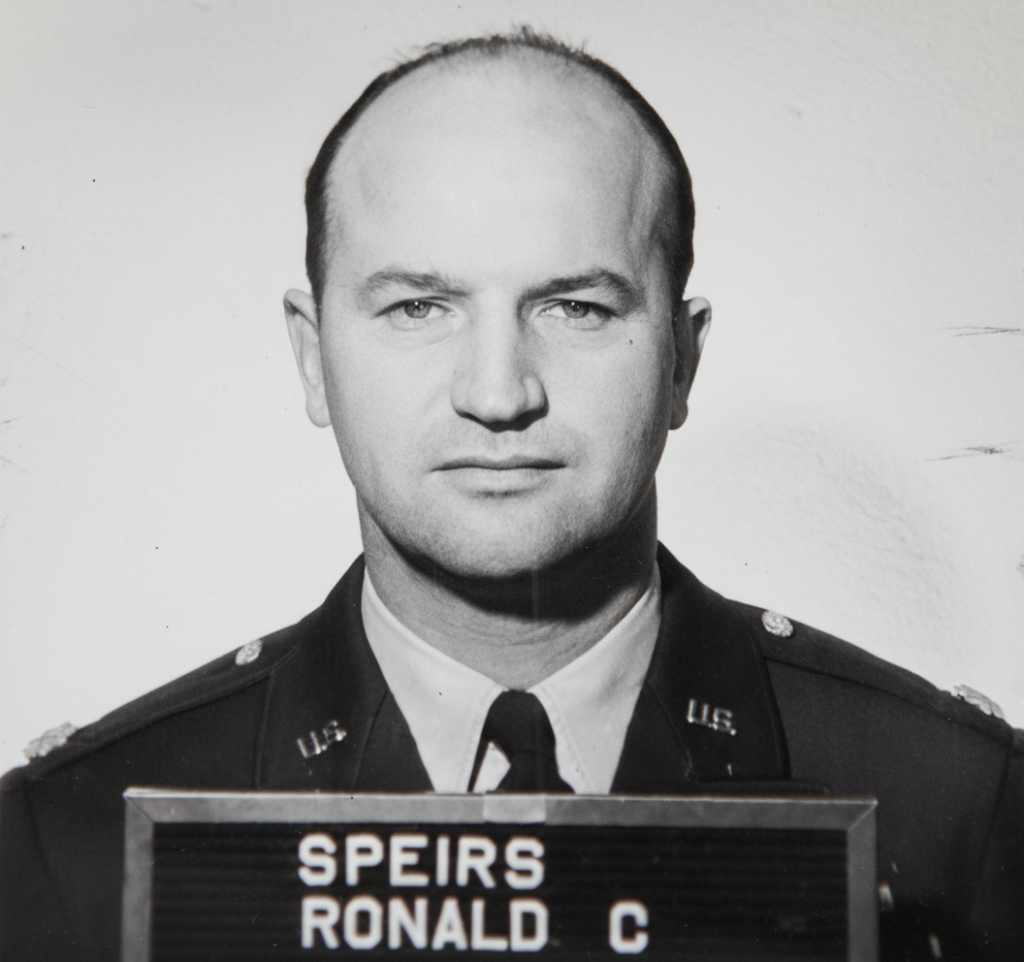
Ronald Charles Speirs was born on April 20, 1920, in Edinburgh, Scotland. His family emigrated to Boston on Christmas Day, 1924. He grew up in the Brighton neighborhood, attended The English High School, and studied accounting at Bentley School before the war transformed him into something entirely different.
He married Margaret Griffiths on May 20, 1944. Seventeen days later, he parachuted into Normandy. His son Robert later became a lieutenant colonel in the Royal Green Jackets, a British Army regiment. Speirs married three more times after the war, finding lasting happiness in a final marriage in 1987.
The show gave him one of the most memorable monologues in television history. When Private Albert Blithe cowered in a ditch, paralyzed by fear, Speirs crouched beside him and said: “The only hope you have is to accept that you’re already dead. The sooner you accept that, the sooner you’ll function as you’re supposed to. Without mercy. Without compassion. Without remorse.”
Whether he actually said those words is unconfirmed. But the philosophy they describe? That was real. Speirs lived by it from D-Day to his retirement. He was the officer other officers called when everything else had failed.
He was also, by any honest assessment, a man who crossed lines that shouldn’t be crossed. And was rewarded for it.
Reflection
Ronald Speirs saved lives at Foy. He took lives in Normandy. He guarded war criminals in Berlin after committing acts that, by strict legal definition, were war crimes themselves. Winters called him the finest combat officer in the battalion and also said he killed for the effect of killing.
The Army promoted him. His men followed him. History turned him into a legend.
Does the run through Foy erase what happened in Normandy? Does saving a company at the Battle of the Bulge offset shooting unarmed prisoners on D-Day? Or does war create a space where both things can be true at once, where the same man can be the best officer in the battalion and the one nobody should have let off the hook?
Sources
Dick Winters with Cole C. Kingseed, Beyond Band of Brothers: The War Memoirs of Major Dick Winters, Chapter 10. Berkley Caliber, 2006.
Cole C. Kingseed, Conversations with Major Dick Winters: Life Lessons from the Commander of the Band of Brothers, Chapter 7. Berkley, 2014.
Erik Dorr and Jared Frederick, Fierce Valor: The True Story of Ronald Speirs and His Band of Brothers. Regnery History, 2022.
Stephen E. Ambrose, Band of Brothers: E Company, 506th Regiment, 101st Airborne from Normandy to Hitler’s Eagle’s Nest. Simon & Schuster, 1992.
Albert Speer, Spandau: The Secret Diaries. Macmillan, 1976.
U.S. Army Silver Star citation, First Lieutenant Ronald C. Speirs, 10 October 1944 (Military Times Hall of Valor; reproduced in Fierce Valor).
Related Band of Brothers Stories
- Are any Easy Company members still alive?
- Dick Winters: The Complete Biography of Easy Company’s Real Leader
- Herbert Sobel: Band of Brothers’ Forgotten Captain
- “Now I Know Why I Am Here”: Kaufering Camp True Story
Frequently Asked Questions
Did Ronald Speirs kill prisoners in Band of Brothers?
According to the eyewitness accounts in Jared Frederick’s Fierce Valor, yes: seven Germans across two incidents on D-Day, three prisoners and four men trying to surrender. The show’s depiction of him offering cigarettes to twenty prisoners before shooting them is dramatized: there was no group of twenty. Witness Art DiMarzio did recall the prisoners being offered cigarettes in the first incident, but the real killings were smaller in scale and colder in reality than the staged scene. Speirs himself confirmed the killings when Ambrose’s publisher asked for verification before printing the book.
Did Ronald Speirs really run through Foy?
Yes. On January 13, 1945, Speirs sprinted through the German-occupied village of Foy, Belgium, to coordinate with Item Company, then ran back through enemy lines. The event is confirmed by multiple eyewitnesses including Carwood Lipton, and it happened almost exactly as shown in Band of Brothers Episode 7.
How did Ronald Speirs die?
Ronald Speirs died on April 11, 2007, at the age of 86, after several years of declining health. He was cremated, and at his own request his ashes were later scattered in Big Therriault Lake in northwest Montana, near the Canadian border, so there is no gravesite to visit. He had retired from the Army as a lieutenant colonel in 1964 after a career spanning World War II, Korea, and the Cold War.
Was Ronald Speirs a war criminal?
Ronald Speirs was never charged, investigated, or convicted of any war crime. However, by Geneva Convention standards, shooting surrendered prisoners is a war crime regardless of orders given. Dick Winters himself wrote that Speirs’ actions in Normandy were “inexcusable” but that the Army tolerated them because Speirs was too effective a combat leader to lose during the critical campaigns of 1944-45.
What happened to Ronald Speirs after World War II?
Speirs served in the Korean War with the 187th Regimental Combat Team (1950-51), studied Russian (1956), served as a liaison to the Red Army in East Germany, became the American governor of Spandau Prison in Berlin where Rudolf Hess was held (1957), trained soldiers in Laos during Operation White Star (1962), and finished his career at the Pentagon before retiring as a lieutenant colonel in 1964.
Correction, October 25, 2026: An earlier version of this article said Ronald Speirs commanded Easy Company longer than any other officer. Herbert Sobel commanded it longer. The prisoner shootings and the death of the sergeant are now attributed to the eyewitness accounts in Jared Frederick’s Fierce Valor.