Band of Brothers Webster: What Really Happened to Him?
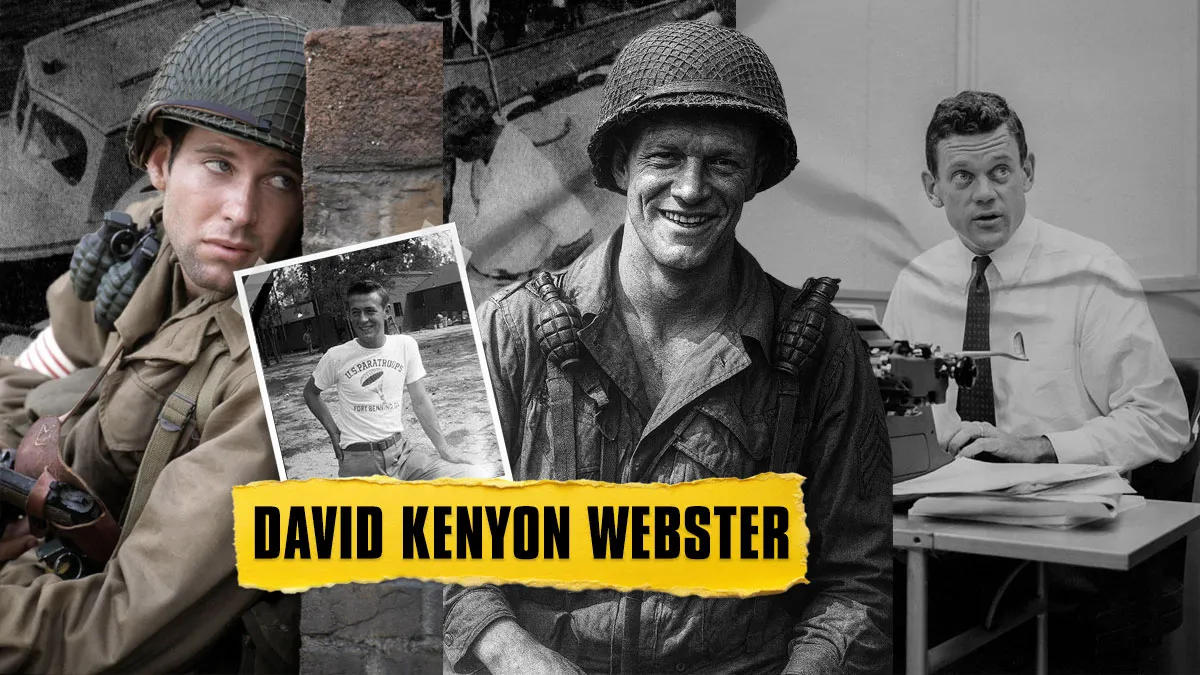
David Kenyon Webster, the Harvard-educated paratrooper portrayed in HBO’s Band of Brothers, survived combat from D-Day to V-E Day, then vanished at sea on September 9, 1961. A search the next day found his small sailing dinghy, Tusitala, awash about five miles off Santa Monica, with one oar and the tiller missing. His body was never recovered. He was 39 years old. Six decades later, his disappearance remains one of the most haunting unsolved mysteries connected to the men of Easy Company, 506th Parachute Infantry Regiment.
1922 – 1961 • Lost at Sea, Never Recovered
David Kenyon Webster jumped into Normandy on D-Day, fought through Holland, and crossed Germany in the spring of 1945, past the slave-labor camps and the survivors of Dachau. Then, on September 9, 1961, the Harvard-trained paratrooper whose letters and memoir became a key source for Band of Brothers sailed his dinghy Tusitala out from Santa Monica to fish for sharks. He never came back. His boat was found about five miles offshore, missing an oar and its tiller. His body was never recovered.
This is the full David Kenyon Webster Band of Brothers story: the Harvard English major who stayed in the ranks, whose wartime letters and unpublished memoir Stephen Ambrose quoted throughout Band of Brothers, who spent his last years studying sharks, and who then vanished in waters he knew well. Six decades on, no one can say with certainty what happened that Saturday.
Who Was David Kenyon Webster?
Webster was born June 2, 1922, in New York City and grew up in Bronxville, in Westchester County. Stephen Ambrose described his family as moderately wealthy, with influence. He prepared at the Taft School in Connecticut and went on to Harvard as an English major. Heavily influenced by the literature of the First World War, Ambrose wrote, he wanted to experience combat and then describe it.
In 1942 Webster left Harvard and enlisted. He volunteered for the paratroopers and joined the 506th Parachute Infantry Regiment at Toccoa, where he trained in Fox Company. He was 20 years old. He was not the only son his family sent to war; his younger brother, John, also joined the paratroopers.
What makes the David Kenyon Webster story different from most Band of Brothers soldiers is what he did with his pen. He wrote long letters home throughout the war, and Ambrose quoted them, along with his diary entries, all through Band of Brothers. After the war he wrote the memoir itself. In his own words, most of it was “based on letters written during the war and on recollections put down at length right after the war.”
From Harvard to the 506th: The Making of a Chronicler
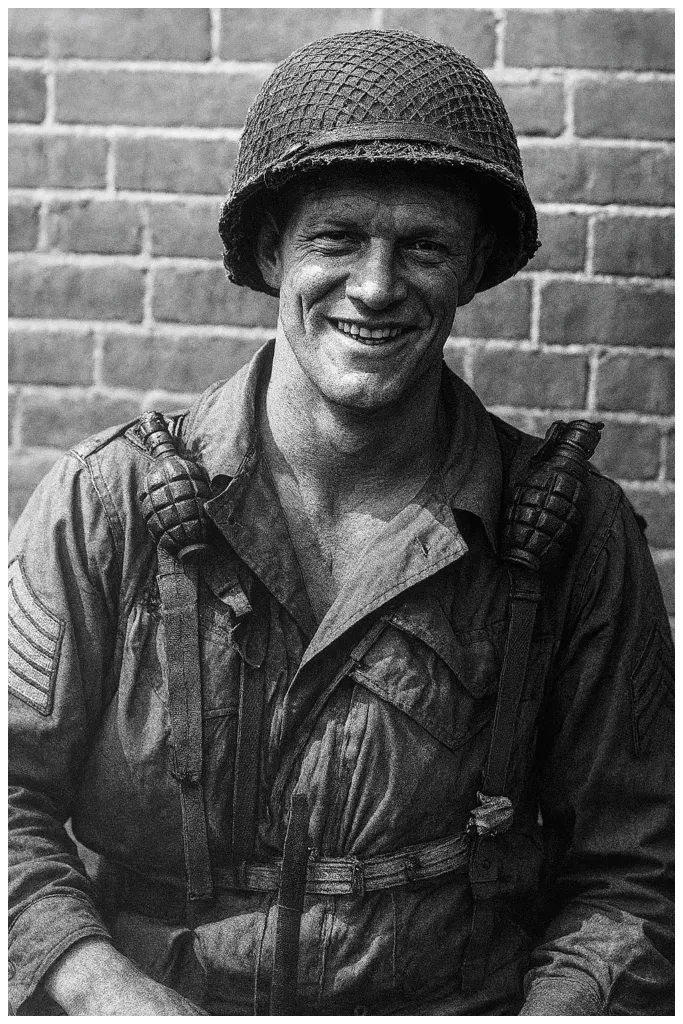
Ambrose wrote that Webster may have been the only Harvard “English lit” major who volunteered for the parachute infantry and then fought through northwest Europe as a combat infantryman. He found the barracks language “vile, monotonous, and unimaginative,” Ambrose noted, and got used to it without ever liking it.
Combat came fast. Webster jumped into Normandy in the early hours of June 6, 1944, as an ammunition carrier in the machine-gun platoon of 2nd Battalion’s Headquarters Company. He landed in about three feet of water in the flooded fields behind Utah Beach and waded with other paratroopers until about 8:00 a.m., when they reached dry ground and joined the 2nd Battalion. A few days later, as the regiment pushed toward Carentan, a mortar shell blew off his helmet and left his right arm bleeding, and he was evacuated to England.
Three months later, on September 17, 1944, he jumped again, now a rifleman in Easy Company’s 1st Platoon, into Holland for Operation Market Garden. On October 5, during the fighting on the Island between the Waal and the Rhine, a bullet went through his right calf. Webster was evacuated to a hospital in England, which meant he missed the siege of Bastogne with Easy Company. He rejoined the unit in February 1945. When he caught up with his old platoon, he counted only eleven men where there should have been forty. “I felt like crying,” he wrote.
The return also moved him. In words Ambrose quoted in his introduction to Parachute Infantry, Webster recalled being back with his squad: “It was good to be back with fellows I knew and could trust. Listening to the chatter, I felt warm and relaxed inside, like a lost child who has returned to a bright home full of love after wandering in a cold black forest.” It is as close as his writing comes to naming what the phrase “band of brothers” meant to the men inside it.
He was with Easy Company for the rest of the war: through Haguenau, into Germany, past the slave-labor camps and the survivors of Dachau, and finally to Berchtesgaden, where he and his friends raided the wine cellar.
From Toccoa to Haguenau: Webster’s Combat Path
Webster reported to Camp Toccoa, Georgia, in 1942 and trained in Fox Company of the 506th. He jumped on D-Day with 2nd Battalion’s Headquarters Company and transferred to Easy Company after Normandy because, as he put it, “I wanted to fight as a rifleman in a line company.” His Normandy wound, which he later described as being “nicked by a tiny piece of shrapnel,” kept him out of the fighting beyond Carentan, and he was back in Aldbourne before the battalion returned.
On September 19, 1944, Easy Company ran into German tanks beyond Nuenen. Webster jumped off a British Cromwell into a roadside ditch as the first German tank appeared, and in the fight that followed, as the company fell back into the village, Pvt. Robert Van Klinken was killed by a machine-gun burst.
Two weeks later, on October 5, 1944, in the dike action on the Island that Dick Winters later called his “apogee as a company commander,” Webster was hit in the right calf by German machine-gun fire at about 11:30 a.m. It was a clean wound, and he spent the rest of 1944 in hospitals and a replacement depot in England. He missed Bastogne. By the time he rejoined Easy Company in February 1945, in time for Haguenau, the war in Europe had three months left to run. When the bullet hit him, all he could think to say was “They got me!”, which even then seemed to him “an inadequate and unimaginative cliché.”
By the summer of 1945 Webster counted 87 points under the Army’s demobilization system, which sent men with 85 or more home. The last five were the points for the meritorious-service Bronze Star that General Taylor had decreed for the old men of the division, and they were slow to come through. While he waited, Easy Company moved back to France to train for the war against Japan. His points were confirmed in August 1945 and he left the company to start for home. He was out of the Army before the year ended, thankful, Ambrose wrote, that he never had to make the “big jump” into Japan.
Why David Webster Stayed a Private
Most Band of Brothers viewers miss this detail, but it explains a lot about Webster. He never became a sergeant. Ambrose wrote that he was almost the only original Toccoa man who never became a noncommissioned officer: various officers wanted to make him a squad leader, and he refused.
He could have aimed higher. His family, Ambrose wrote, “was moderately wealthy and had influence, so he could have had a commission if he had wanted one, or a cushy job far behind the front lines.” He wanted neither, and he made it a rule of his Army life never to volunteer for anything.
His conviction came through most sharply when his mother wrote to express her alarm at his fatalistic letters, and her worry about his younger brother John, who had just joined the paratroopers. His reply, quoted by Stephen Ambrose in Band of Brothers and again in the introduction to Parachute Infantry, refused the premise outright: “Would you prefer for somebody else’s son to die in the mud? You want us to win the war, but you apparently don’t want to have your sons involved in the actual bloodshed. That’s a strangely contradictory attitude. Somebody has to get in and kill the enemy.”
Ambrose saw another side to it. Webster, he wrote, “was an intellectual, as much an observer and chronicler of the phenomenon of soldiering as a practitioner.” Staying in the ranks kept him in the dirt with the men he would later write about, and Parachute Infantry is the richer for it.
In his own words, “The highest I ever got was P.F.C.” In Austria in the summer of 1945 he served for a time as an acting squad leader before being moved back to assistant. He went home with the Purple Heart, the meritorious-service Bronze Star, and the E.T.O. ribbon with three battle stars and the invasion arrowhead that he wore on his blouse.
How Webster’s Writing Fed the Book Band of Brothers
After the war, Webster moved to California and tried to sell his memoir while he worked at a variety of jobs. He placed many articles, the best known in the Saturday Evening Post, but no publisher would take the book. Ambrose put it bluntly: the publishers right after the war “wanted novels with lots of sex, not authentic memoirs.”
Decades later, historian Stephen Ambrose was researching a new book on Easy Company. Alongside his interviews with Dick Winters and dozens of other veterans, he drew on Webster’s wartime letters and his unpublished manuscript. Ambrose never met Webster, but the material gave him something unusual: a literate, first-person record of the campaign from a private’s point of view.
Ambrose’s 1992 book Band of Brothers quotes Webster’s letters and diary again and again, from Toccoa to the hospital wards of 1944. Two years later, in 1994, with Ambrose urging publication, Louisiana State University Press published Webster’s own manuscript under the title Parachute Infantry: An American Paratrooper’s Memoir of D-Day and the Fall of the Third Reich.
Then HBO came calling. In 2001, the Spielberg and Hanks miniseries adapted Ambrose’s book for television. Eion Bailey was cast as Webster. Episode 8, “The Last Patrol,” is told largely from Webster’s perspective, picking up after he rejoins the company following his hospital stay. Its picture of an outsider returning to a unit that had been through Bastogne without him draws on Webster’s own account. A revised and expanded edition of Parachute Infantry, with more than 100 pages of previously unpublished material including letters home, followed in 2002.
The Journalist and the Shark Researcher
Webster became a newspaper reporter, first with the Los Angeles Daily News and then with the Wall Street Journal. It was steady work, and it sharpened his reporting instincts.
But journalism was not his real second act. Webster became obsessed with sharks. He read everything he could find, which in the 1950s was not much. He began sailing off the California coast to watch them, first from boats and later, remarkably, in the water with them. According to his wife Barbara, he swam among sharks and caught many by handline, observing the animals up close at a time when almost no one did so deliberately. He wanted to see the animal rather than fear it.
He wrote a book about sharks and, Ambrose recorded, submitted it twenty-nine times without finding a publisher. It appeared only after he disappeared: Myth and Maneater: The Story of the Shark was published in London in 1962 and by W. W. Norton in New York in 1963, and Dell reissued it as a mass-market paperback when Jaws came out in 1975. For Webster, Barbara said, the shark “became a symbol of everything that is mysterious and fierce about the sea.”
The Webster Bibliography: A Working Writer’s Postwar Decade
Most accounts of David Webster collapse his postwar life into “he became a journalist and disappeared at sea.” That misses how productive he actually was. Between 1946 and 1959, Webster published a steady stream of long-form journalism, much of it returning to his war experience, processing it in print over more than a decade. He attended the Bread Loaf Writers’ Conference at Middlebury, Vermont, and took public-relations work at North American Aviation. At the time of his death he was a technical writer for the System Development Corporation, an early Cold War defense contractor.
His published articles, in chronological order:
- “In Defense of Doggies”, Infantry Journal, September 1946. A defense of the average GI in answer to early postwar critiques of soldier conduct.
- “The Paratroopers’ Jumping Zoo”, Infantry Journal, October 1946. Training-camp culture in the 506th.
- “Birth of the Auerbach Twins”, Graphic Arts Monthly, December 1946.
- “Pro Conscriptu”, Infantry Journal, May 1947. An argument for postwar conscription.
- “Red Coats at the Crossroads”, Journal of Education, September 1950.
- “Madman, I Love You”, The Reporter, August 21, 1951.
- “We Drank Hitler’s Champagne”, The Saturday Evening Post, May 1952. Webster’s most widely read wartime article. An account of the 506th’s occupation of Berchtesgaden, written with the dry irony that became his trademark.
- “The Generals’ Anger”, Army Combat Forces Journal, August 1954.
- “The Night Before D-Day”, Saga, October 1959. A late return to the Normandy jump; portions of it later formed the opening chapter of Parachute Infantry.
His full memoir, Parachute Infantry: An American Paratrooper’s Memoir of D-Day and the Fall of the Third Reich, found no publisher in his lifetime. In the years after the war, Ambrose wrote, publishers wanted novels rather than authentic memoirs. It was finally published thirty-three years after his death.
The Final Voyage of the Tusitala, September 9, 1961
Webster named his sailing dinghy Tusitala, which, Barbara explained, means “Teller of Tales.” Robert Louis Stevenson had adopted the same word as his honorific in the final years he spent in Samoa. Barbara described the boat as an eleven-foot dinghy; the 1961 newspaper report of his disappearance put it at twelve feet. For Webster, a chronicler turned shark watcher, the name was a quiet self-portrait.
On September 9, 1961, he set sail from Santa Monica with squid bait, a heavy line, and a hook for shark fishing. He did not come back that afternoon.
The Coast Guard began a search. The next day the Tusitala was found awash about five miles offshore, with no one aboard.
The one detail every account agrees on is spare. The Tusitala was missing one oar and its tiller, either of which could have been swept overboard in a sudden swell or lost while the boat drifted for hours before it was found.
Two more dramatic details appear in many popular retellings of the disappearance: that all of Webster’s diving gear was gone, and that his wedding band and war service rings had been placed neatly inside the cabin. Both are worth naming, because they drive most versions of the story. Both should also be read with caution. Neither appears in Ambrose’s account, which drew on Barbara Webster, or in the 1961 newspaper report, and both of those record only the missing oar and tiller. Whether the rings were real or a later embellishment, they have become the image readers remember, and they belong to the legend more than to the documented record.
No body was recovered. He was 39 years old. He left behind Barbara and their children.
A Memorial Without a Grave
Because Webster’s body was never recovered, he has no grave. Find a Grave keeps a memorial page for him. For readers, the memoir he left behind serves as the more lasting marker.
The Stoessel Connection: A Paratrooper Married Into the Diplomatic Establishment
One detail rarely mentioned in Band of Brothers fan accounts: Webster’s wife, Barbara Stoessel, was the sister of Walter J. Stoessel Jr.: one of the most accomplished American diplomats of the Cold War. Walter Stoessel served as U.S. Ambassador to Poland (1968–72), the Soviet Union (1974–76), and West Germany (1976–81), and finished his career as Deputy Secretary of State under Reagan. He died in 1986.
Barbara was a graduate of Scripps College and an artist. The couple married in the early 1950s (1951 in Ambrose’s account, 1952 in later ones) and had children. The marriage placed David Webster, the Harvard man who had stayed in the ranks for his whole war, at the edges of the American foreign-policy establishment by way of his brother-in-law’s career. There is no record that Webster ever used the connection. His writing remained focused on the men he had served with, not the people his wife’s family knew.
Theories About What Happened to David Webster
Four plausible explanations have circulated in the sixty years since the disappearance. None is provable, and readers tend to favour whichever one matches their reading of Webster’s character.
| Theory | The Evidence |
| Shark attack | Webster frequently entered the water to observe large sharks, and the Santa Monica Basin has a documented great white population. The grim irony has kept this theory popular, though the often-repeated claim that his diving gear was missing is not confirmed by the original reports. |
| Accident at sea | A rogue swell, a mechanical failure, or a sudden storm could have knocked him overboard. Pacific conditions in September are unpredictable. The missing oar and tiller support this. |
| Deliberate disappearance | Some retellings suggest he took his own life. Nothing in the record supports it. Webster had spent years trying to get his memoir and his shark book published, but the author note in Parachute Infantry calls his death a boating accident while shark fishing, and the much-repeated detail of rings left in the boat is unverified. |
| Foul play | Some have speculated about foul play. No evidence has ever surfaced to support it. |
None of the theories can be proved. The author note in Parachute Infantry describes his death simply as “a boating accident while shark fishing.”
Why the Webster Mystery Still Endures
Three things keep the David Kenyon Webster story alive. The first is the absence of a body. Ocean disappearances leave readers with permanent questions, and Webster’s took place during daylight, close to shore, in a period when Santa Monica was already a busy coastline. The second is the narrative symmetry. A Harvard man who wrote the definitive Band of Brothers memoir and then died studying the sharks he loved is the kind of ending a novelist would reject as too neat.
There is an eerier echo in his own words. Writing home from England after Normandy, in a letter Ambrose later quoted, Webster told his parents: “I am living on borrowed time. I do not think I shall live through the next jump. If I don’t come back, try not to take it too hard. I wish I could persuade you to regard death as casually as we do over here.” He survived every jump. The sea, seventeen years later, was the thing that finally kept him.
The third is the uncertainty itself. Each retelling adds or subtracts a detail, so that no two versions of Webster’s last morning quite agree, and the gaps invite every reader to finish the story their own way.
The David Kenyon Webster Band of Brothers Legacy
The Band of Brothers canon rests on several soldier-memoirs. Dick Winters wrote a leader’s account. Bill Guarnere and Babe Heffron wrote a street-level account from two best friends. Don Malarkey wrote an emotional reckoning. Webster’s Parachute Infantry is the literary account, the one that reads like reportage, written by a Harvard English major who went on to work as a newspaper reporter.
Parachute Infantry, when it finally appeared in 1994, was reviewed seriously. The New York Times called the book “gutsy, sometimes bemused and sometimes angry.” Booklist identified its tone as “a perfectly pitched, Sad Sack sarcasm that is an authentic witness to the combat experience.” Webster had been right about his own writing, and wrong about the timing of when it would find readers.
The Taft School in Watertown, Connecticut, where Webster prepared for Harvard, established the David Kenyon Webster Prize for Excellence in Writing in his memory. It is awarded annually to a Taft student.
Military historians value Webster’s journal for a specific reason: he describes what ordinary soldiers thought about, argued about, and were afraid of. Officers’ memoirs can tell you what happened on a given ridge. Webster tells you what the guy next to you said at breakfast that morning, and what he looked like when he stopped talking.
The HBO series made Webster a familiar face to millions who would never read a military history. But the real legacy is Parachute Infantry itself. It is still the single best primary source for understanding what it was like to be an American paratrooper in the European theatre, and no later account has matched it.
Related Band of Brothers Stories
- Are any Easy Company members still alive?
- Ronald Speirs: What Band of Brothers Didn’t Tell You
- Major Dick Winters: Complete Biography
- D-Day Paratroopers: Why the T-5 Jump Was a Nightmare
Frequently Asked Questions
What happened to David Kenyon Webster in Band of Brothers?
Webster survived the war and came home. On September 9, 1961, he sailed alone from Santa Monica in his dinghy Tusitala to fish for sharks and was never seen again. A search the next day found the boat awash about five miles offshore. No body was ever found.
Did David Webster really write the book that became Band of Brothers?
Stephen Ambrose wrote the 1992 book Band of Brothers, but he drew heavily on Webster’s wartime letters and unpublished manuscript, quoting them throughout. Webster’s own memoir, Parachute Infantry, was published separately in 1994 after years of rejections. Both books helped shape the 2001 HBO series.
Who played David Webster in the HBO miniseries?
American actor Eion Bailey played Webster. He appears in several episodes but takes centre stage in episode 8, “The Last Patrol,” which follows Webster as he rejoins Easy Company after being wounded in Holland. The episode is closely based on Webster’s own account in Parachute Infantry.
Why did Webster stay a Private throughout the war?
He never sought rank. With his family’s influence he could have had a commission, Ambrose wrote, and officers wanted to make him a squad leader, but he refused, and he made it a rule never to volunteer for anything. The highest rank he held was Private First Class. Staying in the ranks also kept him close to the men he later wrote about in Parachute Infantry.
Where can I read Parachute Infantry today?
Parachute Infantry: An American Paratrooper’s Memoir of D-Day and the Fall of the Third Reich is available from Louisiana State University Press, major booksellers, and most public library systems. Used copies of the original 1994 edition also circulate on secondary markets.
Was Webster’s disappearance linked to sharks?
Webster frequently observed sharks at close range, and the Santa Monica Basin has a documented great white population, so a shark attack is one possibility. It cannot be proved, however, and some of the most-repeated details of that morning, including the story of rings left in the cabin, do not appear in Ambrose’s account or the 1961 newspaper report.
Did Webster have family when he died?
Yes. Webster married Barbara Stoessel, an artist, in the early 1950s, and they had children. Barbara later saw his shark book into print, and his memoir was published in 1994 with Stephen Ambrose’s encouragement.
Sources and Further Reading
- Webster, David Kenyon. Parachute Infantry: An American Paratrooper’s Memoir of D-Day and the Fall of the Third Reich. Louisiana State University Press, 1994.
- Webster, David Kenyon. Myth and Maneater: The Story of the Shark. W. W. Norton, 1963 (first published in London by Peter Davies, 1962).
- Ambrose, Stephen E. Band of Brothers: E Company, 506th Regiment, 101st Airborne, from Normandy to Hitler’s Eagle’s Nest. Simon & Schuster, 1992.
- HBO. Band of Brothers, Part 8: “The Last Patrol.” Dreamworks / Playtone, 2001.
- National Archives: 506th Parachute Infantry Regiment records.
Correction, October 25, 2026: An earlier version of this article said Webster rejoined Easy Company in January 1945. By his own account in Parachute Infantry, he came back in February 1945. An earlier version of this article contained several errors, now corrected against Webster’s own Parachute Infantry, Stephen Ambrose’s Band of Brothers and his introduction to Parachute Infantry, and Dick Winters’s Beyond Band of Brothers. Webster jumped on D-Day with 2nd Battalion’s Headquarters Company, not Easy Company, and was wounded a few days later near Carentan and evacuated to England. He rejoined Easy Company in February 1945, not January. His highest rank was Private First Class; he was never a corporal, and no source says he turned down Officer Candidate School. He had 87 points, not four short of 85. He did not help liberate the Kaufering camps. His boat was found the next day, not the same day; his sailing dinghy is described as eleven feet by his widow and twelve feet in a 1961 newspaper report. Myth and Maneater was published by Norton in 1963. We removed a quotation (“a gold mine”) we could not source, an unsourced claim that he did shark-repellent research for the Navy, and invented details including wartime nicknames and a Coast Guard report.