A surgeon in a field hospital near Loc Ninh leaned over a body bag and started to pull the zipper closed. The man inside had been carried in with the dead. His face was caked in blood, his intestines were held in by his own hand, and he had not moved. Then the body spat in the doctor’s face. That was how the Army learned Roy Benavidez was still alive after six hours in a fight nobody expected him to walk away from.
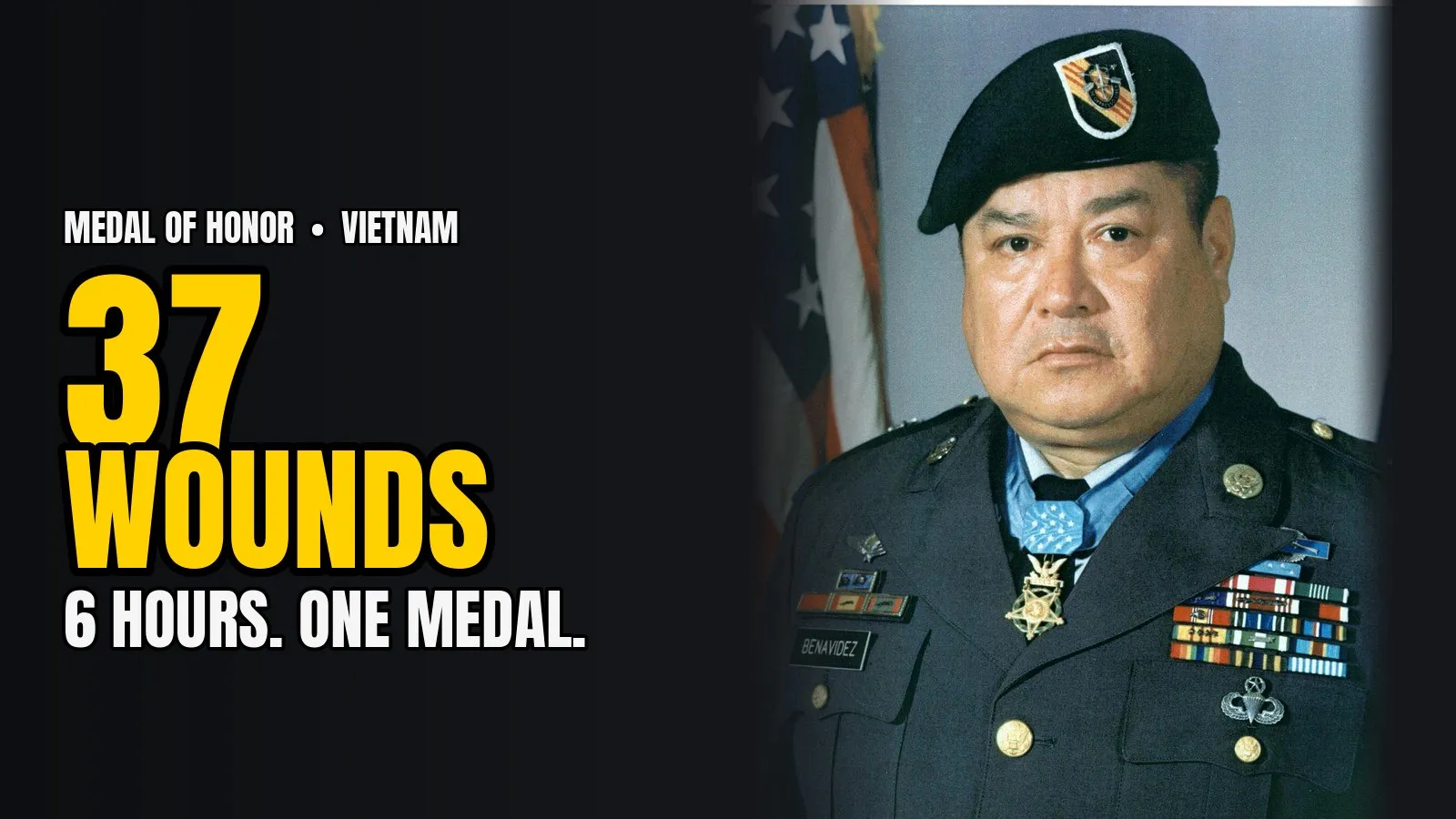
This is the true story of Roy Benavidez, the orphaned son of a Texas sharecropper who took 37 separate wounds in a single afternoon and lived another 30 years to talk about it. The medal is the part most accounts lead with. The 13-year fight to prove he had earned it, and the witness who surfaced from a beach in Fiji, is the part that turns a war story into something stranger.
Who was Roy Benavidez?
Part of our complete Medal of Honor series, covering the history of America’s highest military award and the recipients whose actions defined valor in combat.
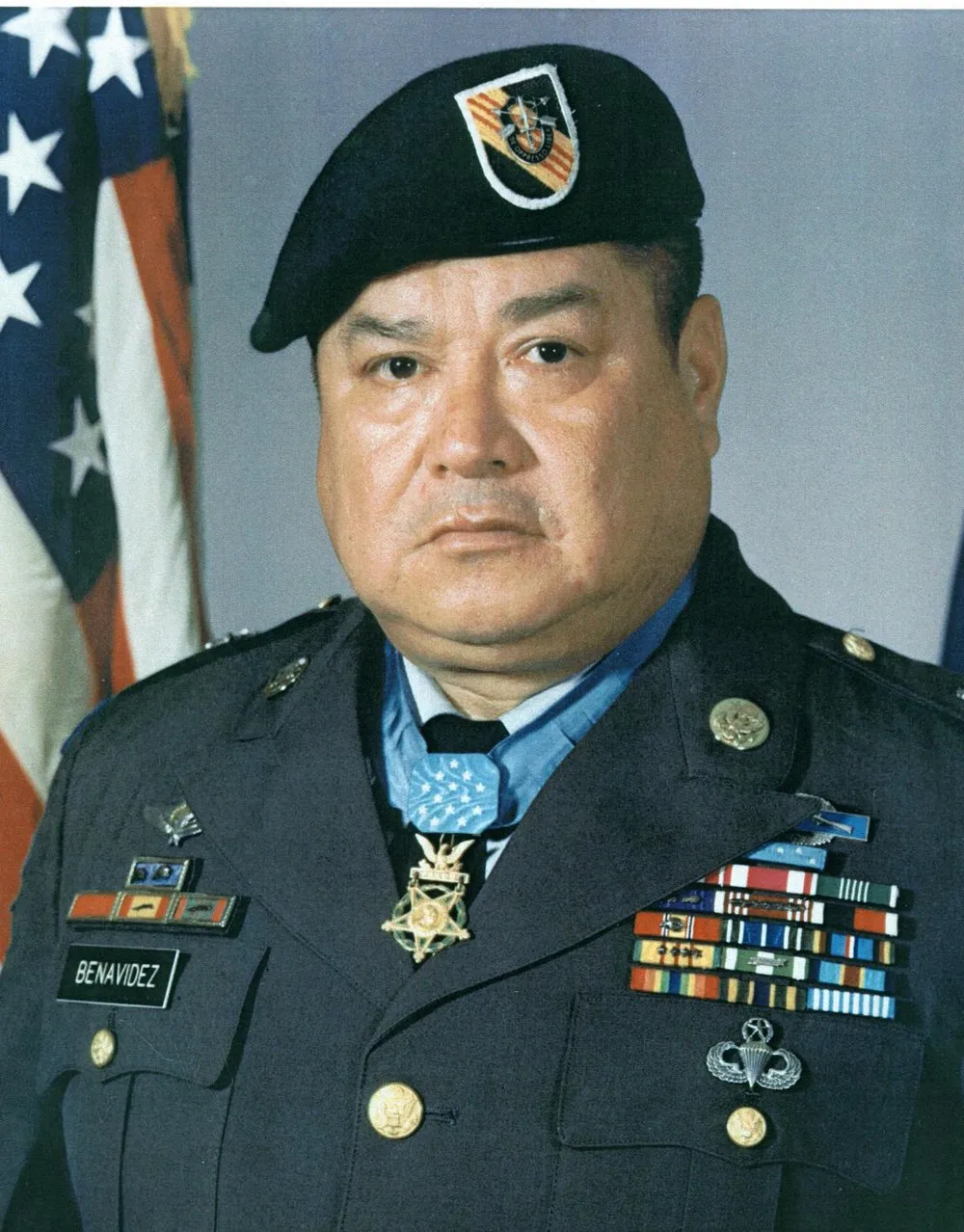
Raul Perez “Roy” Benavidez was born on August 5, 1935, near Cuero, Texas, the son of a Mexican farmer and a Yaqui mother. Both parents were dead of tuberculosis by the time he was seven. He and his younger brother were raised by relatives in El Campo, a cotton town where the boys picked crops across Texas, New Mexico, and Colorado. He shined shoes at the bus station. He quit school at 15 to work full time. The Army would later list him as a high-school dropout from a migrant family, which is exactly what he was.
He joined the Texas Army National Guard in 1952, at 17, and moved to active duty in 1955. In 1959 he married Hilaria “Lala” Coy, finished Airborne school, and joined the 82nd Airborne Division at Fort Bragg. From there he qualified for Special Forces and the 5th Special Forces Group, the Green Berets, and was assigned to the secretive reconnaissance program that ran missions along the borders of South Vietnam. By 1968 he was a staff sergeant with Detachment B-56, the unit whose teams went where the maps stopped being useful.
How did a landmine almost end his career?
Benavidez nearly never made it to the action that defined him. On his first tour in 1965, serving as an advisor, he stepped on a landmine during a patrol. The blast tore up his back and legs. Doctors at Fort Sam Houston in San Antonio told him he would never walk again and began the paperwork for a medical discharge.
He refused it. Every night, against orders, he crawled out of bed and dragged himself by his elbows and chin to a wall, then tried to push his body upright against it. The pain was severe enough that other patients heard him at it in the dark. He kept at it for more than a year. In July 1966 he walked out of the hospital on his own legs. He then did something almost no recovering paraplegic would: he requalified as a paratrooper, returned to Special Forces, and shipped back to Vietnam in January 1968. Four months later he was at a forward base monitoring a radio when a mission went wrong.
What happened at Loc Ninh on May 2, 1968?
On the morning of May 2, 1968, a 12-man Special Forces patrol was inserted into dense jungle west of Loc Ninh to gather intelligence on a major enemy buildup. The team had three Americans and nine Montagnard tribesmen. Within an hour they were surrounded by a North Vietnamese Army battalion of roughly 1,000 soldiers and pinned down by heavy fire. Three helicopters tried to pull them out and were driven off by small-arms and anti-aircraft fire. The team radioed that they could not be reached.
Benavidez heard the call at the base. He boarded one of the returning helicopters carrying nothing but a knife and his medical bag. When the aircraft reached the area, it could not land. He jumped from the hovering helicopter and ran about 75 meters across open ground under fire to reach the team. He was hit in the right leg, the face, and the head before he got there. That was the first minute of six hours.
How was Roy Benavidez wounded 37 times?
The number 37 covers bullet, bayonet, and shrapnel wounds counted after the fight. They came one cluster at a time across the afternoon, each from a different attempt to keep the team alive.
He reached the wounded, repositioned them, and directed their fire so an extraction aircraft could get in. He threw smoke to mark a landing zone and dragged men toward the helicopter. Going back for the dead team leader’s body and a pouch of classified documents, he was shot in the abdomen and took grenade fragments in his back. At nearly the same moment the rescue helicopter’s pilot was killed and the aircraft crashed. Benavidez pulled survivors out of the wreck, formed them into a defensive perimeter, and moved around it under fire handing out water and ammunition.
He called in air strikes and directed gunship fire to hold the enemy back long enough for another helicopter to try. While he was dragging a wounded man aboard, an NVA soldier ran up and clubbed him across the head with a rifle. Benavidez fought him hand to hand, was bayoneted in the process, and killed the man with his own knife. He shot two more enemy soldiers rushing the aircraft, then made a last trip across the field for the remaining wounded and the classified material before climbing aboard himself. By the time the helicopter lifted, he was holding his own intestines in with his hand and could not speak.
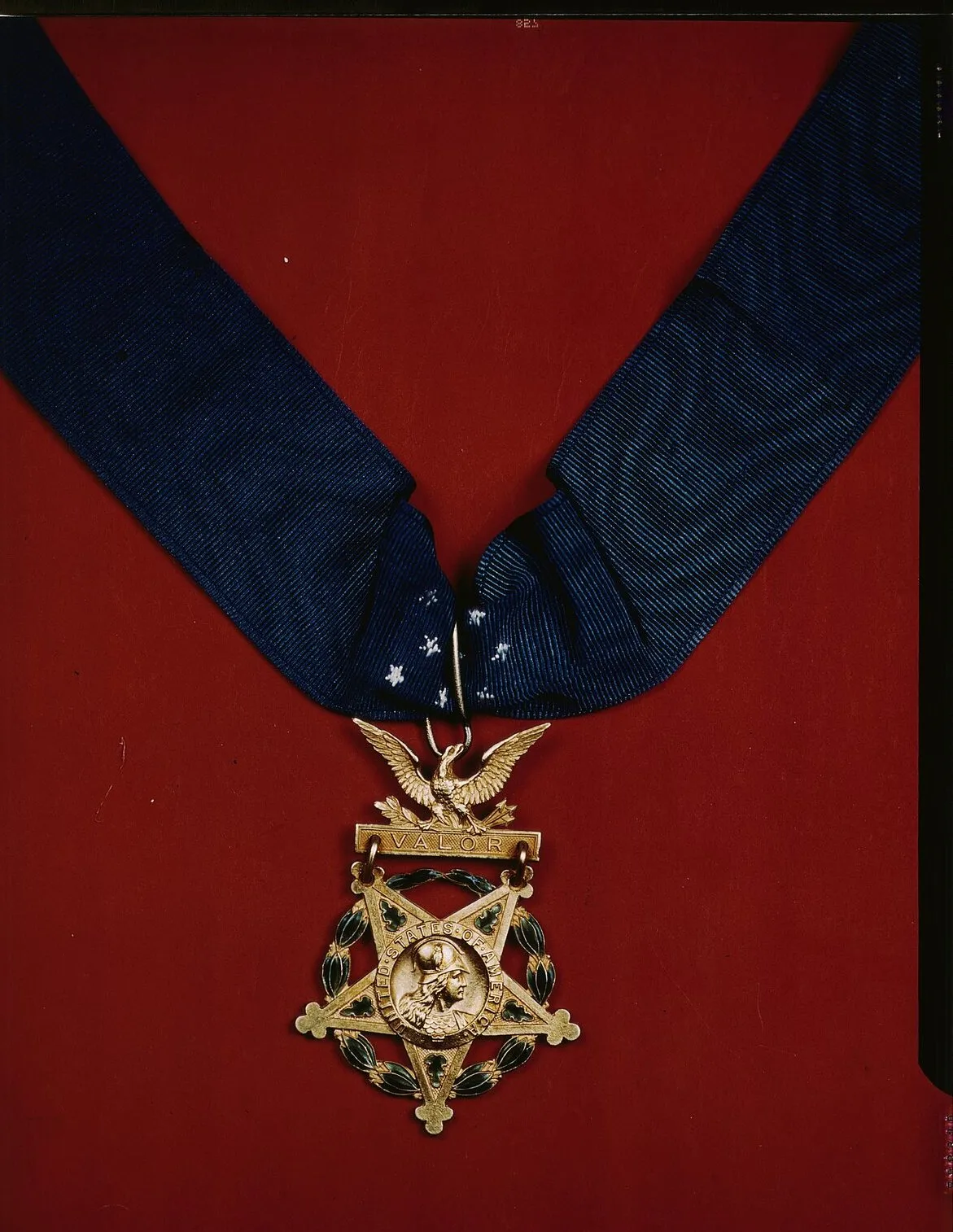
The Medal of Honor citation, preserved by the Congressional Medal of Honor Society, opens with the line reserved for the highest valor: “For conspicuous gallantry and intrepidity at the risk of his life above and beyond the call of duty.” It records that he “jumped from the hovering helicopter” and “ran approximately 75 meters under withering small arms fire,” carried and dragged the wounded to the aircraft, and despite his own injuries organized the survivors and called in the air support that held off the enemy battalion. The citation credits him with saving the lives of at least eight men through “fearless personal leadership, tenacious devotion to duty, and extremely valorous actions in the face of overwhelming odds.” The striking part is how routine each impossible act sounds in the dry language of an award document.
Why was he zipped into a body bag?
At the base, the medical staff took him for dead. He was not moving, not breathing in any way they could detect, and he was covered head to foot in blood, much of it his own. They placed him in a body bag among the others killed that day. A doctor came to make it official.
Benavidez could hear what was happening but could not move or call out. As the doctor bent down to certify the death and close the bag, Benavidez did the only thing left to him: he spat in the man’s face. The doctor recoiled, looked again, and called for help. That spit is why there was a Medal of Honor to award at all. He spent close to a year recovering in hospitals and was awarded the Distinguished Service Cross, the nation’s second-highest award for valor, along with another Purple Heart.
Why did the Medal of Honor take 13 years?
The Distinguished Service Cross was a high honor, but the men who had read the full account believed the action warranted the Medal of Honor. In 1973 a Special Forces officer, Lieutenant Colonel Ralph Drake, pushed to have the award upgraded. He ran into two walls. The statutory time limit for a Medal of Honor recommendation had passed, and the Army Decorations Board would not approve the upgrade without a sworn eyewitness who had been on the ground during the fight.
Everyone assumed there was no such witness left. The man best placed to give that account, radio operator Brian O’Connor, had been so badly wounded that he was evacuated and lost track of. He was, in fact, alive and living in the Fiji Islands. In 1980, on holiday in Australia, O’Connor read a newspaper story about Benavidez reprinted from a Texas paper. He recognized the date, the place, and the man. He contacted Benavidez and submitted a detailed ten-page sworn statement of everything he had seen. That account broke the logjam.
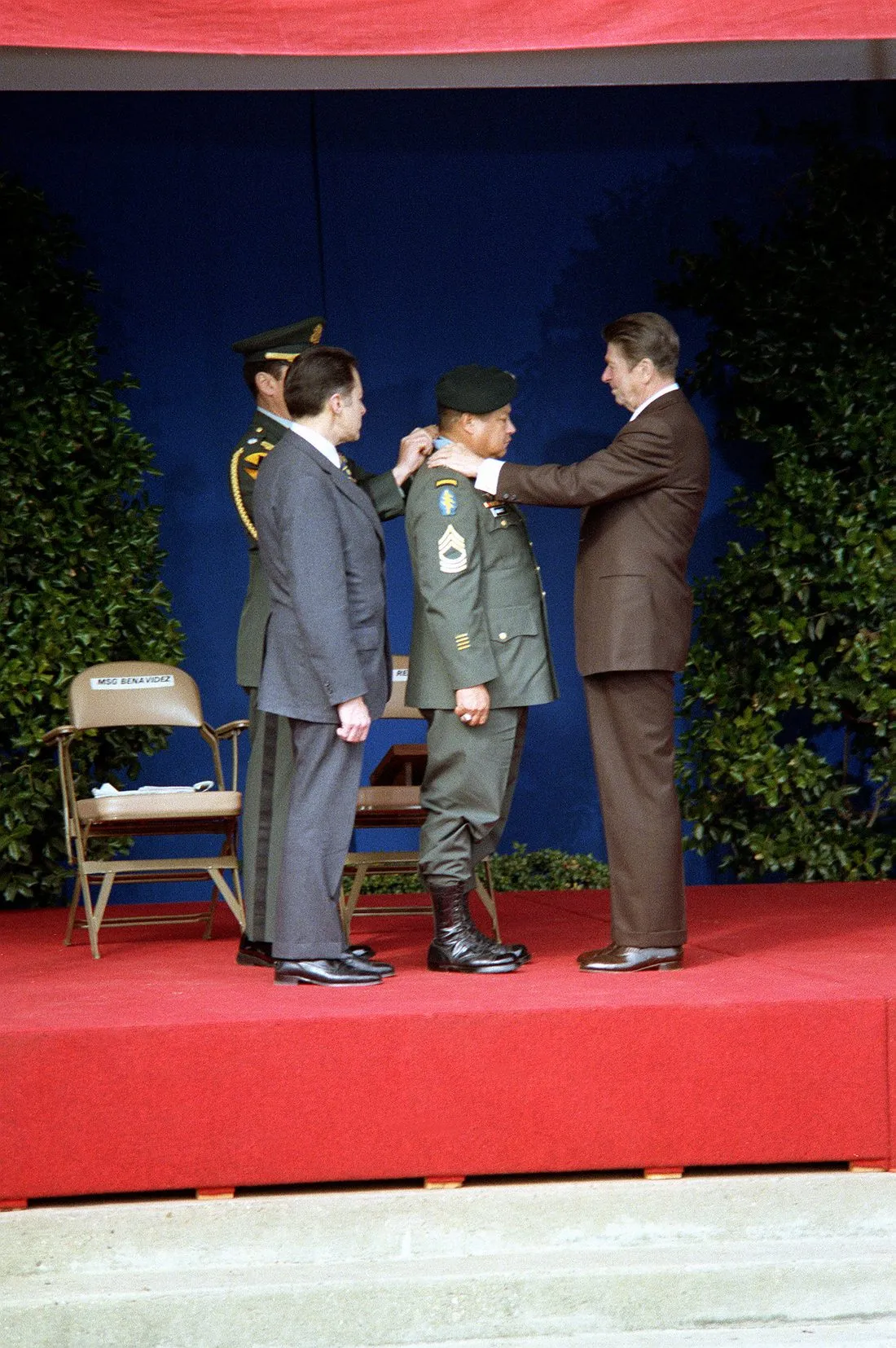
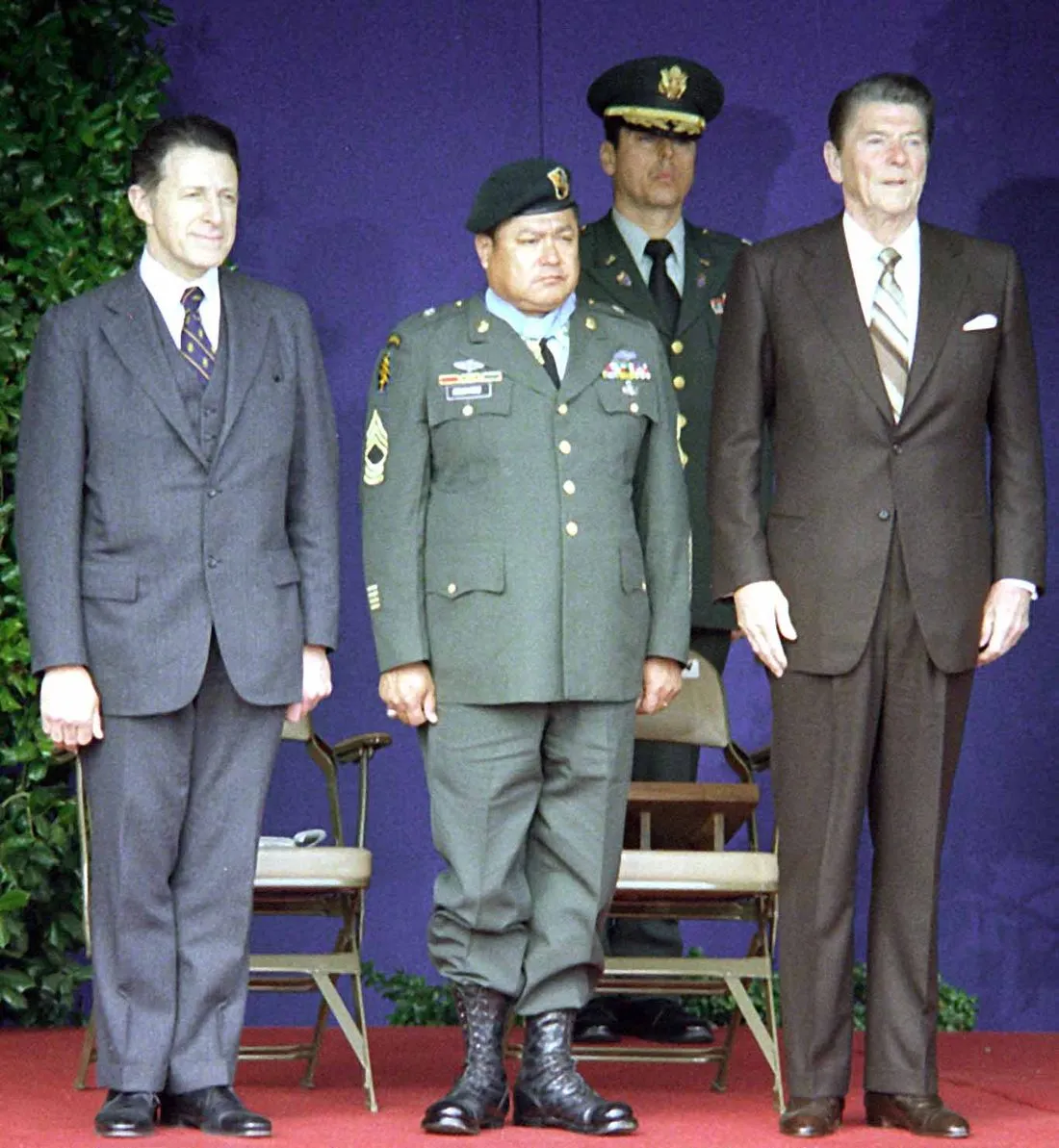
On February 24, 1981, President Ronald Reagan presented Roy Benavidez with the Medal of Honor at the Pentagon. Before reading the citation, Reagan turned to the assembled press and said, according to the Reagan Library record of the ceremony, “If the story of his heroism were a movie script, you would not believe it.” It had taken almost 13 years.
Is there a Roy Benavidez movie?
There is no major Hollywood feature about Roy Benavidez. For a story a sitting president called too unbelievable to script, that is a strange gap, and fans have noticed. Online petitions have run for years asking for a proper film, with one campaign aimed directly at director Mel Gibson, who had already shown he could film an “impossible” Medal of Honor story without flinching from the violence.
That comparison is the obvious one. Gibson’s Hacksaw Ridge told the story of Desmond Doss, a medic who saved 75 men without firing a shot, and audiences accepted scenes that sounded invented because they were documented. Benavidez offers the same problem in reverse: a single soldier, six hours, 37 wounds, hand-to-hand combat, and a body bag. The reason it has not been filmed has less to do with believability than with the fact that the most decorated stories often reach the screen decades late, if at all. Audie Murphy had to play himself to get his war on film. Benavidez is still waiting.
What happened to Roy Benavidez after the war?
Benavidez retired from the Army as a master sergeant in 1976 and went home to El Campo with Lala and their three children. He turned into one of the most sought-after speakers in the country, talking to schoolchildren and soldiers about education, discipline, and staying off the easy roads that had nearly swallowed him as a boy.
In 1983 he used that voice in a fight of a different kind. When the Reagan administration moved to cut disability benefits and dropped thousands of veterans from the rolls, Benavidez testified before the House Select Committee on Aging against the cuts. He had received a notice himself. A Medal of Honor recipient telling Congress that the government was abandoning the men it had sent to war carried weight, and the policy was reversed for many of those affected. He wrote three books about his life, including The Three Wars of Roy Benavidez, the three wars being poverty, combat, and the long battle for recognition.
Roy Benavidez died on November 29, 1998, at age 63, at Brooke Army Medical Center in San Antonio, of respiratory failure and complications from diabetes. He is buried at Fort Sam Houston National Cemetery, the same San Antonio post where doctors had once told him he would never walk. The Navy named a ship for him, the USNS Benavidez; schools, a National Guard armory, and a stretch of Texas highway carry his name. In 2001 he became the first Hispanic American with his own commemorative G.I. Joe figure. He had told the story so many times that he never needed Hollywood to tell it for him.

Related Medal of Honor stories
- Desmond Doss: the unarmed medic of Hacksaw Ridge and the moments Hollywood cut
- Audie Murphy: the most decorated American soldier of WWII who played himself on screen
- John Chapman: the combat controller who fought alone on Takur Ghar
Frequently asked questions
How many wounds did Roy Benavidez have?
Roy Benavidez had 37 separate bullet, bayonet, and shrapnel wounds from the six-hour fight near Loc Ninh on May 2, 1968. They included wounds to his head, face, right leg, abdomen, and back, plus a bayonet wound from hand-to-hand combat. He was treated for nearly a year afterward.
Did Roy Benavidez really get put in a body bag?
Yes. At the field hospital he was presumed dead and placed in a body bag among the day’s killed. As a doctor leaned in to certify the death, Benavidez could not move or speak, so he spat in the doctor’s face. The doctor realized he was alive and called for help. The account comes from Benavidez himself and from the official record of the action.
Why did Roy Benavidez wait 13 years for the Medal of Honor?
He first received the Distinguished Service Cross. The upgrade to the Medal of Honor stalled because the recommendation deadline had passed and the Army required a sworn eyewitness from the battle. The key witness, radioman Brian O’Connor, was presumed lost but turned up alive in Fiji in 1980 and submitted a ten-page statement. Reagan presented the medal on February 24, 1981.
Is there a Roy Benavidez movie?
No major Hollywood feature film has been made about Roy Benavidez. He has appeared in documentaries and television segments, and fans have petitioned for years for a biopic, but no studio production has been released. President Reagan said at the 1981 ceremony that the story would be unbelievable as a movie script.
Was Roy Benavidez the most decorated soldier of the Vietnam War?
He is one of the most decorated soldiers of the Vietnam War and among its best-known Medal of Honor recipients, but “most decorated” is not a single official title. His awards include the Medal of Honor, the Distinguished Service Cross, and several Purple Hearts (published accounts give different totals). His Loc Ninh action is one of the most cited individual feats of the war.
What does “Tango Mike Mike” mean?
“Tango Mike Mike” was Benavidez’s nickname, from the radio-alphabet initials for “That Mean Mexican.” Fellow soldiers gave it to him, and it became the title of accounts of his Loc Ninh action. He used it himself when telling his story in later years.
Where is Roy Benavidez buried?
He is buried at Fort Sam Houston National Cemetery in San Antonio, Texas, with full military honors. He died on November 29, 1998, at the nearby Brooke Army Medical Center at age 63.
Sources
- Medal of Honor citation and recipient record: Congressional Medal of Honor Society, “Roy P. Benavidez”
- Special Forces action narrative and unit history: USASOC History Office, “Master Sergeant Roy P. Benavidez”
- Navy namesake and biographical summary: Naval History and Heritage Command, “Master Sergeant Roy Benavidez”
- Presentation ceremony remarks: Ronald Reagan Presidential Library, February 24, 1981
- Benavidez, Roy P., with John R. Craig. Medal of Honor: A Vietnam Warrior’s Story. Brassey’s, 1995 (memoir).
Correction, October 25, 2026: An earlier version of this article gave conflicting Purple Heart counts. Published accounts differ on his total, so the article no longer states one.