Key Takeaway
Part of our complete Medal of Honor series, the history of America’s highest military award and the stories of recipients whose actions defined valor in combat.
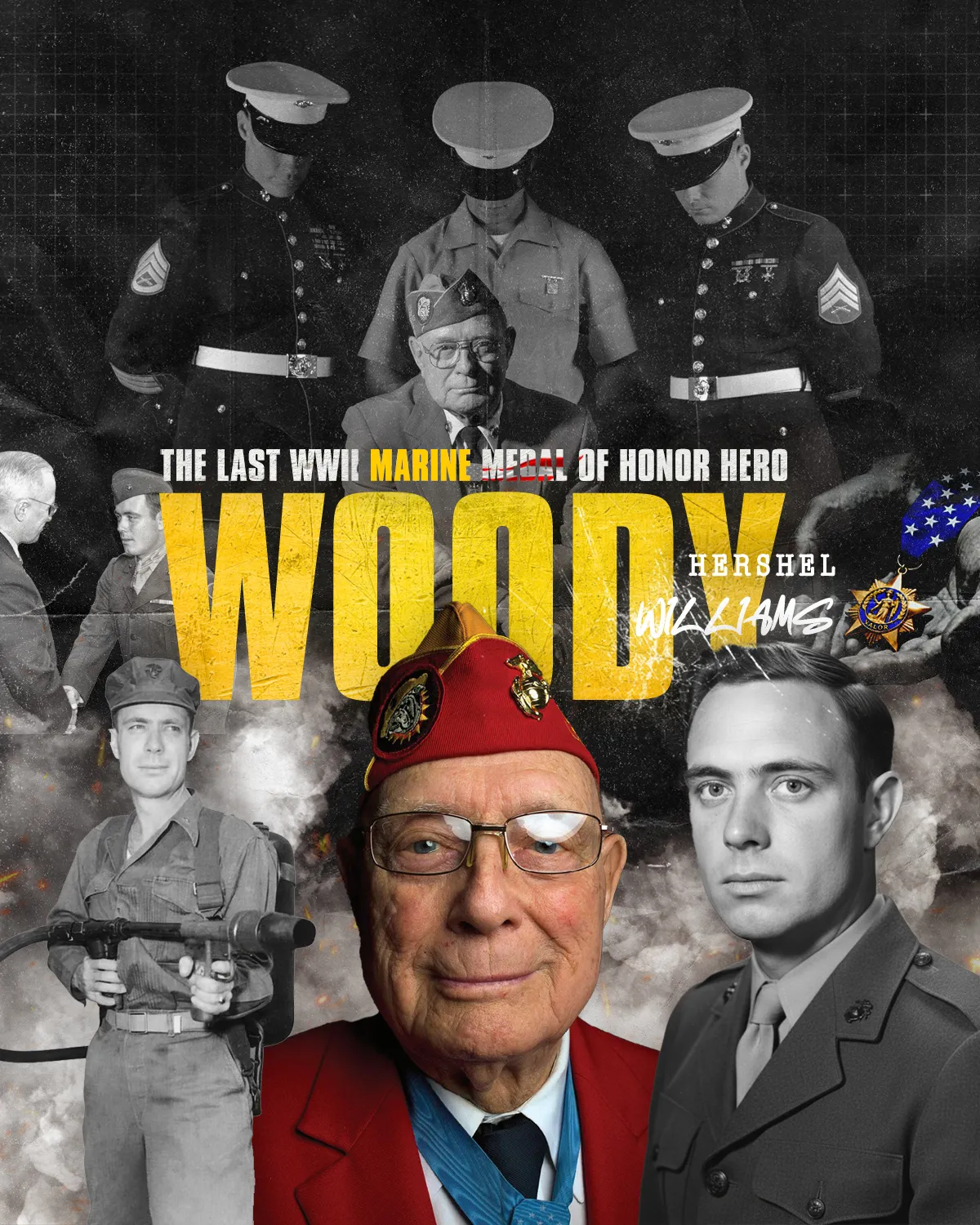
Woody Williams strapped a 70-pound flamethrower to his back on Iwo Jima and spent four hours crawling toward Japanese pillboxes that had an entire Marine unit pinned flat. He destroyed seven of them. By himself. Two of the four guys covering him were killed during the assault. Out of roughly 300 flamethrower operators on that island, fewer than 20 made it home. Williams was one of them. He received the Medal of Honor, spent the next six decades serving veterans and Gold Star families, and when he died on June 29, 2022, at age 98, he was the last living Medal of Honor recipient from the entire Second World War.
A Farm Boy from West Virginia
Hershel Woodrow Williams was born October 2, 1923, in Quiet Dell, West Virginia. Youngest of eleven kids on a dairy farm. If you know anything about dairy farming, you know the mornings start before the sun does and the work doesn’t stop until after dark. That was his childhood.
The Depression shaped everything. The Williams family ate what they grew and traded what they couldn’t eat. Woody learned early that nothing was free and nothing was easy, which turned out to be decent preparation for what came later.
Before the war, he drove a taxi. Then a truck for a construction outfit. No military ambitions. No grand plans. And then Pearl Harbor happened on December 7, 1941, and none of that mattered anymore.
Rejected by the Marines, Then Accepted
First time Williams walked into a Marine recruiting station, they turned him away. Five foot six. Too short. The Marines at that point in the war still had standards they could afford to enforce. That changed as the casualty lists got longer.
He tried again after they loosened the height requirement. This time they took him. Boot camp. Then assignment to the 21st Marines, 3rd Marine Division. The Corps trained him as a demolition specialist and flamethrower operator, which was about the most dangerous job description they offered. You strapped 70 pounds of fuel and compressed gas to your back. You were slow, you were visible, and every enemy sniper on the field knew exactly what you were carrying and what it could do. You were target number one.
Williams saw combat for the first time at Guam in July 1944. Rough introduction. But the fight that would follow him for the rest of his life was still seven months out.
The Battle of Iwo Jima
February 1945. American forces needed Iwo Jima badly. The island sat about 750 miles south of Tokyo, and the Air Force needed it for fighter escorts to protect the B-29s that were hammering the Japanese mainland. Without Iwo Jima, the bombers were flying unescorted and taking losses.
Japan understood this perfectly. General Tadamichi Kuribayashi had spent months turning the island into a fortress. Tunnels connecting reinforced bunkers. Concrete pillboxes with interlocking fields of fire. Underground passageways that let defenders pop up, shoot, and disappear. More than 20,000 Japanese troops dug in deep, many of them invisible from the surface.
About 30,000 Marines were ashore by nightfall on February 19, the first of roughly 70,000 who fought on the island. The sand was volcanic ash, black and loose, the consistency of a bean bag. Vehicles sank. Men’s boots disappeared into it. Japanese artillery and mortars opened up from positions the Marines couldn’t even see. In the first 36 hours: more than 2,400 American casualties.
Williams and the 3rd Marine Division landed two days later, on February 21. They pushed inland immediately toward the center of the island, where the fortifications were heaviest.
February 23, 1945: Four Hours That Changed Everything
The advance stalled. A line of reinforced concrete pillboxes had the Marines completely pinned. Machine gun fire from multiple positions, overlapping fields so there was no safe angle of approach. Grenades bounced off the concrete. Rifle fire was useless. Nobody could move.
The CO called for a flamethrower.
Williams stepped forward.
He picked four Marines for covering fire and started crawling toward the first pillbox. Two of those four cover men would be dead before it was over.
What followed is the kind of thing that sounds made up. For four straight hours, Williams worked his way from one pillbox to the next. He’d find the blind spot, press himself against the outer wall, angle the nozzle toward the firing slit, and let it go. Burning fuel straight into the interior.
At one point he actually climbed on top of a pillbox and fired the flamethrower down through a ventilation shaft. Killed everyone inside before they could reposition.
Between each pillbox, he had to crawl back to friendly lines to swap out his fuel tanks. That meant crossing open ground, under fire, multiple times. Each trip out. Each trip back. Over and over for four hours.
When he was done, seven pillboxes were destroyed. The defensive line that had stopped an entire Marine unit was broken. The advance resumed. The 92 percent casualty rate for flamethrower operators on Iwo Jima was not an exaggeration. Williams just happened to be in the other eight percent.
The Medal of Honor
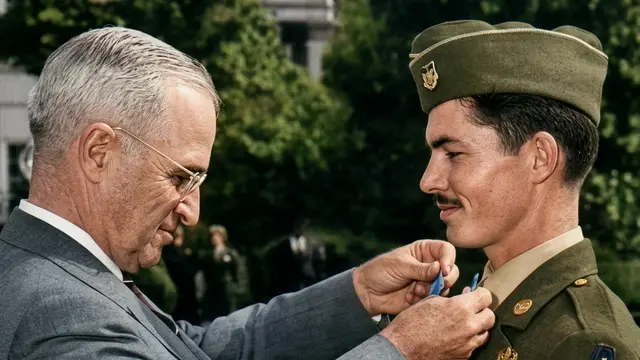
On October 5, 1945, President Harry Truman placed the Medal of Honor around Williams’ neck at the White House. The official citation used the phrase “conspicuous gallantry and intrepidity at the risk of his life above and beyond the call of duty.”
Williams said afterward that the medal wasn’t his. It belonged to the Marines who’d covered him, especially the two who didn’t come back. He wore it for the rest of his life, but never as a trophy. He called it a reminder of what other people had given up so he could do his job.
The War Inside: PTSD Before Anyone Called It That
The shooting stopped. The nightmares didn’t. Williams came home carrying what we’d now call PTSD, though in those days nobody really had a name for it. “Shell shock” was about as clinical as the conversation got, and admitting you were struggling was considered weakness.
So he struggled quietly. Flashbacks. Nightmares. A restlessness that wouldn’t settle. He dealt with it alone for years, the way most guys from that generation did.
It wasn’t until the 1960s that he found something that helped. Williams turned to his Christian faith, and he credited it with giving him a way to confront what he’d seen and done. He became deeply religious and eventually served as chaplain of the Congressional Medal of Honor Society for over 30 years. Not everyone finds their way through the dark. Williams did, but it took him two decades.
Six Decades of Service After the War
Most people with a Medal of Honor could coast on it for life. Williams did the opposite. He spent 33 years working for the Department of Veterans Affairs as a Veterans Service Representative, helping other veterans navigate the bureaucracy that was supposed to take care of them. He knew what vets needed because he was one.
His biggest legacy, though, started in 2010. That’s when he founded the Hershel “Woody” Williams Medal of Honor Foundation, dedicated to honoring Gold Star Families, the relatives of service members killed in action. Under his direction, the foundation built more than 100 Gold Star Families Memorial Monuments across the country, with another 70-plus planned. His goal was a monument in every state. He wanted to make sure that the families of the dead were never invisible.
In 2018, the VA medical center in Huntington, West Virginia, was renamed the Hershel “Woody” Williams VA Medical Center. They don’t rename hospitals after living people very often. They made an exception for Woody.
Death and National Tribute
Hershel “Woody” Williams died on June 29, 2022. He was 98 years old. He passed away at the VA medical center that carried his name, which feels like the kind of ending a screenwriter would come up with, except it was real.
With his death, an era genuinely ended. The last living Medal of Honor recipient from World War II was gone. His body lay in honor at the United States Capitol, a distinction they don’t hand out casually. He was buried with full military honors at the Donel C. Kinnard Memorial State Veterans Cemetery in Institute, West Virginia.
Why Woody Williams Matters
Williams matters because the war story isn’t even the most impressive part. Lots of people did brave things in combat. What Williams did afterward is what sets him apart. He could have spent the rest of his life dining out on the Medal of Honor and nobody would have said a word. Instead, he spent six decades fighting different battles: against PTSD, against VA red tape, against the national habit of forgetting the families left behind.
That flamethrower on Iwo Jima weighed 70 pounds. The weight he carried after the war, the memories, the faces, the responsibility of being alive when so many weren’t, was a lot heavier. He bore both without complaining about either.
Related Medal of Honor Stories
- Desmond Doss: The Real Hacksaw Ridge Story Mel Gibson Cut
- John Chapman: The Air Force Combat Controller Who Fought Alone on Roberts Ridge
- Dick Winters: The Complete Biography of Easy Company’s Real Leader
- “Now I Know Why I Am Here”: Kaufering Camp True Story
Frequently Asked Questions
Who was Hershel “Woody” Williams?
A Marine who took out seven Japanese pillboxes with a flamethrower on Iwo Jima and received the Medal of Honor for it. He spent the rest of his life serving veterans and Gold Star families. When he died in 2022 at 98, he was the last WWII Medal of Honor recipient alive.
Why did Woody Williams receive the Medal of Honor?
Four hours of solo combat on February 23, 1945. He destroyed seven fortified pillboxes using a flamethrower, breaking a Japanese defensive line that had pinned down his entire unit. Two of his four cover men died during the assault.
How did Woody Williams die?
He died on June 29, 2022, at age 98, at the Hershel “Woody” Williams VA Medical Center in Huntington, West Virginia. The hospital had been renamed after him while he was still alive.
What is the Gold Star Families Memorial Foundation?
Williams founded it in 2010 to build memorial monuments honoring families who lost someone in military service. More than 100 monuments now stand across the country, with over 70 more in the works.
What was the survival rate for flamethrower operators at Iwo Jima?
About 8 percent. Out of roughly 300 portable flamethrower operators deployed on Iwo Jima, fewer than 20 survived. The casualty rate was approximately 92 percent. Williams was one of the few who walked off that island.
Correction, October 25, 2026: An earlier version of this article said about 70,000 Marines landed on February 19, 1945. About 30,000 were ashore by nightfall that day; roughly 70,000 fought on the island over the campaign.