He crawled three hundred yards on his stomach after a sniper broke his left arm. He had been left alone for five hours on a ridge where the Japanese were finishing off the wounded. He had given up his stretcher to another man the same night and made himself the medic again. Mel Gibson filmed most of what he did on Hacksaw Ridge. But the parts that sound impossible, the parts that still make people doubt the history books, those never made it to the screen.
This is the true story of Private First Class Desmond Doss, the Seventh-day Adventist medic who refused to carry a weapon and walked into the most brutal battle of the Pacific War with a Bible and a rope. He saved approximately 75 men on a cliff the Americans had given up on. He received the Medal of Honor from President Truman on October 12, 1945. And the 2016 Andrew Garfield film, Hacksaw Ridge, left out the incidents that would have pushed audiences past their breaking point.
Who Was Desmond Doss?
Part of our complete Medal of Honor series, the history of America’s highest military award and the stories of recipients whose actions defined valor in combat.
Desmond Thomas Doss was born in Lynchburg, Virginia on February 7, 1919, the son of a carpenter and a Seventh-day Adventist mother who taught him the Ten Commandments as a literal framework for living. The sixth commandment, “Thou shalt not kill,” became the rule he would not bend when the United States entered the war.
He was drafted in April 1942 and reported to Camp Lee, Virginia. He refused to carry a rifle. He refused to train on Saturdays, his Sabbath. His officers tried everything short of imprisoning him to force him out of the infantry. They failed. Doss was assigned as a combat medic with Company B, 1st Battalion, 307th Infantry Regiment, 77th Infantry Division, and he shipped out to the Pacific to earn the Medal of Honor without ever firing a round at another human being.
The short answer to what he did is this. On the Maeda Escarpment in Okinawa, between April 29 and May 21, 1945, he lowered roughly 75 wounded Americans down a four-hundred-foot cliff while Japanese soldiers killed everything that moved above him. He prayed for one more man, each time, for hours. Then he was wounded by a grenade, hit by a sniper, and crawled back to the American lines bleeding from seventeen separate pieces of shrapnel.
The Faith Behind the Refusal
The Seventh-day Adventist Church taught that the sixth commandment was absolute, and Saturday was the Sabbath. Doss believed both. He also believed that serving his country was a moral duty, so he volunteered to be a medic, a role the church considered compatible with its teaching. The Army disagreed. An unarmed man in a rifle company, the thinking went, was a liability.
Doss also disliked the label the Army pinned on him. He preferred to call himself a “conscientious cooperator” rather than an objector. “I like to call myself a conscientious cooperator instead of objector,” he explained in a later interview, “because we believe in serving our country in every way possible.” It was a small distinction that carried his entire argument: he was not refusing to serve, only refusing to take a life.
His sergeant at Fort Jackson tried to break him. Other soldiers threw boots at him while he knelt praying at night. His company commander, Captain Jack Glover, threatened to have him formally transferred to non-combat duty as unfit for service. The Army attempted, informally, to push him out. There was no actual court-martial, though the film frames it that way for dramatic clarity. What there was, according to the Army’s own record, was continuous harassment and repeated transfer attempts that Doss simply waited out.
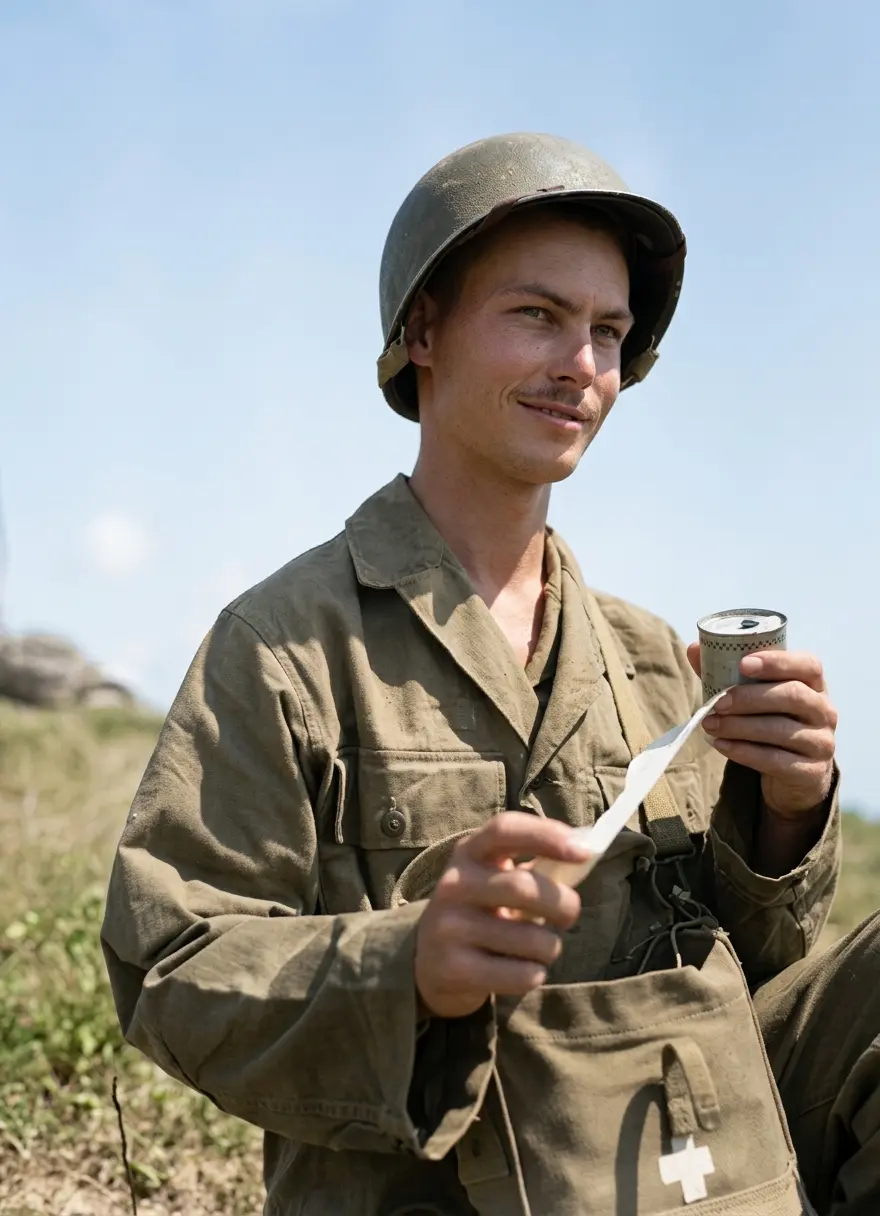
He memorized his medical kit. He became faster than the men around him at dressing a wound under fire. By the time the 77th Infantry reached Guam in July 1944, the same officers who had tried to remove him were placing him in the forward aid position. They had learned what the men around him already knew. Having Doss near you in combat was a tactical advantage.
It is worth naming the detail here because it shifts how you read the rest of the story. Doss was not a passive object of the film’s sympathy. He was a combat-proven medic by the time his battalion climbed the rope ladders onto the Maeda Escarpment. The miracle was not that he survived Hacksaw Ridge. The miracle was what he did there after earning the right, by two previous campaigns, to be considered an expert.
What Really Happened at the Maeda Escarpment
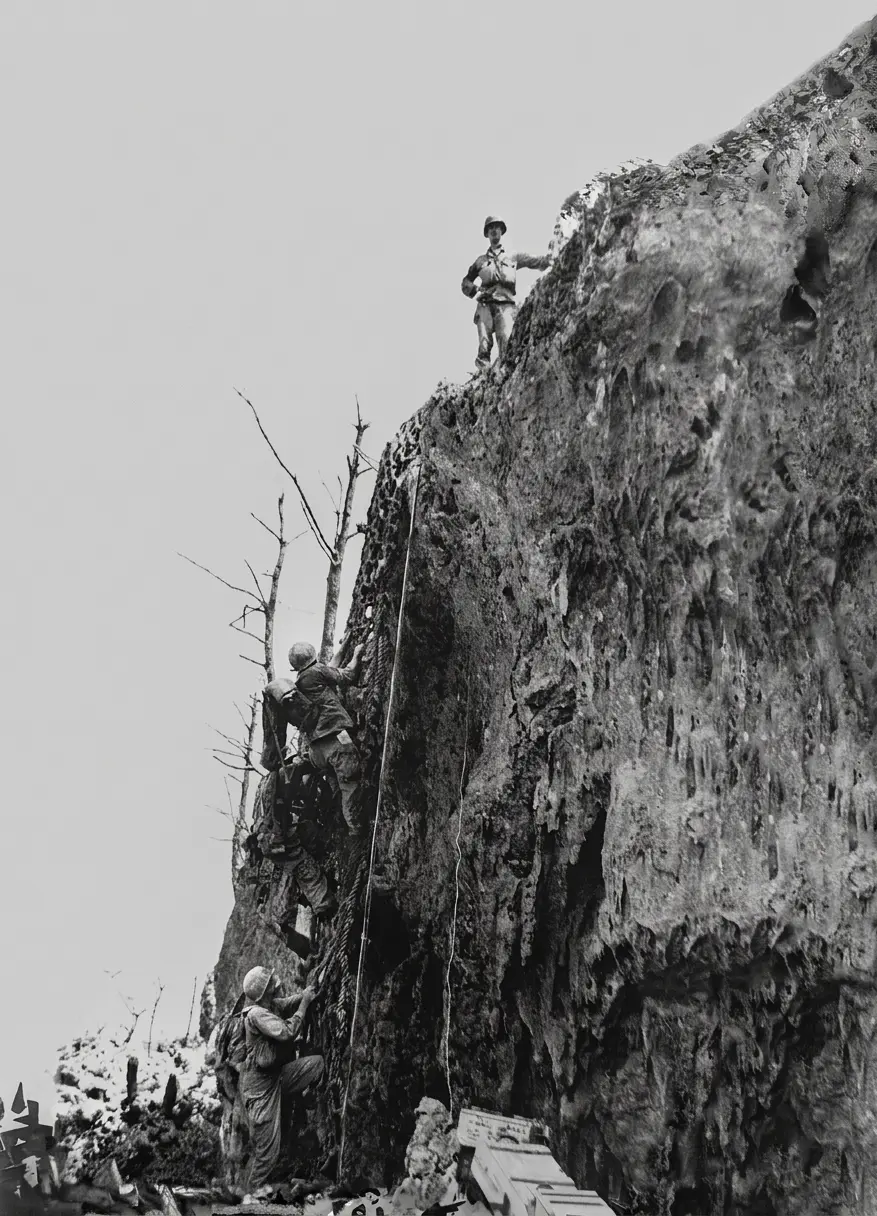
The Americans called it Hacksaw Ridge. The Japanese fortified it as the northern anchor of the Shuri Line, the defensive system protecting the capital of Okinawa. A four-hundred-foot sheer cliff faced the American approach. Above the cliff lay a plateau honeycombed with caves, tunnels, and mutually supporting machine-gun positions. The 77th Infantry Division was ordered to take it on April 29, 1945.
The 1st Battalion climbed cargo nets to reach the top. By afternoon, Japanese counterattacks had broken the American line. Soldiers retreated down the nets. Some jumped. Most of the wounded, around seventy-five men, were left behind on the plateau. Doss was the only medic who stayed.
For the next twelve hours, he worked the cliff edge alone. He tied each wounded man into a double bowline, a knot he had learned in West Virginia as a boy. The film shows him using a Spanish bowline, but according to the documentary The Conscientious Objector and interviews with veterans who watched him work, the actual knot was a double bowline, a variation with an extra loop that made the rope less likely to slip under a wounded man’s weight. He lowered each one to the base of the cliff.
Between rescues, he prayed the same short sentence. “Lord, please help me get one more.” He has been quoted saying it through the entire night, each descent treated as the last one he was likely to survive. By nightfall on May 5, the Army’s own record credits him with approximately seventy-five rescues. Doss himself said fifty. The Army initially proposed one hundred. The citation settled on approximately 75, a midpoint between Doss’s own estimate of fifty and the Army’s initial hundred; that number now appears on the monument at Lynchburg, Virginia.
The Impossible Moments Mel Gibson Cut
This is the section that matters, because it is the section the film could not carry. Mel Gibson has said in interviews that three specific incidents were removed from Hacksaw Ridge because test audiences would not believe them.
The first is the stretcher. On May 21, 1945, after being wounded by a grenade in the legs, Doss was placed on a stretcher to be carried down the escarpment. During the descent, he saw another wounded soldier next to the path. He rolled off his own stretcher and directed the litter-bearers to take the other man instead. He treated his own legs and waited for a second evacuation. While he waited, a Japanese sniper shot him through the left arm, shattering the bone. He bound his rifle stock to his arm as a splint. Then he crawled three hundred yards on his stomach, alone, across a battlefield held by the enemy, back to the American lines. He had been left behind for five hours before he made the crawl. Gibson cut the sequence because he thought the audience would stop believing the film.
The second is the sniper incident that every veteran of the battalion mentioned in the post-war Conscientious Objector interviews. While Doss was lowering a wounded man from the escarpment, a Japanese soldier came over the ridge from a hidden position and had him in direct line of sight. The Japanese soldier pulled the trigger. The rifle jammed. He cleared the action and tried again. It jammed again. The Americans who watched from below saw the Japanese soldier try four or five times before disappearing from the ridge. Doss never stopped lowering the man. He later said he had not seen the Japanese soldier at all, only heard about the incident from the men he had saved.
The third is the grenade moment itself, which the film softened. On May 21, during a night attack near Shuri, Doss stayed in exposed territory while the rest of Company B took cover. He did this knowing that a medic moving in the dark could easily be mistaken for a Japanese infiltrator and shot by his own side. He continued giving aid until a grenade exploded near him, driving seventeen pieces of shrapnel into his legs. The film shows a more controlled grenade deflection. The real event was more chaotic and more dangerous, and it left him on the ground.
There is a fourth detail that Gibson did include but that viewers often do not recognize as historical. Doss treated wounded Japanese soldiers as well as Americans. His son, Desmond Doss Jr., has described this in several interviews as his father’s defining belief. “He saw the face of God in every soldier on that battlefield,” Doss Jr. said. “Japanese, American, it did not change his work.” The film shows one such rescue, quickly. The real number is unknown but was higher.
Here is where the story turns. These cut and softened moments are not curiosities for trivia lists. They are the reason the Medal of Honor citation used the word “approximately.” The War Department knew that if it put the full record on paper, the public would read it as mythology, not battlefield reporting. And so, the official numbers went conservative.
The Medal of Honor Citation
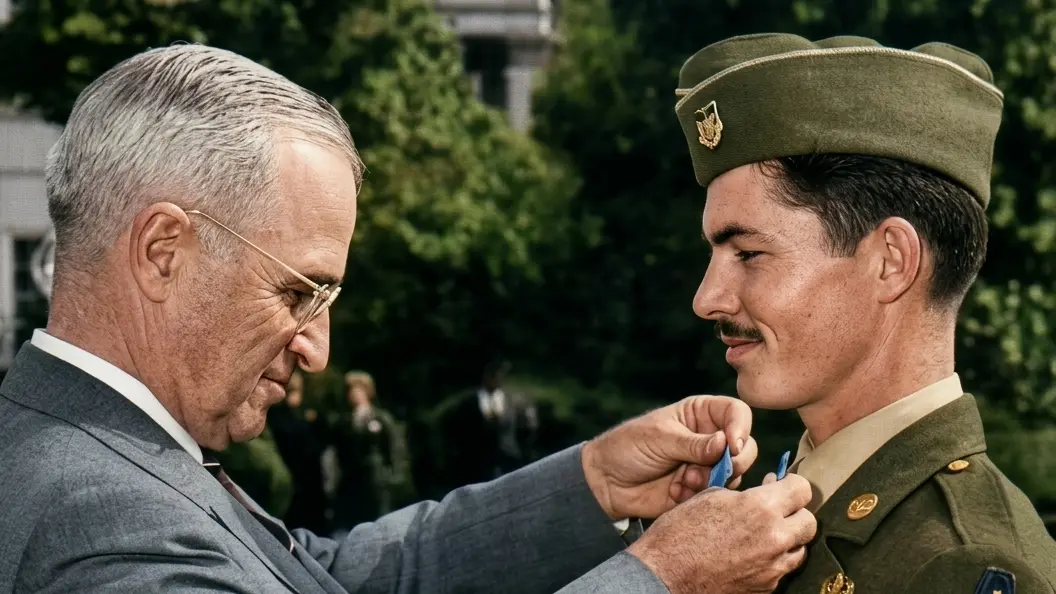
On October 12, 1945, President Harry S. Truman placed the Medal of Honor around Doss’s neck on the White House lawn. Doss was the first conscientious objector in American history to receive it. The citation read that he had “saved the lives of many soldiers” during the battle for the Maeda Escarpment “while under heavy enemy fire” and had continued to render aid despite being “seriously wounded” himself.
The citation itself, still the most-quoted account of what he did, is worth reading in the War Department’s own words:
“Private First Class Doss was a company aid man when the 1st Battalion assaulted a jagged escarpment 400 feet high. As our troops gained the summit, a heavy concentration of artillery, mortar, and machinegun fire crashed into them, inflicting approximately 75 casualties and driving the others back. Private First Class Doss refused to seek cover and remained in the fire-swept area with the many stricken, carrying them one by one to the edge of the escarpment and there lowering them on a rope-supported litter down the face of a cliff to friendly hands.”
The citation goes on to log dated acts most retellings skip. On May 2 he treated a man 200 yards forward of the lines under fire. On May 4 he moved through a shower of grenades to within eight yards of a cave mouth to reach four wounded men. On May 5 he carried a casualty 100 yards to safety, and on May 21, already wounded, he made the long crawl back to the aid station. It closes by recording that his name “became a symbol throughout the 77th Infantry Division for outstanding gallantry.”
Truman is said to have held Doss’s hand for an unusually long moment during the ceremony and told him, “I’m proud of you. You really deserve this.” The moment is documented in contemporary photographs and in the Doss family archives at the official memorial site. For a president who had authorized the atomic bomb three months earlier, Doss represented something the war had not yet produced in ceremony. A soldier who had entered the Pacific theater with no intention of killing anyone and had come out a decorated hero anyway.
The Medal of Honor was not his only decoration. Doss was awarded two Bronze Stars (one for valor) and three Purple Hearts, the Combat Medical Badge, the Good Conduct Medal, the American Campaign Medal, the World War II Victory Medal, the Asiatic-Pacific Campaign Medal with arrowhead device and three bronze service stars, and the Philippine Liberation Medal, along with the Presidential Unit Citation and Meritorious Unit Commendation his unit earned. Every piece of that ribbon was earned without discharging a firearm. He is one of only a handful of recipients in the history of the Medal of Honor to have done so.
Life After Hacksaw Ridge
Doss returned home to a country that did not know what to do with him. He contracted tuberculosis in 1946 from his time in the Pacific and spent most of the next five years in military and civilian hospitals. He lost a lung. He lost five ribs. The antibiotics used to treat his TB destroyed his hearing, and he lived in near-total deafness from 1976 onward until a cochlear implant partially restored his hearing in 1988.
He and his first wife, Dorothy, lived quietly in Rising Fawn, Georgia, on a small farm. Dorothy handled the family’s correspondence because Doss could not hear telephone calls. He gave occasional lectures at Seventh-day Adventist schools. He refused most interview requests. When the documentary The Conscientious Objector was made in 2004 by director Terry Benedict, it was the first time Doss allowed his full story to be told on film. He did so only because veterans he had served with were beginning to die, and he wanted their testimony recorded.
Dorothy died in a car accident on November 17, 1991. Doss remarried in 1993 to Frances May Duman. He died on March 23, 2006, at his home in Piedmont, Alabama, at the age of 87. He was buried on April 3, 2006, at Chattanooga National Cemetery in Chattanooga, Tennessee, in Section P, Site 6399-A. His Find a Grave memorial records the site for the many visitors who still come to pay respects.
Ten years after his death, Mel Gibson’s Hacksaw Ridge opened in theaters. The film earned six Academy Award nominations and won two. Andrew Garfield played Doss. The Seventh-day Adventist Church saw a spike in inquiries, according to spokespeople from the North American Division. A monument was dedicated in Lynchburg, Virginia, the town where Doss was born, and his name was added to the Medal of Honor permanent memorial at Arlington.
What the Film Got Right
Before closing, it is worth being fair to the film. Hacksaw Ridge gets several things right that most Hollywood war movies change for pacing.
The boot camp harassment is accurate. Doss was beaten, threatened, and taunted. The relationship with his Seventh-day Adventist faith is handled with care. The cliff geography and the cargo nets are correct. The siege of the escarpment, broken into multiple pushes over three weeks, is compressed but not falsified. The prayer he repeated between rescues, “Lord, please help me get one more,” is real and has been verified by veterans who were on the aid station receiving Doss’s rescued wounded. And the film’s portrayal of Doss’s marriage to Dorothy Schutte is, according to the Doss family, emotionally accurate even where details are changed.
Desmond Doss Jr. consulted on the film during pre-production. He told Gibson’s team that his father would have approved of the film’s decision to let the uncomfortable moments be uncomfortable. The scene of Doss alone at night, surrounded by dead and wounded, praying by candlelight, is as close to the reality as a film can reasonably get.
The Question Worth Asking
The easiest reading of Doss’s story is that he was a man of deep faith who happened to be brave, and that this is why he did what he did. That reading is partially true.
A harder reading is that Doss, the first of only three conscientious objectors ever awarded the Medal of Honor, entered combat with a defined set of rules more restrictive than the Geneva Conventions and refused to adjust those rules when the situation demanded it. He should have been killed many times over. He should not have been able to lower seventy-five wounded men off a cliff by himself. A Japanese rifle should not have jammed four times in succession. A crawl of three hundred yards with a shattered arm, unobserved, across a contested ridge, should not end with the survivor alive in an American aid station.
So the question is the one Mel Gibson ran into and could not answer on film. Was Doss lucky beyond statistical explanation, or was something else at work? The Army’s official position is that he was an exceptionally skilled medic who made his own luck. The Doss family’s position is that his prayers were answered. Neither answer is complete.
What we can say with certainty is that the men he saved kept telling the story. They told it long enough, and in enough detail, that the Army had to issue a Medal of Honor citation to a man who had not fired a shot. That, in itself, is historically unusual. The Hacksaw Ridge film is the second draft of that story. The first draft, the one Doss himself would have preferred, is still the quiet book The Unlikeliest Hero by Booton Herndon. If you read it, you will find the real events that Gibson cut, printed exactly as the men who saw them said they happened.
Related Medal of Honor Stories
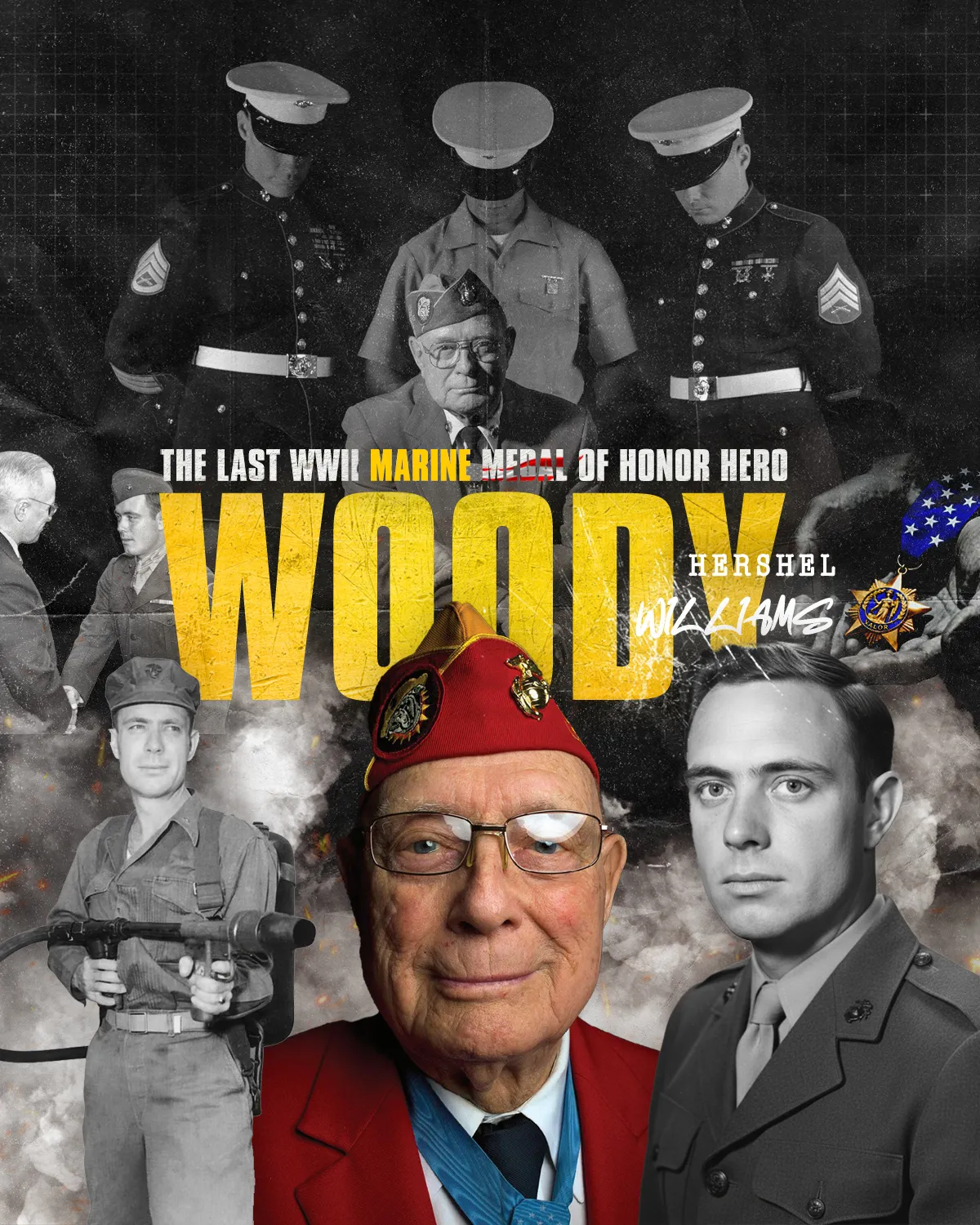
- Hershel “Woody” Williams: The Last WWII Medal of Honor Recipient
- John Chapman: The Combat Controller Who Fought Alone on Roberts Ridge
- Dick Winters: The Complete Biography of Easy Company’s Real Leader
Frequently Asked Questions
How many lives did Desmond Doss save at Hacksaw Ridge?
His citation credits him with lowering about 75 casualties down the escarpment. The Army initially proposed one hundred. Doss himself insisted on fifty. The compromise number of seventy-five now appears on his monument in Lynchburg, Virginia, and in most historical accounts.
Is Hacksaw Ridge a true story?
Yes. The 2016 Mel Gibson film is based on real events, with Andrew Garfield portraying Desmond Doss. The boot camp harassment, the cliff rescues, the wife Dorothy, and the “Lord, please help me get one more” prayer are all documented. Three specific wartime incidents were cut from the film because Gibson feared audiences would not find them believable, including the stretcher trade and the jammed Japanese rifle.
Why was Desmond Doss a conscientious objector?
Doss was a Seventh-day Adventist and believed the Ten Commandments, specifically “Thou shalt not kill,” applied literally. He volunteered to serve as a combat medic rather than avoid service entirely. The Adventist Church supported his interpretation that medical care was compatible with the Sixth Commandment.
Was Desmond Doss ever court-martialed?
No. The film dramatizes a formal court-martial, but the actual historical record documents only harassment, attempted transfers, and informal pressure to leave the infantry. Captain Jack Glover threatened to have him declared unfit, but no court-martial was ever brought.
What knot did Desmond Doss really use?
The film shows a Spanish bowline. According to the 2004 documentary The Conscientious Objector and the veterans interviewed for it, the actual knot Doss used on the Maeda Escarpment was a double bowline, a variant with an extra loop that made the rope less likely to slip under a wounded man’s weight.
Sources
- Herndon, Booton. The Unlikeliest Hero: The Story of Desmond T. Doss, Conscientious Objector Who Won His Nation’s Highest Military Honor. Review and Herald Publishing, 2004.
- Doss, Frances M. Desmond Doss Conscientious Objector: The Story of an Unlikely Hero. Pacific Press, 2015.
- Benedict, Terry, director. The Conscientious Objector (documentary). 2004.
- U.S. Army official biography: Pfc. Desmond Doss: The Unlikely Hero Behind Hacksaw Ridge
- Medal of Honor citation, October 12, 1945. Congressional Record.
Correction, October 25, 2026: An earlier version of this article called Desmond Doss the only Medal of Honor recipient of his kind (he was the first of three conscientious objectors to receive it), placed his stretcher sacrifice earlier in the week rather than the same night, and described an unsourced negotiation over his citation. It has been corrected against his Medal of Honor citation.