Key Takeaway
Part of our complete Medal of Honor series, the history of America’s highest military award and the stories of recipients whose actions defined valor in combat.
March 4, 2002. A frozen mountaintop in Afghanistan. Air Force Tech Sergeant John Chapman charged an al-Qaeda bunker, got shot, and was left for dead by his own team. That should have been the end of the story. It wasn’t. Chapman woke up. Alone, bleeding, surrounded by enemy fighters at 10,000 feet, he picked his weapon back up and fought for nearly an hour by himself. The drone footage that proved all of this wasn’t properly analyzed until 2016. Sixteen years after his death, the military finally understood what had actually happened up there. He received the Medal of Honor, the first airman to get one since Vietnam.
Who Was John Chapman?
Born July 14, 1965, in Springfield, Massachusetts. Grew up in Windsor Locks, Connecticut. Played football in high school. Quiet kid. The kind of person who didn’t say much but followed through on everything.
He joined the Air Force in 1985 and eventually became a Combat Controller. If you’re not familiar with that title, here’s the short version: Combat Controllers are the guys who operate behind enemy lines calling in airstrikes while people are shooting at them. The selection pipeline washes out more than 80 percent of candidates. Chapman made it through.
By 2002, he was assigned to the 24th Special Tactics Squadron out of Pope Air Force Base, North Carolina. That’s the Air Force’s top special operations unit. He’d deployed multiple times already. His teammates considered him one of the best Controllers in the force. Married, with two daughters, Madison and Brianna. The type of guy you wanted next to you when everything went sideways.
Operation Anaconda, March 2002
Early March 2002. U.S. and coalition forces launched Operation Anaconda in the Shahikot Valley of eastern Afghanistan, south of Gardez. The mission was to surround and destroy a pocket of al-Qaeda and Taliban fighters who’d dug themselves into the mountains.
The plan: conventional infantry sweeps the valley floor while special operations teams set up on the surrounding peaks to call in airstrikes. Chapman got attached to a Navy SEAL recon team called Mako 30. Their job was to land on top of Takur Ghar, a 10,469-foot mountain covered in snow, and establish overwatch positions.
Intelligence said the peak was empty.
Intelligence was wrong.
The Insertion Goes Sideways
Early hours of March 4. An MH-47E Chinook carrying Mako 30 approached the summit. The second the helicopter flared to land, al-Qaeda fighters in fortified bunkers opened up with RPGs and machine guns. Point-blank range. The Chinook took hits immediately. Hydraulic fluid everywhere. Pilots fighting to get the bird off the ground.
In the chaos, Navy SEAL Neil Roberts either fell or was thrown from the open rear ramp. He landed in the snow, alone, surrounded by the enemy.
The damaged helicopter crash-landed about four miles away. Everyone aboard survived, but Roberts was still up on that mountain.
Chapman and the six remaining Mako 30 operators made the call that defined everything that followed. They were going back. They boarded a second helicopter and flew straight into a position they already knew was defended, because one of their guys was up there.
Chapman Charges Uphill
The second Chinook put down near the peak just before dawn. The ramp dropped. Immediate contact from multiple directions.
Chapman didn’t wait. He moved straight at the nearest bunker. Uphill. Through snow that came up past his thighs. Machine gun fire and RPGs ripping the air around him. He reached the bunker, went in, and killed the fighters inside.
Then he kept going. He left the cover of that cleared position and moved to within about twelve meters of a second bunker, where an emplaced machine gun was firing on his team, completely exposed. He was engaging that second position when enemy rounds hit him.
He went down hard.
The rest of the team was pinned, taking fire from multiple positions, taking casualties. The team leader looked at Chapman, saw no movement, and made the call: pull back down the mountain. They left him on the peak. They believed he was dead.
The Hour Nobody Knew About
For sixteen years, that was the whole story. Chapman charged two bunkers, got killed, end of chapter. He received the Air Force Cross posthumously. The military moved on.
Except there was drone footage.
In 2016, Air Force Secretary Deborah Lee James ordered a fresh look at the video from that day. Technology had improved dramatically since 2002. Image enhancement tools that didn’t exist during the battle could now pull details out of the grainy footage that nobody had been able to see before.
What the analysts found changed everything. Chapman wasn’t dead. After his team pulled back, he regained consciousness. Wounded. Bleeding. Alone on a frozen mountaintop at 10,000 feet with al-Qaeda fighters closing in from three directions. And he started fighting again.
For close to an hour, Chapman held that position by himself. The footage shows him engaging fighters from multiple angles. At one point, he crawled into a bunker and shot a fighter who rushed him. There’s evidence suggesting he got into hand-to-hand combat with another.
Then the Quick Reaction Force showed up. Two Chinooks carrying Army Rangers heading for the summit. As the first helicopter came in, Chapman pulled himself up and started shooting at the enemy fighters who were firing on the incoming aircraft. He was drawing their fire away from the Rangers.
He was killed moments before those Rangers touched down. His last act on earth was protecting the guys who came to take back the mountain he’d already been holding alone for an hour.
The Toll of Roberts Ridge
Seven Americans died on Takur Ghar that day:
- Petty Officer 1st Class Neil Roberts, Navy SEAL
- Technical Sergeant John Chapman, Air Force Combat Controller
- Senior Airman Jason Cunningham, Air Force Pararescueman
- Corporal Matthew Commons, Army Ranger
- Sergeant Bradley Crose, Army Ranger
- Specialist Marc Anderson, Army Ranger
- Sergeant Philip Svitak, 160th Special Operations Aviation Regiment
Chapman’s solo stand is widely credited with protecting the 23-man Ranger quick-reaction force that landed to retake the peak. By pulling himself up and drawing enemy fire onto his own position as their helicopters came in, he bought those men the seconds they needed to reach cover instead of being cut down on the ramp.
The Medal of Honor, Sixteen Years Later
Originally, Chapman got the Air Force Cross. A significant award, no question. But once the drone footage revealed what actually happened during that missing hour, the Air Force pushed for an upgrade.
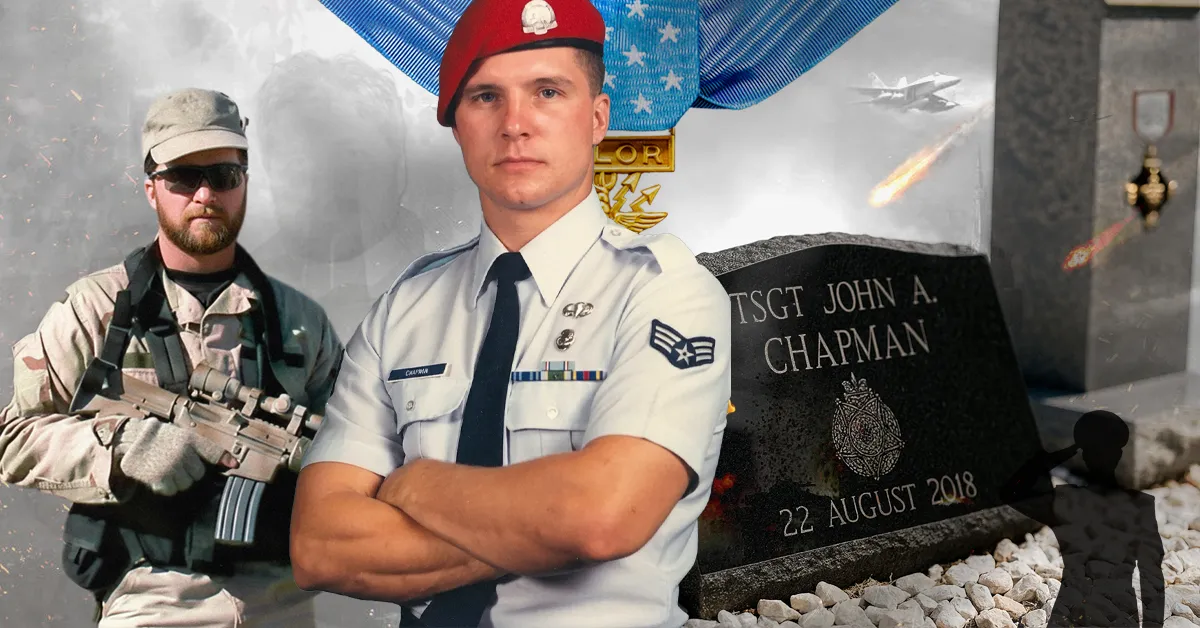
On August 22, 2018, President Trump presented the Medal of Honor to Chapman’s family at the White House. His widow, Valerie Nessel, and his two daughters received it. Chapman had been a technical sergeant when he was killed; the Air Force posthumously promoted him to master sergeant on August 24, 2018, two days after the ceremony. He became the first airman to earn the Medal of Honor since Vietnam, and he is believed to be the only recipient in history whose actions were captured on combat video.
His Medal of Honor citation put the final hour into the Air Force’s official record:
“With complete disregard for his own life, Sergeant Chapman deliberately moved from cover only 12 meters from the enemy, and exposed himself once again to attack a second bunker, from which an emplaced machine gun was firing on his team. Despite severe, mortal wounds, he continued to fight relentlessly, sustaining a violent engagement with multiple enemy personnel before making the ultimate sacrifice.”
Think about that for a second. We can actually watch what he did. Not a dramatization. Not a recreation. The real thing, recorded by a drone circling above while one man fought alone in the snow.
John Chapman’s Medals and Decorations
Chapman’s decorations reflect a full career in Air Force special operations, nearly all of it earned before he turned 37:
- Medal of Honor
- Purple Heart
- Air Force Commendation Medal
- Joint Service Achievement Medal
- Air Force Achievement Medal
- Air Force Combat Action Medal
- Air Force Good Conduct Medal (four devices)
- National Defense Service Medal
- Master Parachutist Badge
The Controversy Over What Happened on the Mountain
Chapman’s Medal of Honor did not come without dispute. The decision to leave the peak belonged to the Mako 30 team leader, Senior Chief Britt Slabinski, who ordered the withdrawal believing Chapman was dead. When the Air Force re-analyzed the drone footage and concluded that Chapman had survived and fought on alone, Naval Special Warfare leadership challenged that reading of the grainy video, and the disagreement between the two services slowed the upgrade for years.
It was ultimately settled by decorating both men. Slabinski’s Navy Cross for the same battle was upgraded to the Medal of Honor and presented on May 24, 2018, three months before Chapman’s ceremony. Two of the nation’s highest awards came out of the same terrible morning, and how to read what the footage shows still divides veterans of the fight.
Why John Chapman’s Story Matters
His story almost disappeared. If the technology to enhance that drone footage had never improved, nobody would have known about that final hour. Chapman would have stayed an Air Force Cross recipient, remembered for charging two bunkers, and that would have been it. The full truth lived on a hard drive somewhere for sixteen years, waiting for someone to look closely enough.
That matters beyond Chapman himself. His case changed how the military reviews posthumous awards. It proved that even accounts from elite operators can miss things. Sometimes the complete picture doesn’t emerge for years. Sometimes decades.
His widow, Valerie Nessel, has said the recognition was never what he would have chosen for himself. “[John] would want to recognize the other men who lost their lives,” she told the Air Force. “He would not want the other guys to be forgotten.” His former commander, Col. Ken Rodriguez, put Chapman’s standing more plainly: “In a very high-caliber career field, with the highest quality of men, even then, John stood out as our guy.”
Chapman didn’t fight for recognition. He fought because there were enemies shooting at Americans and he was the only one left in a position to do something about it. When his team pulled out, when any reasonable person would have stayed down and waited to die, he got back up. He kept going for an hour. And his final conscious decision was to expose himself to enemy fire so a helicopter full of Rangers could land safely.
That’s not a brave moment. That’s an entire hour of choosing to fight when nobody would have blamed him for being dead.
Where John Chapman Is Buried
John Chapman is buried at Saint Mary Byzantine Catholic Church Cemetery in Windber, Pennsylvania, near where his family gathered to lay him to rest in 2002. His Find a Grave memorial records the site. He is also honored with a memorial marker at Arlington National Cemetery, dedicated in January 2004, and his name was added to the Air Force Memorial’s Medal of Honor wall in 2018. The Air Force later named facilities at the Combat Control School in his honor.
Sources and Further Reading
- Medal of Honor citation, Master Sergeant John A. Chapman, U.S. Air Force, 2018.
- Dan Schilling and Lori Chapman Longfritz, Alone at Dawn: Medal of Honor Recipient John A. Chapman and the Untold Story of the World’s Deadliest Special Operations Force. Grand Central Publishing, 2019.
- U.S. Air Force Medal of Honor feature and official biography, af.mil.
- Congressional Medal of Honor Society, recipient record.
Related Medal of Honor Stories
- Hershel “Woody” Williams: The Last WWII Medal of Honor Recipient: Full Story
- Dick Winters: The Complete Biography of Easy Company’s Real Leader
- Ronald Speirs: What Band of Brothers Didn’t Tell You
Frequently Asked Questions
Who was John Chapman?
An Air Force Combat Controller killed on March 4, 2002, during the Battle of Takur Ghar in Afghanistan. After being shot and left for dead, he fought alone for nearly an hour. He received the Medal of Honor posthumously in 2018, the first airman to receive it since Vietnam.
What happened at the Battle of Takur Ghar?
A Navy SEAL fell from a helicopter onto an al-Qaeda-held mountaintop. Chapman’s team went back to rescue him and got ambushed. Chapman charged enemy positions, was shot and left behind. He regained consciousness and fought solo for about an hour before being killed while protecting an incoming rescue helicopter.
Was John Chapman’s Medal of Honor action captured on video?
Yes. A drone was recording the battle. When the footage was re-examined in 2016 with better technology, it revealed Chapman’s solo fight. He’s believed to be the only Medal of Honor recipient whose actions exist on combat video.
Why did it take 16 years for Chapman to receive the Medal of Honor?
He initially got the Air Force Cross. The drone footage from 2002 was too grainy to show the full picture. It wasn’t until 2016 that enhanced imaging revealed he’d survived the initial assault and kept fighting. That evidence led to the upgrade.
How many people died in the Battle of Takur Ghar?
Seven Americans. One SEAL, two Air Force operators, and four Army soldiers. Chapman’s final stand is credited with shielding the 23-man Ranger quick-reaction force that arrived to retake the summit.
Where is John Chapman buried?
John Chapman is buried at Saint Mary Byzantine Catholic Church Cemetery in Windber, Pennsylvania. He also has a memorial marker at Arlington National Cemetery, dedicated in 2004, and his name is on the Air Force Memorial’s Medal of Honor wall.