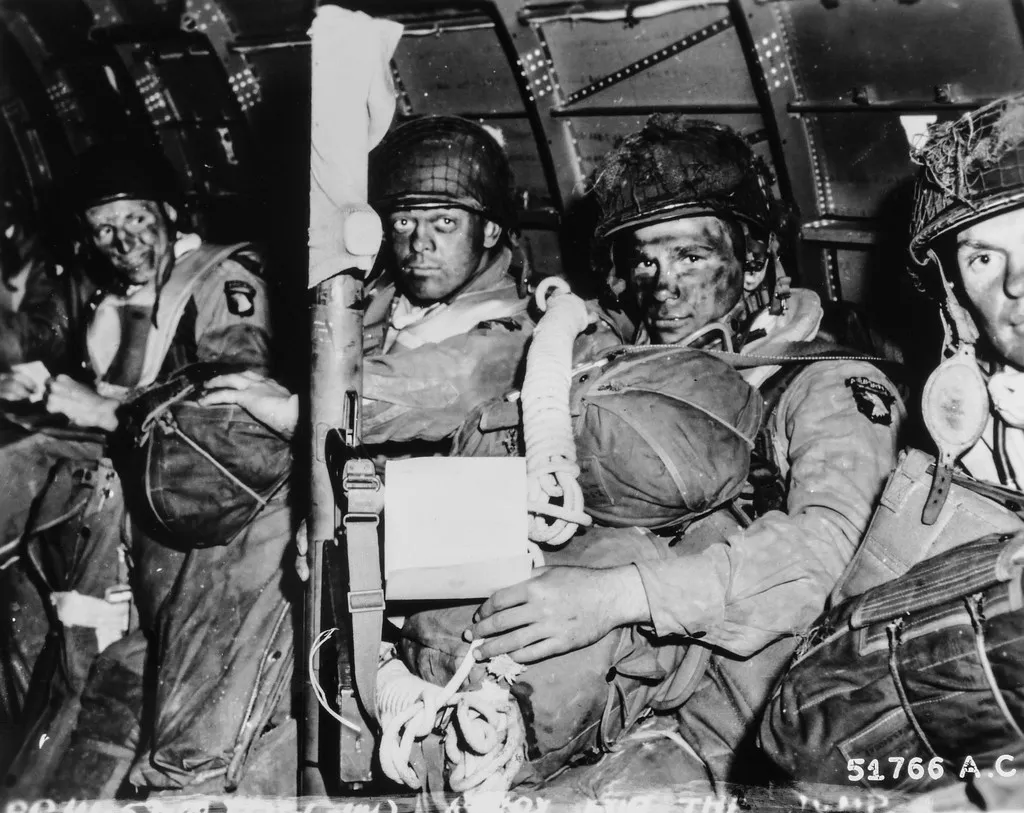
Before their boots touched French soil, something violent happened to every single man in the sky. They did not see it coming. And the show that made them famous never explained it.
When the 101st and 82nd Airborne jumped into Normandy on the night of June 5–6, 1944, most of the trouble did not start on the ground. It started in the air. In the split second the parachute canopy snapped open. D-Day paratroopers were slammed so hard by the opening shock of the T-5 parachute that men with thirty kilos of equipment strapped to their bodies felt their bones jolt, their leg bags tear away, and their grenades explode out of their pockets. That first jolt set the tone for everything that went wrong that night.
“Band of Brothers, ” shows the jump as confusion, flak, and scattered landings. It does not show what the men felt the moment their canopies filled with air. It is the detail that separates the Hollywood version from the memoir version, and the reason so many D-Day paratroopers hit French soil already bruised, half-equipped, and hunting for someone else’s rifle.
Why D-Day Paratroopers Slammed Into the Sky Before They Hit the Ground
The jump sequence looks simple on film. A jumpmaster shouts “Go!” The green light flashes. Men step into the slipstream and the canopy blooms above them. On screen, it is graceful. In 1944, it was not.
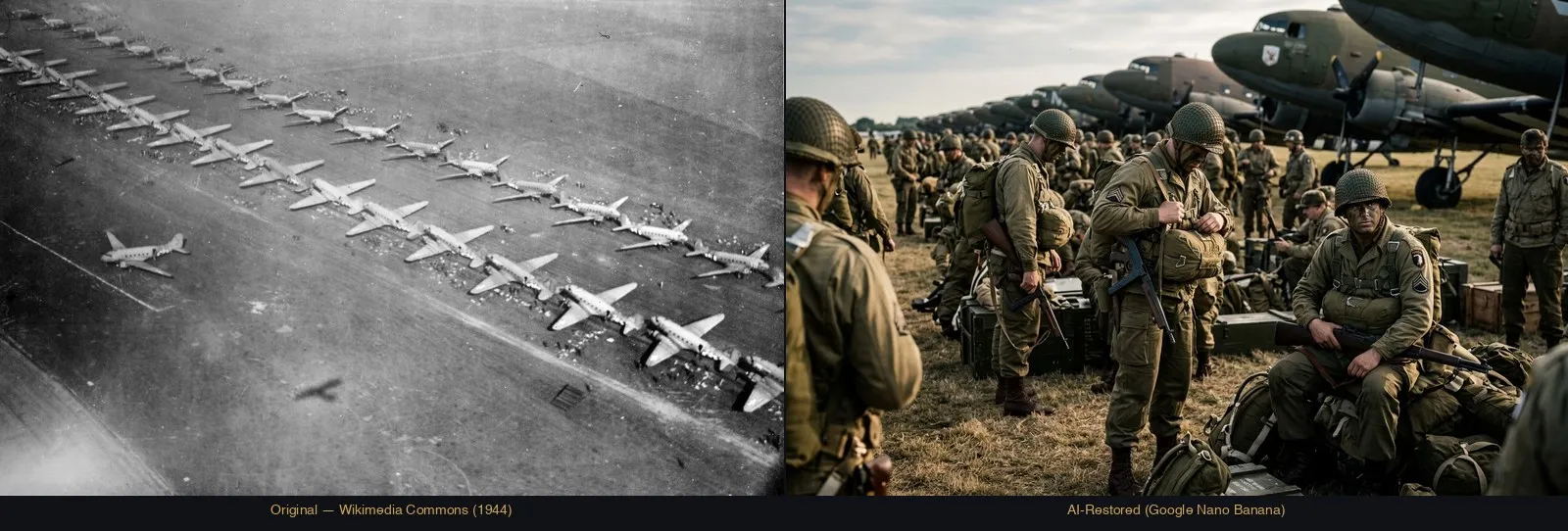
The standard American paratrooper parachute on D-Day was the T-5, a design the US Army standardized in June 1941 after failed trials of the earlier T-4 model. According to International Military Antiques and the 326th Airborne Engineer Battalion’s equipment records, the T-5 was the most widely used Allied parachute of World War II. More than 13,000 US airborne troops jumped with it into Normandy alone.
Here is the part the show could not put on screen. When a T-5 deployed, the canopy came out of the pack first. The suspension lines followed. The risers, the webbing connecting the harness to the lines, came last. That sequence meant the canopy was already catching air before the lines had fully extended. The open canopy acted as a brake. The paratrooper, still accelerating downward under gravity plus aircraft forward momentum, hit the end of the lines at full speed.
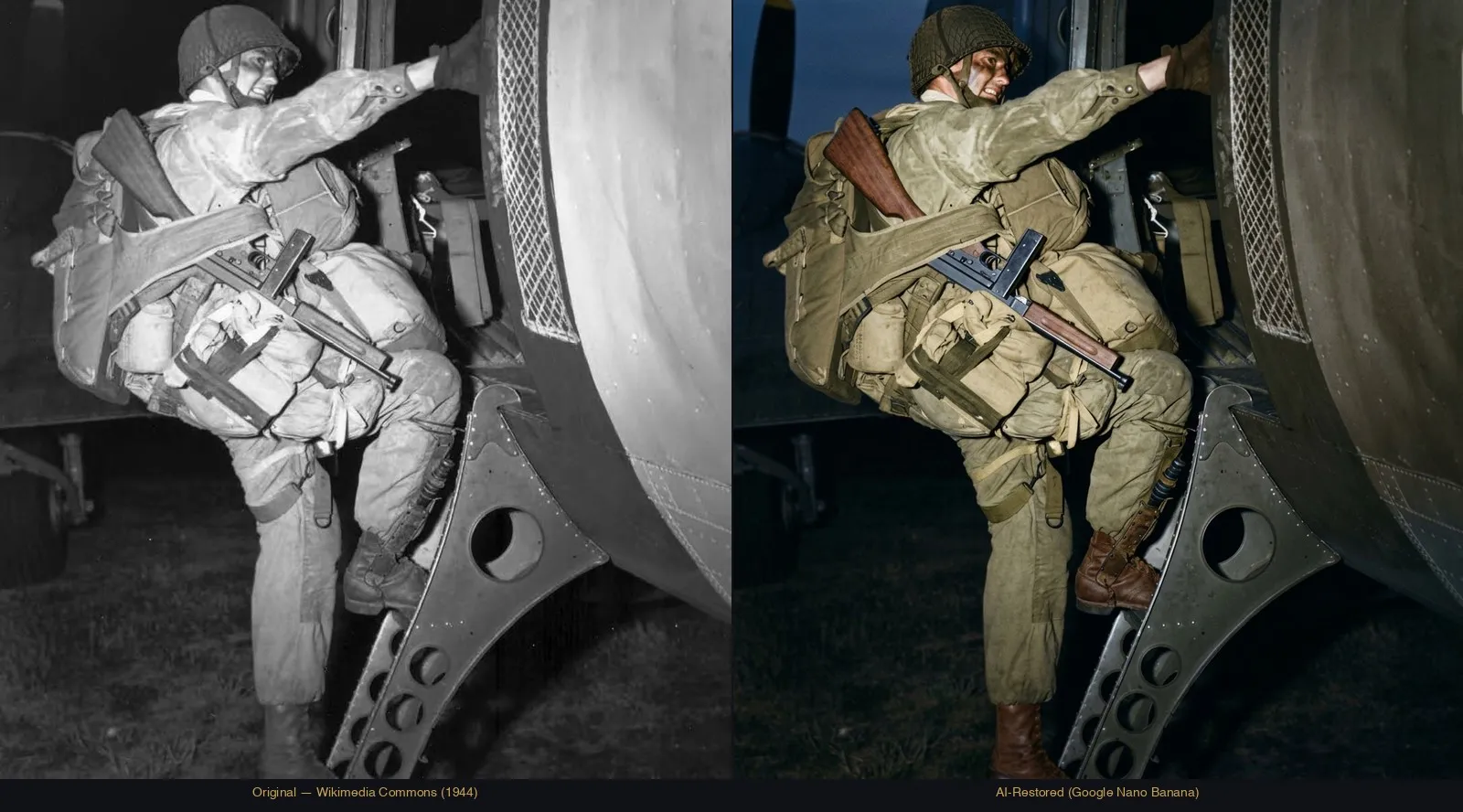
Airborne veterans called it the “opening shock.” Modern sport and military parachutes reverse the sequence, lines first, canopy second. And the difference is enormous. A jumper under a modern chute decelerates smoothly. A 1944 D-Day paratrooper under a T-5, carrying a Thompson, a grenade pouch, rations, a reserve chute, a helmet, and a thirty-kilo leg bag, got punched in the ribs by his own harness.
Then the aircraft made it worse.
The T-5 Parachute Design Nobody Wanted to Jump With Again
Jump doctrine called for the C-47 Skytrains to throttle back to about 110 miles per hour over the drop zones. Slow aircraft meant softer openings. On the night of the invasion, German anti-aircraft fire over the Cotentin Peninsula was so intense that most pilots did the opposite. They held their speed. Some pushed past 150 miles per hour to clear the flak belts faster, protecting the plane and everyone still onboard but punishing the men already stepping into the door.
Every extra ten miles per hour multiplied the opening shock. Jumpers who had rehearsed in England at textbook speeds were now exiting aircraft at 140, 150, sometimes 160 miles per hour. Combine that with the T-5’s canopy-first deployment, and men were hitting the end of their suspension lines with a force their training had never simulated. Memoirs from the 82nd and 101st Airborne describe paratroopers whose helmets flew off in the opening, whose boot laces tore, whose chinstraps cut welts into the skin.
Here is where the story turns.
Men were not just bruised by the shock. They were stripped by it. Items clipped to their webbing or shoved into their pockets broke free and spiraled into the darkness. Grenades, maps, spare magazines, even cigarettes. The National WWII Museum’s records note that some troopers landed with barely a sidearm and a knife. The T-5’s violence during opening was a quiet contributor to why D-Day paratroopers spent the first hours of the invasion searching ditches for any weapon they could find.
The Leg Bag Disaster Band of Brothers Didn’t Show
The leg bag is the single biggest equipment failure of the airborne invasion, and the show whispers past it. A British innovation adopted by American units only weeks before the jump, the leg bag was a reinforced canvas kit bag tied by a long rope to the paratrooper’s harness and strapped to one shin during the jump. Inside it went the main weapon, usually a Thompson submachine gun, an M1 Garand, or a light machine gun, plus a pack, ammunition reserves, and mission-specific gear.
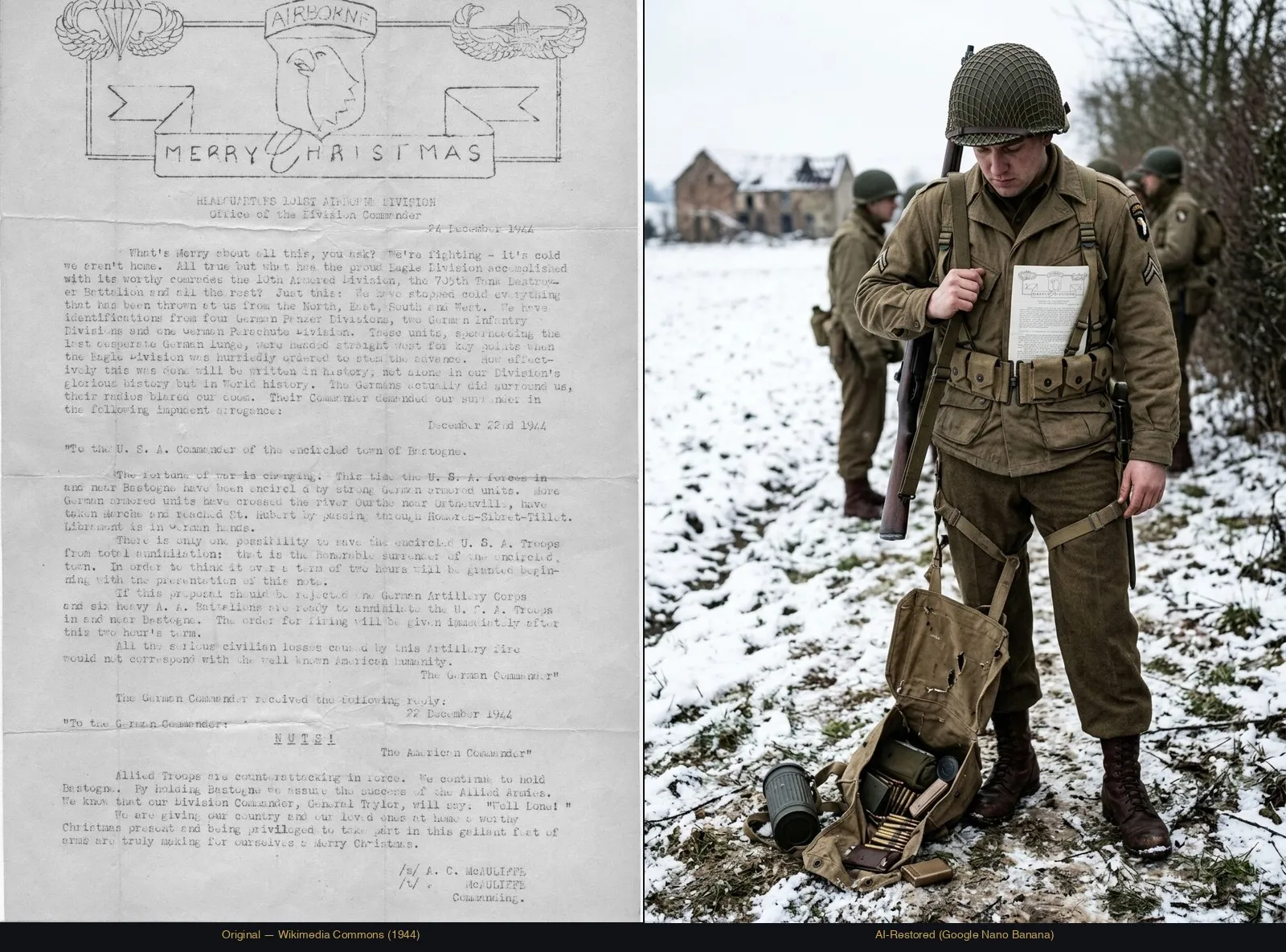
The theory was sound. After the canopy opened, the paratrooper would release the bag on its rope, let it dangle about twenty feet below, and hit the ground seconds after it did. That way he would not land on thirty kilos of equipment.
The theory met reality the moment the planes hit 150 miles per hour.
Dick Winters, commander of Easy Company, 506th PIR, wrote in his memoir that he lost his leg bag the instant he cleared the door. The opening shock snapped the rope. The bag, holding his Thompson, his rations, and most of his ammunition, vanished into the dark. According to his account, nearly every man in Easy Company lost his bag the same way. Winters landed outside Sainte-Marie-du-Mont with nothing but a trench knife.
Why did this happen across the entire airborne force? Two reasons, both preventable.
First, US paratroopers had never trained with leg bags before the jump. The British had been using them for years. American units received them in England in the final weeks before D-Day with little more than verbal instruction. There was no rehearsal jump, no stress test, no gradual introduction to how the bag behaved in the slipstream. Men who had jumped fifty times in their careers were meeting this piece of equipment for the first time while flying into anti-aircraft fire.
Second, the bags were designed for jumps at 110 miles per hour. At 150, the slipstream hitting the bag the moment it cleared the aircraft generated force the rope was never built to withstand. The bag tore loose, the rope whipped back against the jumper’s leg, and the weapons inside, officially the paratrooper’s only means of fighting for the next twelve hours, disappeared into hedgerows.
“Band of Brothers” shows Winters landing in a field, grabbing scattered equipment, and moving on. The camera does not pause to explain why he has almost nothing.
How Many D-Day Paratroopers Actually Died on the Jump?
The casualty numbers for the airborne invasion are one of the most-asked questions about D-Day, and they deserve precision. According to the National WWII Museum and Wikipedia’s compiled records, approximately 13,100 American paratroopers of the 82nd and 101st Airborne Divisions dropped into Normandy across two parachute missions and six glider missions on the night of June 5–6 and the morning of June 6.
Total American airborne casualties on D-Day: 2,499. That figure breaks down as:
- 101st Airborne Division: 1,240 casualties, 182 killed, 557 wounded, 501 missing.
- 82nd Airborne Division: 1,259 casualties. 156 killed, 347 wounded, 756 missing.
Combined killed on June 6 alone: 338. Combined missing: 1,257, men who were either dead in hedgerows, drowned in flooded fields the Germans had deliberately opened, or captured in scattered landings far from their drop zones. The percentage killed among jumped paratroopers is roughly 2.5 percent on the first day, though missing-and-presumed-dead figures push the real fatality rate closer to 4–5 percent by the end of the first week of combat.
Not all of these casualties came from the jump itself. Many died in the fighting around Sainte-Mère-Église, La Fière bridge, and Carentan in the hours and days after landing. But a meaningful share. Nobody knows the exact number, came from the jump alone. Men knocked unconscious by the opening shock. Men who drowned in flooded Merderet River fields because they could not cut free of their harnesses in time. Men dropped from aircraft flying too low because the pilot was jinking to avoid flak, who opened their chutes at barely 200 feet.
Some troopers never got a full canopy. Their last sight was the ground.
What the Show Quietly Changed About the Airborne Jump
“Band of Brothers” is one of the most factually careful war series ever made. It still had to compress, simplify, and in a few places rewrite the night of June 5 for television. Here is what the producers adjusted. And what those adjustments cost in technical accuracy.
The show depicts parachute deployment as relatively smooth. In reality, the T-5’s canopy-first sequence produced a violent jerk that memoirs describe as feeling like “being hit by a truck.” Actors could not safely replicate that impact on set, and showing it would have required extensive rigged-stunt work that the production budget did not have. The compromise: clean, quick canopy opens and no visible opening-shock injury.
The leg bag issue appears only obliquely. A viewer who has not read Winters’s memoir or Stephen Ambrose’s source book may not realize that almost every man in Easy Company had lost his primary weapon before setting foot on French soil. The show has troopers scrounging, but it does not explain why, which makes their scramble look like ordinary battlefield confusion rather than a systemic equipment failure that Allied command had failed to test.
Aircraft speed is also softened. The C-47s in “Band of Brothers” appear to fly in formation, steady and relatively controlled. Archival footage and pilot debriefs describe the real formations as broken up almost immediately by cloud cover and flak, with planes scattering across dozens of miles. The show chose dramatic clarity over operational chaos. A defensible trade, but one worth knowing about if you want the full picture of what D-Day paratroopers actually faced.
Here is what the show got exactly right.
The anti-aircraft fire was as intense as depicted. The pilot reactions, throttle up, break formation, get through, were as shown. And the scattered landings were, if anything, worse in reality than on screen. Some 82nd Airborne sticks landed twenty miles from their drop zones. Some 101st troopers landed in the English Channel and drowned under their own parachutes.
What the Jump Cost the Men Who Survived It
Long-term, the T-5 opening shock left marks. Spinal compression injuries, neck strains, and shoulder damage were common. Veterans interviewed by the National WWII Museum and NPR in later decades recalled chronic back pain that started on June 6 and never left them. A jumper who survived D-Day had usually completed at least fifty training jumps; the Normandy drop was often described as “harder than all fifty combined”, a line that appears in multiple 101st and 82nd oral histories.
The leg bag failure had operational consequences that rippled through the first week of the invasion. Men without their weapons could not engage. Units fighting at reduced firepower took longer to secure objectives. The assault on the La Fière bridge by the 82nd’s 505th PIR turned into a four-day battle in part because too many of the attacking paratroopers had landed without the machine guns and mortars that were supposed to give them overmatch.
After Normandy, the US Army overhauled leg-bag doctrine and parachute-training protocols. By Operation Market Garden three months later, jumpers had practiced with the bags and the worst equipment-stripping problems had been partially solved. Though the T-5 itself stayed in service, opening shocks and all, until it was replaced by the T-7 after the war.
The most quoted reform came from Dick Winters himself. In Easy Company’s post-Normandy training, every new replacement was briefed on exactly how the jump sequence would feel, how to cut away a tangled chute, and how to recover after losing a leg bag. Winters refused to let his men discover those facts the way he had discovered them over a dark French field with a trench knife.
Reflection: Was It a Parachute Failure or a Command Failure?
Historians still argue about the leg-bag fiasco. Some blame the British for selling a solution the Americans did not have time to test. Some blame Allied command for rushing the equipment into service without mandatory training. Some blame the pilots for flying too fast, a decision that saved lives in the aircraft at the cost of lives in the door.
But every argument misses the larger point the T-5 and the leg bag together make. The D-Day paratroopers jumped into the most ambitious airborne operation of the war carrying equipment they had never fully tested, under conditions nobody had fully anticipated, on aircraft flown faster than the training manuals permitted. The jump was not a failure of any single piece of gear. It was a failure of the assumption that men who had trained a hundred times for a jump could survive the first time that jump turned real.
So here is the question worth sitting with. If the airborne command knew the T-5’s opening shock and the leg bag’s fragility before June 5. And there is memoir evidence that some commanders did know, was the Normandy jump a brave tactical gamble, or a quietly negligent one? And when the men landed with broken backs and empty hands and still took their objectives, does that make the decision to send them look worse, or look somehow justified by the impossible standard they were held to?
The men who jumped that night never got a clean answer. Neither, probably, should we.
Related Band of Brothers Stories
- The Band of Brothers Eindhoven Liberation: What Really Happened in September 1944
- Dick Winters: The Complete Biography of Easy Company’s Real Leader
- Herbert Sobel: Band of Brothers’ Forgotten Captain
Frequently Asked Questions
How many D-Day paratroopers died?
Of the roughly 13,100 American paratroopers who jumped into Normandy on June 6, 1944, 338 were confirmed killed on D-Day itself across the 82nd and 101st Airborne Divisions. Another 1,257 were listed as missing, many of whom were later confirmed dead in flooded fields, broken jumps, or scattered German captures. Total first-day airborne casualties reached 2,499 between the two divisions.
What percent of D-Day paratroopers died?
Roughly 2.5 percent of American paratroopers were confirmed killed on D-Day itself, but the true fatality rate when missing-and-presumed-dead figures are included rose to 4 to 5 percent by the end of the first week of combat in Normandy. The 82nd Airborne alone had 15 of its 16 battalion commanders killed or wounded in the first 48 hours.
How many paratroopers jumped on D-Day?
Approximately 13,100 American paratroopers of the 82nd and 101st Airborne Divisions dropped into Normandy across two parachute missions on the night of June 5–6, 1944. Six additional glider missions delivered reinforcements in the following hours. Combined with British and Canadian airborne drops on the eastern flank, the total Allied airborne force on D-Day numbered over 24,000.
When did the paratroopers drop on D-Day?
American paratroopers began jumping into Normandy shortly after midnight on the night of June 5–6, 1944, with the bulk of the 82nd and 101st Airborne Divisions on the ground between 12:30 and 1:30 AM on June 6. The airborne drops preceded the seaborne landings at the beaches by approximately five hours.
Where did D-Day paratroopers take off from?
American paratroopers took off from a network of airfields in southern England, primarily in Devon, Wiltshire, and Berkshire. The 101st Airborne flew out of bases near Uppottery, Exeter, and Merryfield, while the 82nd Airborne used airfields including Spanhoe, Cottesmore, and Folkingham. C-47 Skytrains carried the full airborne lift, with each aircraft holding a “stick” of about 15 to 18 paratroopers.
Sources
- Beyond Band of Brothers: The War Memoirs of Major Dick Winters by Dick Winters with Cole C. Kingseed (2006), Chapters 5–6 on Normandy jump and leg-bag loss.
- Band of Brothers: E Company, 506th Regiment, 101st Airborne by Stephen E. Ambrose (1992), source material for the HBO series.
- “The Airborne Invasion of Normandy,” The National WWII Museum.
- “How D-Day Was Fought From The Air,” Imperial War Museums.
- T-5 parachute historical records, 326th Airborne Engineer Battalion association.
Written by the CineMilitary Editorial Team. Last updated April 17, 2026. This article draws on primary memoir sources and verified archival records. AI tools were used for research synthesis; all facts were cross-checked against at least two independent sources before publication. If you spot a factual correction, please contact us.