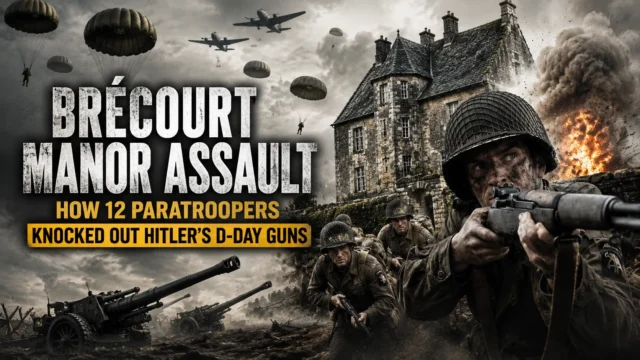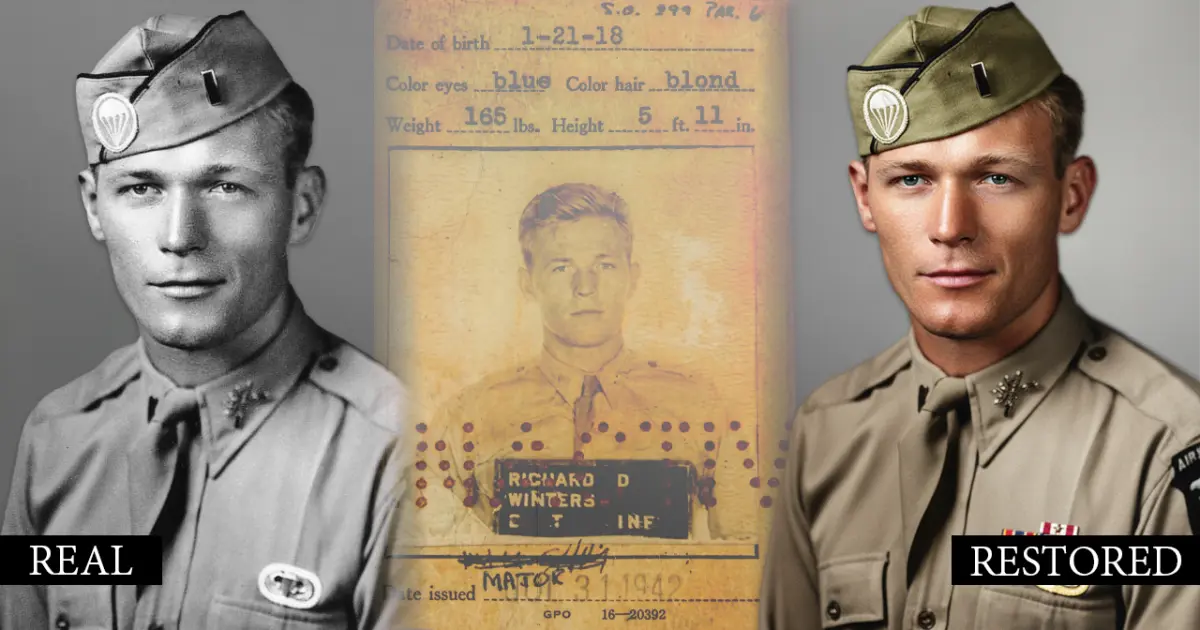
Dick Winters jumped into Normandy at one in the morning on June 6, 1944, with a broken wristwatch, two chocolate bars, and a Gammon grenade he had never thrown. Seven hours later, the 26-year-old Pennsylvania farmer’s son had led the assault that knocked out a battery of German 105 mm howitzers shelling Utah Beach, saved an unknown number of American lives on Causeway Exit 2, and written a small-unit assault plan the United States Military Academy at West Point still teaches to every officer class.
He almost never talked about it. Not for fifty years. Not until a historian named Stephen Ambrose came to his farm in Hershey, Pennsylvania, with a tape recorder and asked him to explain what had happened that morning outside a French manor house called Brécourt. The answer became a book. The book became an HBO miniseries. And Dick Winters, who sold cattle feed to Amish dairy farmers for most of his adult life, became one of the most studied leaders in modern American military history.
This is the complete biography of Dick Winters. Every date. Every action. Every unit citation. Every quiet year between the war and the fame. What he did at Brécourt. What he did at the dike in Holland he considered his finest hour. What he did after the war when nobody was looking. And what the HBO version of his life got right and what it left out entirely.
Who Was Dick Winters? The Quick Answer
Watch: the story behind Winters giving up his wristwatch before the Normandy jump.
Richard Davis Winters, known almost universally as Dick Winters, was a U.S. Army officer born January 21, 1918, in New Holland, Pennsylvania. He served as commander of Company E (Easy Company), 2nd Battalion, 506th Parachute Infantry Regiment, 101st Airborne Division, from June 1944 to October 1944, and as executive officer of 2nd Battalion from October 1944 to the end of World War II. He was awarded the Distinguished Service Cross, the Bronze Star, and the Purple Heart for actions during the Normandy invasion, Operation Market Garden in Holland, and the Battle of the Bulge. After the war he settled in Hershey, Pennsylvania, founded a livestock feed business serving Lancaster County Amish farmers, married Ethel Muriel Estoppey in 1948, raised two children, and lived in near-complete privacy for fifty years. Stephen Ambrose’s 1992 book Band of Brothers and the 2001 HBO miniseries of the same name made him a household name. He died on January 2, 2011, at age 92, in Campbelltown, Pennsylvania.
The Man Before Easy Company: Lancaster County Beginnings (1918–1937)
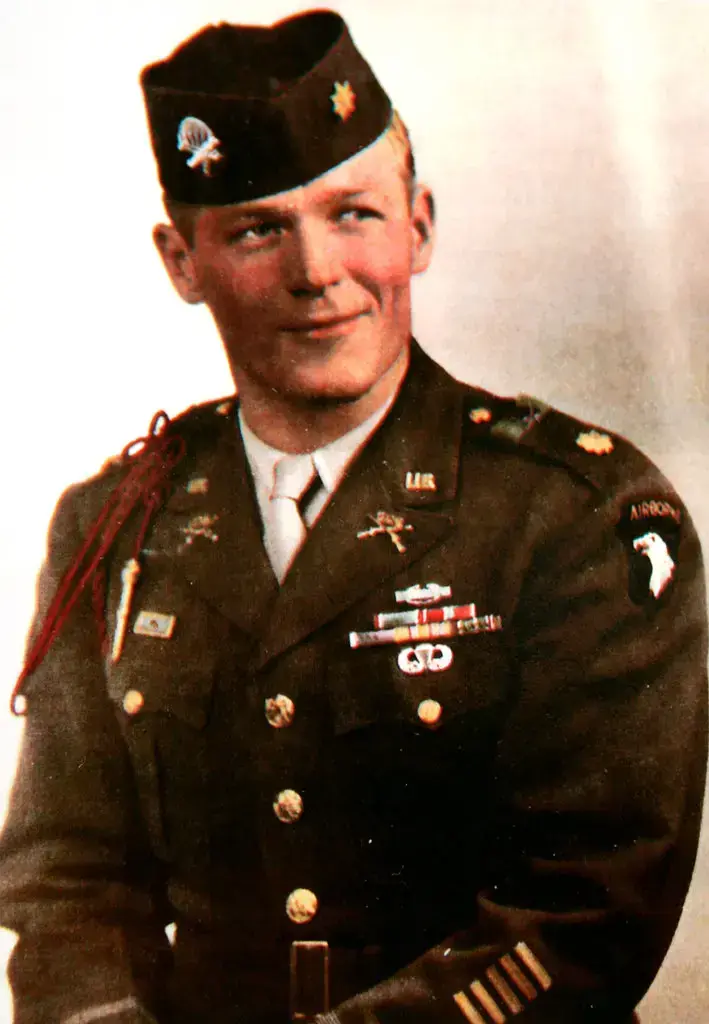
Richard Davis Winters was born on January 21, 1918, in New Holland, Pennsylvania, to Richard and Edith Winters. New Holland is a small farming town in Lancaster County, deep in Pennsylvania Dutch country. His father worked for the A.B. Farquhar Company, a farm equipment manufacturer. The family was unremarkable, working-class, and rooted in the Lancaster County soil.
When Dick was a toddler, the family moved to Ephrata, another small Lancaster County town a few miles away. When he was eight years old, in 1926, they moved again to Lancaster itself, the county seat, so the Winters children could attend better schools. Dick’s sister Ann was younger. The family was not wealthy. His mother, Edith, was said by her son to be the formative influence on his character. She taught him that work came before leisure, that a man’s word was his contract, and that God saw everything you did when you thought nobody was watching.
Dick attended Lancaster Boys High School. He was not the dramatic high school story of a future war hero. He did not play varsity football. He did not lead the student council. He was quiet. He studied. He worked part-time at a local department store. Classmates who remembered him decades later described him as earnest, disciplined, and surprisingly private for a teenager. He graduated in 1937.
Franklin & Marshall College: The Formative Years (1937–1941)
In the fall of 1937, Dick Winters enrolled at Franklin & Marshall College, a small liberal arts school founded in 1787 in Lancaster, a few miles from his family’s home. He chose economics as his major, added science courses, and worked his way through college. He was a member of the college’s Phi Kappa Sigma fraternity, though not a particularly social member.
Two elements of his Franklin & Marshall years matter for understanding what came later. The first was his fitness routine. Winters ran daily on the F&M campus, lifted weights with obsessive regularity, and stayed away from alcohol and tobacco at a time when college men did both routinely. He cultivated the physical condition that would keep him functional through brutal infantry training a few years later. The second was his faith. Winters was a serious Lutheran. He attended services regularly, read the Bible daily, and maintained a moral code he never abandoned. In Beyond Band of Brothers, co-written with Colonel Cole Kingseed decades later, Winters described his religion in plain, unsentimental terms. He believed a man’s conduct was his testimony to God.
Winters graduated from Franklin & Marshall College in June 1941 with a Bachelor of Science degree in economics. Europe had been at war for nearly two years. Winters had been reading every war dispatch he could find since the German invasion of Poland in September 1939. He had already decided what he was going to do.
On August 25, 1941, three and a half months before Pearl Harbor, Dick Winters walked into a Lancaster recruiting office and enlisted in the United States Army as a private. He did not wait for the draft. He did not wait for a declaration of war. He volunteered.
Officer Candidate School: Fort Benning (1941–1942)
Because he was a college graduate, Winters qualified for Officer Candidate School. After basic training at Camp Croft, South Carolina, he was sent to the Infantry School at Fort Benning, Georgia, for ninety days of OCS. He was commissioned a second lieutenant in the U.S. Army on July 2, 1942.
Winters volunteered for the newly forming parachute infantry. The paratroopers were an experimental formation. Nobody in the U.S. Army had ever conducted a large-scale parachute assault. The concept was untested. The training washout rate was enormous. Winters signed up anyway. The extra hazardous-duty pay was one reason. The rigor was another. He wanted the hardest unit in the Army.
Camp Toccoa: Under Captain Sobel (August 1942 – September 1943)
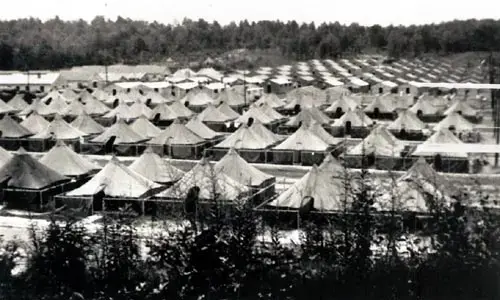
Watch: the real meaning of “Currahee” and why Easy Company ran that mountain.
In mid-August 1942, Second Lieutenant Richard Winters arrived at Camp Toccoa, Georgia, and was assigned to Company E, 2nd Battalion, 506th Parachute Infantry Regiment. The company commander was First Lieutenant Herbert Sobel, a Chicago clothing store manager in civilian life, who had been promoted to command Easy Company despite minimal combat leadership experience.
Winters was given command of 2nd Platoon. In October 1942 he was promoted to first lieutenant. The Toccoa training was legendary. Currahee Mountain rose over 1,700 feet above the camp. The standing order was three miles up, three miles down, under fifty minutes, in full combat gear. Sobel ran the company through this routine almost daily. Winters ran alongside his men and kept up easier than most.
The infamous “spaghetti run” happened at Toccoa. Sobel fed the men a large pasta dinner in the mess hall, then immediately ordered them up the mountain. Soldiers vomited on the trail. Some collapsed. Medics who gave rides back to barracks had their passengers shipped out of the company the same day. Sobel’s message was clear: accepting help was the end of your career in Easy Company.
Winters’s relationship with Sobel was formal, respectful, and distant. He did not openly criticize his commanding officer. He did the punishments Sobel handed down, accepted extra drill, and ran the mountain again when ordered. His men noticed. The quiet second lieutenant was not a man who folded.
One detail that almost never appears in HBO’s version: Winters did not drink alcohol, did not smoke, and did not pursue women. In a company of paratroopers in their early twenties, this stood out sharply. The men read it not as priggishness but as discipline. They trusted him.
The NCO Mutiny and Sobel’s Removal (September 1943)
Watch: what actually happened when Sobel tried to court-martial Winters.
By September 1943, the 506th Parachute Infantry Regiment had moved from Toccoa to Fort Bragg, North Carolina, then to Camp Shanks, New York, for embarkation. The regiment shipped to England aboard the S.S. Samaria in September 1943 and was stationed at the tiny English village of Aldbourne, Wiltshire.
In Aldbourne, a group of Easy Company noncommissioned officers, among them Mike Ranney and Terrence ‘Salty’ Harris, organized what became known as the NCO mutiny. With the platoon sergeants behind them, the NCOs handed in a collective letter of resignation from their ranks, stating they would not follow Sobel into combat. This was a court-martial-level offense under the Articles of War. It could have meant prison. It could have meant execution.
Winters was not part of the mutiny. As a commissioned officer he was not eligible to participate. But Sobel used the crisis to retaliate against him separately. Sobel issued Winters a written reprimand over a trivial inspection issue involving a latrine detail. Winters, following Army regulations, requested a formal court-martial to clear his name. This was a calculated move: going to trial would expose Sobel’s pattern of petty harassment to regimental command.
Colonel Robert Sink, the 506th regimental commander, read the situation. He was not going to lose Easy Company’s trained NCOs over Sobel’s bad leadership. He quietly transferred Sobel to command a jump school at Chilton Foliat. He disciplined the ringleaders of the mutiny with demotions or transfers, but kept them in the regiment. He gave Winters a minor administrative punishment and dropped the court-martial.
Easy Company got a new commander, First Lieutenant Thomas Meehan. The crisis was resolved. Winters remained a platoon leader. The men who had nearly been charged with mutiny lived to jump into Normandy eight months later.
D-Day: The Brécourt Manor Assault (June 6, 1944)

Watch: why Major Winters never received the Medal of Honor for Brécourt.
On the night of June 5, 1944, First Lieutenant Dick Winters boarded a C-47 Skytrain transport aircraft at Uppottery airfield in Devon, southern England. The 506th Parachute Infantry Regiment was jumping into Normandy as part of the Allied airborne assault that would open the invasion of France.
Winters’s plane was hit by German anti-aircraft fire shortly after crossing the French coast. He exited the plane around 1:10 a.m. on June 6. The drop was scattered across dozens of miles. Winters landed near Sainte-Mère-Église, lost his leg bag containing most of his equipment in the jump, and came down with only a bayonet and the Gammon grenade strapped to his chest.
He spent the first hours of D-Day moving through hedgerow country in the dark, gathering scattered paratroopers from multiple units. By dawn he had linked up with elements of Easy Company and other 101st Airborne units. First Lieutenant Thomas Meehan, the Easy Company commander, had been killed when his own C-47 was shot down on the way to the drop zone. Command of Easy Company fell to Winters by default. He had never commanded a rifle company in combat. He was 26 years old.
Around 8:30 a.m. on June 6, 1944, 2nd Battalion of the 506th received a message from 1st Battalion near Le Grand-Chemin: German artillery was shelling Utah Beach from a position near a farm called Brécourt Manor. The guns were firing on Causeway Exit 2, one of the four dirt roads that American infantry of the 4th Infantry Division needed to move inland from the beach. Every round killed American soldiers. Battalion ordered Easy Company to destroy the battery.
Winters conducted a quick personal reconnaissance. The German position turned out to be four 10.5 cm leFH 18 howitzers dug into trenches connected by communication ditches, surrounded by hedgerows, defended by about 50 German soldiers. Winters later identified the guns as the 6th Battery of the 90th Artillery Regiment; the U.S. Army’s official history places them in the German 191st Artillery Regiment. The battery had machine-gun emplacements and was registered to cover the beach exits. A direct frontal assault would have been suicidal.
Winters assembled twelve men from Easy Company: Sergeants Carwood Lipton and William Guarnere, Corporals Donald Malarkey and Joe Toye, Privates Gerald Lorraine, Cleveland Petty, John Plesha, Walter Hendrix, Myron Ranney, Robert Rader, Robert Smith Jr., and Popeye Wynn. He briefed them on the plan.
The plan was a textbook flanking assault. Two machine guns would establish a base of fire from one hedgerow covering the main German trench line. Winters would personally lead the assault element along a communication ditch the Germans had left unfortified. They would take the guns one at a time, moving down the trench line, overwhelming each position before the Germans could shift their defense.
The attack began. Winters took the first howitzer in minutes. His men took the second gun, where Winters found a German map showing the artillery and machine-gun positions across the Cotentin Peninsula. They took the third gun as reinforcements began to arrive, and Lieutenant Ronald Speirs of Dog Company led the assault that took the fourth. Blocks of TNT dropped into the breeches finished the guns.
When the fighting ended, the tally was this: about a dozen Easy Company men, later reinforced by Speirs and a handful of others, had attacked roughly 50 Germans in a fortified position. Four Americans were killed and six wounded (Winters’s count; Ambrose gives two wounded). Fifteen Germans were killed and twelve captured. Four 10.5 cm artillery pieces were destroyed. Causeway Exit 2 was open. American infantry began moving off Utah Beach.
On July 2, 1944, Lieutenant General Omar Bradley, the commander of the United States First Army, personally presented Dick Winters with the Distinguished Service Cross in a small ceremony in Normandy. The DSC is the second-highest U.S. Army award for combat valor, ranking directly below the Medal of Honor. Winters’s men believed he should have received the Medal of Honor. A petition submitted to the U.S. Army in 2005 to upgrade the award was reviewed but not approved. The Army’s position was that the Brécourt action was a collective unit accomplishment rather than the singular action of one individual, and the award criteria for the Medal of Honor require the latter.
The United States Military Academy at West Point teaches the Brécourt Manor assault as a case study in small-unit tactics. Officer candidates study Winters’s after-action report. The assault has appeared in the academy’s combat leadership curriculum continuously since the 1990s.
Carentan and the Normandy Campaign (June–July 1944)
After Brécourt, Easy Company fought through the hedgerow country toward Carentan, a key road junction the Germans needed to split the American airborne beachhead from Utah Beach. On June 12, 1944, Easy Company assaulted Carentan with the rest of 2nd Battalion. During the fighting, Winters was grazed across the leg by a bullet. He did not file paperwork for a Purple Heart. He later said the wound was a scratch and did not compare to the sacrifices of men who were truly bleeding for their country.
A second near-miss happened in Holland a few months later when a bullet passed close enough to cut his trouser leg. Again he did not file. In Winters’s view, the Purple Heart belonged to men who had bled for their men, not to an officer who had gotten lucky. The Army awarded him the Purple Heart for the Carentan leg wound regardless of his own reluctance to claim it.
Easy Company was pulled back to England in late June 1944 to refit and receive replacements. Winters oversaw the training of the replacement personnel and the company’s recovery. He had been promoted to captain on July 1, 1944.
Operation Market Garden: Holland (September–November 1944)
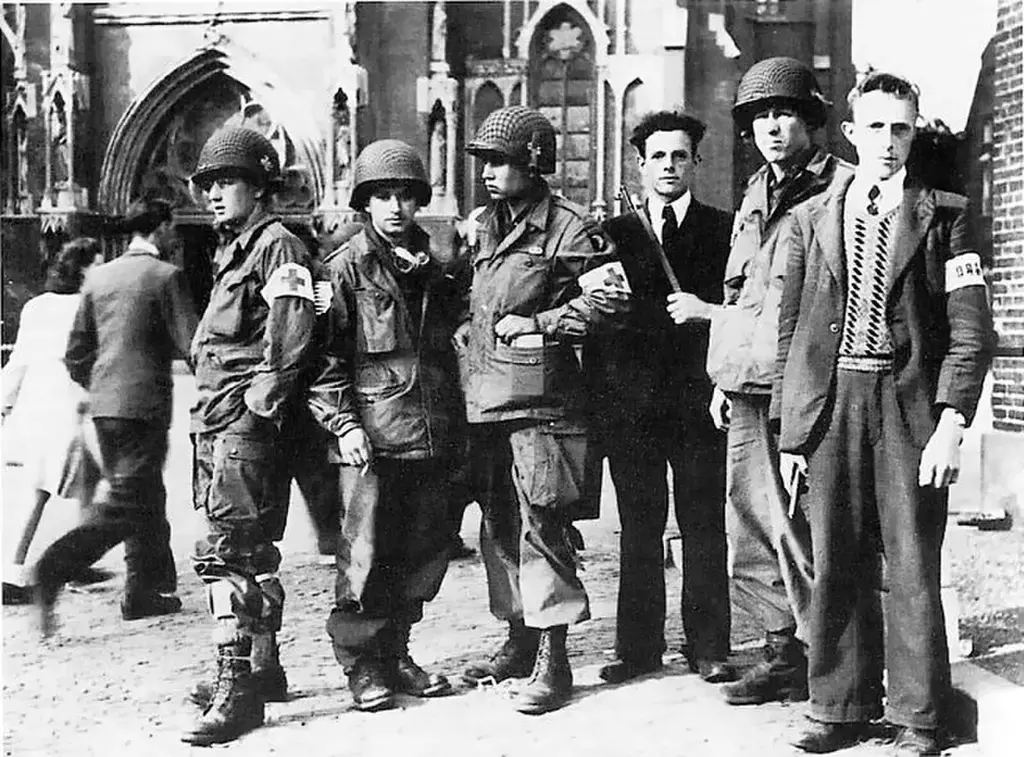
On September 17, 1944, Easy Company jumped into Holland as part of Operation Market Garden, Field Marshal Bernard Montgomery’s ambitious plan to seize a series of bridges across the Rhine and drive into Germany. The 101st Airborne Division dropped near Son and Veghel, with the objective of holding the southern road to Eindhoven.
Easy Company helped liberate the city of Eindhoven on September 18, 1944. Dutch civilians swarmed the paratroopers with flowers, bread, orange banners, and tears. The full story of what happened at Eindhoven, including the collaborator punishments HBO softened, is covered in our Band of Brothers Eindhoven Liberation article.
After Eindhoven, Easy Company moved north to hold defensive positions on a flat low-lying area between the Rhine and the Waal rivers known to the paratroopers as the Island. The Germans had been pushed back but still held the far bank of the Rhine. Night patrols and scattered engagements continued for weeks.
The Dike at Randwijk: Winters’s Finest Hour (October 5, 1944)
Watch: Major Winters explains the Crossroads assault in his own words.
At approximately 3:30 a.m. on October 5, 1944, a five-man Easy Company patrol moved to occupy an outpost on the south side of a raised dike road near the village of Randwijk, on the Island. As Private Joe Lesniewski reached the top of the dike, he saw a German machine-gun crew and an SS soldier preparing to throw a grenade. The grenade landed among the patrol. Four of the five Americans were wounded in the explosion.
The patrol had inadvertently run into the flank of a German SS battalion moving south along the dike road toward the 506th regimental headquarters. Two full companies of SS troops, totaling approximately 300 men, were on the move. If they reached the regimental headquarters, they would break the American line on the Island.
Captain Dick Winters, woken by the first shots, assembled a fifteen-man patrol from Easy Company and moved forward to make contact. He arrived at the dike, assessed the situation, and made one of the critical decisions of his war. He ordered his men to fix bayonets and charge.
Winters and his men crested the dike in a single bayonet rush. The SS companies, taken completely by surprise and unable to see the size of the attacking force in the darkness and smoke, broke ranks and ran. Reinforcements from Easy and Fox Companies arrived within minutes. Winters’s thirty-five men had routed two SS companies totaling roughly 300 men. German losses were heavy. Easy Company’s losses were light, but not bloodless: Pvt. William Dukeman was killed in the action.
Winters later wrote that the moment at the dike, not the Brécourt assault, was the action he considered his finest hour. Asked by his co-author Colonel Cole Kingseed why, Winters said the dike attack was a clean tactical success: no civilians endangered, no collateral damage, and light losses for the company. He had seen an opportunity, acted on it, and saved his regiment’s headquarters from being overrun.
For the dike action, Colonel Sink issued a commendation to Easy Company’s 1st Platoon for gallantry in action. Winters was soon promoted to the executive officer of 2nd Battalion, a staff job. He never commanded Easy Company in direct combat again.
Bastogne and the Battle of the Bulge (December 1944 – January 1945)
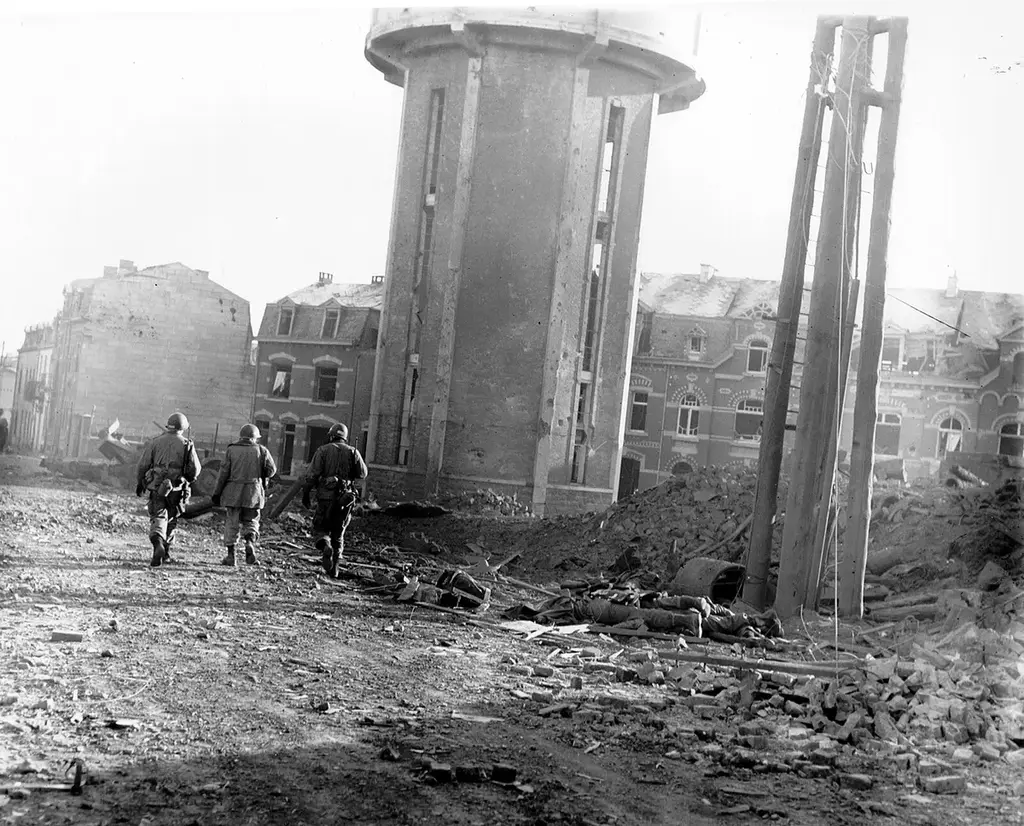
In mid-December 1944, Hitler launched the Ardennes offensive, the last major German counterattack of the war. The 101st Airborne Division was pulled from its rest area at Mourmelon, France, and rushed north by truck to the Belgian town of Bastogne. Easy Company dug into the woods outside Bastogne on December 19, 1944, with without winter gear, without overcoats, and without ammunition reserves.
Winters spent the Bastogne campaign as 2nd Battalion executive officer. His job was no longer leading assaults. It was logistics, personnel management, and the endless paperwork of keeping a battalion functional in sub-zero temperatures. He filed frostbite reports, rotated men out of exposed positions, organized ammunition resupply, and monitored the company commanders.
The story of what Easy Company endured at Bastogne, the charge at Foy under Captain Ronald Speirs after Lieutenant Dike froze, the Christmas bombing of the 20th Field Hospital that killed nurse Renée Lemaire, is covered in our Bastogne episode deep-dive. Winters was not in the front line for most of it. As battalion XO he was in the battalion command post, a small farmhouse in the rear, running the administrative machinery that kept the line companies alive.
When the siege broke on December 26, 1944, after Patton’s Third Army relieved Bastogne, Easy Company kept fighting through January. Foy, Noville, and Rachamps were all taken in January 1945. The campaign cost Easy Company more casualties than any previous engagement. Joe Toye lost a leg on January 3. Bill Guarnere lost his right leg minutes later trying to drag Toye to safety. Buck Compton broke down watching his friends maimed and was rotated out of combat. Winters signed the paperwork for every one of them.
Haguenau, Kaufering, and the Eagle’s Nest (February – May 1945)
Watch: what Winters actually did the morning after Germany surrendered.
Watch: why Winters disobeyed Colonel Sink’s patrol order at Haguenau.
In February 1945, 2nd Battalion moved to Haguenau in Alsace, on the west bank of the Moder River facing German positions. The “Last Patrol” episode of the HBO miniseries was drawn from this period. Winters, as battalion XO, planned the night river-crossing patrols. When senior command ordered a second patrol after the first one had achieved its objective, Winters quietly told his men to stay put and report a fictitious successful mission. It was one of the few times he openly disobeyed a direct order. He later said the risk to his men for no tactical purpose was not justifiable.
In late March 1945, 2nd Battalion crossed the Rhine River into Germany. The German military collapse accelerated. The battalion moved through Bavaria against scattered resistance.
On April 27, 1945, elements of the U.S. 12th Armored Division uncovered the Kaufering IV subcamp of the Dachau concentration camp system near Landsberg, Germany. Easy Company was routed through the same area in the days that followed and saw the results of the Holocaust directly for the first time. The full story of Kaufering and Winters’s reaction to what he found there is covered in our Kaufering true story article. Winters later wrote that what he saw in the camps stayed with him longer than any firefight.
On May 5, 1945, after a day stalled behind the French 2nd Armored Division at a blown bridge, Easy Company entered Berchtesgaden, the Bavarian mountain town where Hitler maintained the Berghof and the Eagle’s Nest retreat. Which Allied unit reached it first is still argued, but the 506th found the area largely intact and full of Hitler’s personal effects, silver, wine, and art. Elements of Easy Company helped themselves to souvenirs.
V-E Day, May 8, 1945, found Easy Company in Austria, near Kaprun, a small village in the Alps. The war in Europe was over. Winters oversaw the battalion’s occupation duties.
One episode that HBO covered briefly but deserves fuller mention: during occupation duty in Austria, two American soldiers in 2nd Battalion were credibly accused of raping a local Austrian woman. Winters, acting as the senior battalion officer available, personally launched the investigation, gathered evidence, identified the guilty parties, and ensured they faced courts-martial. He considered the action one of the most important of his career because it was not about his own men’s heroism but about the Army holding itself to a moral standard even in the ruin of a defeated country.
Coming Home: The Decision to Leave the Army (1945–1948)
Watch: how Major Richard Winters’s military career actually ended.
Winters was offered a permanent commission in the Regular Army after Japan surrendered in August 1945. He declined. His choice surprised some of his superiors. He had a combat record that would have guaranteed rapid promotion in a peacetime Army. He had just commanded a battalion as XO at age 27. The career path was wide open.
Winters’s reason for leaving was simple. He had enlisted in 1941 to help win the war. The war was won. He wanted to go home to Pennsylvania. He did not want to be a professional soldier.
He returned to the United States in November 1945. He accepted a position as personnel manager at Nixon Nitration Works, an industrial chemicals company in New Brunswick, New Jersey, owned by the family of his closest Army friend, Captain Lewis Nixon. The offer was a favor from Nixon’s family. Winters took it as a bridge job while he figured out what to do with the rest of his life.
While working at Nixon Nitration Works, Winters met Ethel Muriel Estoppey. Ethel was born in 1922, three years younger than Dick. She was a Rutgers University graduate who worked in administrative and psychometric testing roles. The two met in New Jersey in 1947 and began a quiet courtship.
Dick Winters and Ethel Estoppey were married on May 16, 1948, in New Brunswick, New Jersey. The wedding was small. By that point Winters had already decided New Jersey was not home. He resigned from Nixon Nitration Works. He and Ethel moved back to Lancaster County, Pennsylvania, to start a life together on his terms.
The Hershey Years: A Livestock Feed Business and Fifty Years of Quiet (1948–1985)
The Winterses bought a rural property near Hershey, Pennsylvania, and Dick began building a business. An old wartime acquaintance who now worked at the Hershey Chocolate Company connected Winters with the chocolate plant’s industrial byproducts: cocoa bean shells, nut and sugar crumbs, spoiled sweeteners, waste butter, leftover dairy solids. The byproducts had high caloric content but were not usable for human consumption.
Winters figured out how to blend these byproducts into a livestock feed additive with strong nutritional value for dairy and beef cattle. He founded R.D. Winters Inc., a one-man operation initially, and began selling the feed to Amish and Mennonite farmers in Lancaster County. The Amish valued two things about the product: it worked, and the man selling it did not lie. Winters’s customer base grew by word of mouth over years.
Ethel Winters was the silent partner of the business. She handled correspondence, bookkeeping, customer records, and scheduling. She was a Rutgers graduate running the paperwork of a Pennsylvania Dutch-country cattle feed business. The arrangement worked.
The couple had two children. Timothy, their son, was born in the early 1950s. He would later earn a Master of Arts in English from Pennsylvania State University. Jill, their daughter, was born later in the 1950s. She earned a Bachelor of Arts from Albright College. Both children grew up on the Hershey farm. Neither knew for most of their childhood that their father had received the Distinguished Service Cross.
For nearly forty years, Dick Winters lived this quiet life. He walked his fields every morning. He ran the feed business. He attended Lutheran services. He read. He did not tell war stories at dinner. He did not put medals on his wall. His neighbors knew him as a businessman who treated his customers fairly and expected the same in return. His children asked occasional questions about the war. He gave brief, factual answers and changed the subject.
One detail that shows the character of the man: when the Easy Company reunion movement began in the late 1970s, Dick Winters became the quiet organizer. Other veterans gave speeches. Winters kept the mailing lists, wrote the invitations, confirmed attendance, and collected the addresses as men died off over the decades. He built the oral history infrastructure that Stephen Ambrose would eventually discover.
Stephen Ambrose and the Book That Changed Everything (1985–1992)
In the mid-1980s, historian Stephen E. Ambrose was researching a book on the 101st Airborne Division’s World War II service. Ambrose already had a reputation as a popular military historian. He had written Band of Brothers as a concept: a book focused not on generals or strategy but on one rifle company’s entire war from training to Berchtesgaden.
Ambrose wrote to Dick Winters in Hershey. Winters agreed to be interviewed. He sent Ambrose his wartime journals, his correspondence with other Easy Company veterans, his notes, and his own detailed recollections. Ambrose conducted extended interviews with Winters at his Pennsylvania farm over several years. Winters helped Ambrose contact dozens of other surviving Easy Company members.
Band of Brothers: Easy Company, 506th Regiment, 101st Airborne from Normandy to Hitler’s Eagle’s Nest, by Stephen E. Ambrose, was published by Simon & Schuster in 1992. It was a modest commercial success initially. Winters’s name became known to a few tens of thousands of military history readers. It did not disrupt his life.
HBO, Hollywood, and the Encounter with Tom Hanks (1998–2001)
Watch: Winters’s own surprising critique of the Band of Brothers miniseries.
In 1998, Steven Spielberg and Tom Hanks announced that their DreamWorks production company, partnered with HBO, would produce a ten-part miniseries adaptation of Ambrose’s book. Budget: 125 million dollars. Production timeline: two and a half years. Hanks and Spielberg served as executive producers.
Winters, now 80 years old, was cautious about the project. He had seen Hollywood’s treatment of war stories. He did not want his men cheapened. He agreed to consult on the scripts and to meet the actors in early production.
The famous “I can shun you” exchange with Tom Hanks happened during a production visit in 2000. Winters read the draft scripts and objected to the heavy use of profanity, particularly what he felt was gratuitous cursing assigned to the real men. He told Hanks directly that if the show went too far, he would publicly withdraw his endorsement and stop cooperating with production. Hanks listened. Some lines were softened. The core scripts moved forward. The full account of that encounter and the Tom Hanks negotiation is in our companion article, why Dick Winters almost quit Band of Brothers.
British actor Damian Lewis was cast as Winters, part of a cast matched to the real Easy Company men. Lewis spent extended time studying Winters’s manner, his unusual quietness, and his Pennsylvania speech patterns. The two met during production. Lewis later said that Winters was the most privately intense man he had ever met. Playing him required stripping almost all visible emotion from the performance.
The HBO miniseries Band of Brothers premiered on September 9, 2001. It aired through November 2001 against the backdrop of the September 11 terrorist attacks. Audiences poured in. The series won the Emmy for Outstanding Miniseries and the Golden Globe for Best Miniseries. Damian Lewis was nominated for a Golden Globe as Winters. The miniseries became one of HBO’s most acclaimed productions ever made.
Dick Winters, 83 years old and living quietly in Hershey, woke up famous.
Dick Winters on Leadership: The Nine Principles
In Beyond Band of Brothers, Dick Winters and Colonel Cole C. Kingseed distilled the lessons of his combat leadership and his subsequent thirty years of running a business into a set of leadership principles. These principles are now widely taught in business schools, U.S. Army leadership programs, and corporate executive training. They are given here as Winters himself articulated them.
- Strive to be a leader of character, competence, and courage. Character is what you do when nobody is watching. Competence is earned through work. Courage is not the absence of fear but acting despite it.
- Lead from the front. Say “Follow me!” and then lead the way. A leader who asks his people to do what he will not do himself has no right to lead anyone.
- Stay in top physical shape. Physical stamina is the root of mental toughness. When your body fails, your judgment fails with it.
- Develop your team. Know your people. Set fair and realistic goals. Lead by example. Teamwork develops on its own.
- Delegate responsibility to your subordinates and let them do their jobs. People cannot do their best work if they are never allowed to use their own imagination.
- Anticipate problems and prepare to overcome obstacles. Do not wait until you reach the top of the ridge to make up your mind.
- Remain humble. Do not worry about who receives the credit. Never let power or authority go to your head.
- Take a moment of self-reflection. Look at yourself in the mirror every night and ask yourself if you did your best.
- True satisfaction comes from getting the job done. The key to successful leadership is to earn respect through character, not demand it through rank.
Winters never claimed to be a great general. He had commanded a battalion for a few months as an executive officer and a rifle company for four months in combat. But the clarity of these principles and the consistency of his conduct make them useful to leaders in any field. West Point uses them. Civilian corporations use them. Franklin & Marshall College, his alma mater, teaches them in its leadership curriculum.
The Final Years: Fame at Eighty (2001–2011)
After the HBO premiere, Dick Winters’s life changed at a scale he had not anticipated. School children began writing him letters from across the United States. Military academies invited him to speak. Book publishers approached him. Documentary crews requested interviews. Tourists started driving past his Hershey farm.
Winters accepted some of this and declined most of it. He spoke at Franklin & Marshall College, at West Point, at a few carefully chosen leadership conferences. He answered letters personally, often writing dozens of replies per week to schoolchildren. He refused most television interview requests.
In 2006, he published Beyond Band of Brothers: The War Memoirs of Major Dick Winters, co-written with Colonel Cole C. Kingseed. The book was not a dramatic war narrative. It was a field commander’s reflections on leadership, discipline, and the lessons he had drawn from his combat experience. It sold over one million copies.
On May 16, 2009, Franklin & Marshall College conferred upon Dick Winters an honorary doctorate in humane letters. The date, not coincidentally, was his 61st wedding anniversary. The ceremony was held in Lancaster. He gave a short speech about his mother and Lancaster County. He did not mention Brécourt Manor. It was one of his last public appearances.
Winters was diagnosed with Parkinson’s disease in the late 2000s. His health declined steadily. Ethel, now in her late 80s, became his primary caregiver. Their children visited regularly.
Dick Winters died at 4:00 p.m. on January 2, 2011, in Campbelltown, Pennsylvania, at age 92, of complications from Parkinson’s disease. His death was not announced publicly until after his burial. He had specifically requested no military funeral, no honor guard, no public memorial. He was buried in a small family plot in Ephrata, the Pennsylvania town his family had lived in when he was a boy. His headstone is simple. It does not mention the Distinguished Service Cross.
“I Served in a Company of Heroes”: The Quote That Defined Him
Watch: why Winters sat alone after every battle, even decades later.
In the years after Band of Brothers aired, children sent Dick Winters thousands of letters. Most asked variations of the same question. Was he a hero? Winters had a standard answer he used at Easy Company reunions and in closing remarks at West Point. He borrowed it from Sgt. Mike Ranney, who wrote it in a letter to Winters in January 1992, recalling a question from his grandson. Stephen Ambrose used the passage to close Band of Brothers.
‘Grandpa, were you a hero in the war?’ … ‘No,’ I answered, ‘but I served in a company of heroes.’
He meant it. The quote became the final line of the HBO miniseries. It is printed in every edition of Beyond Band of Brothers. It was the answer Winters refused to budge from for the rest of his life.
Legacy: Monument, Foundation, and Curriculum
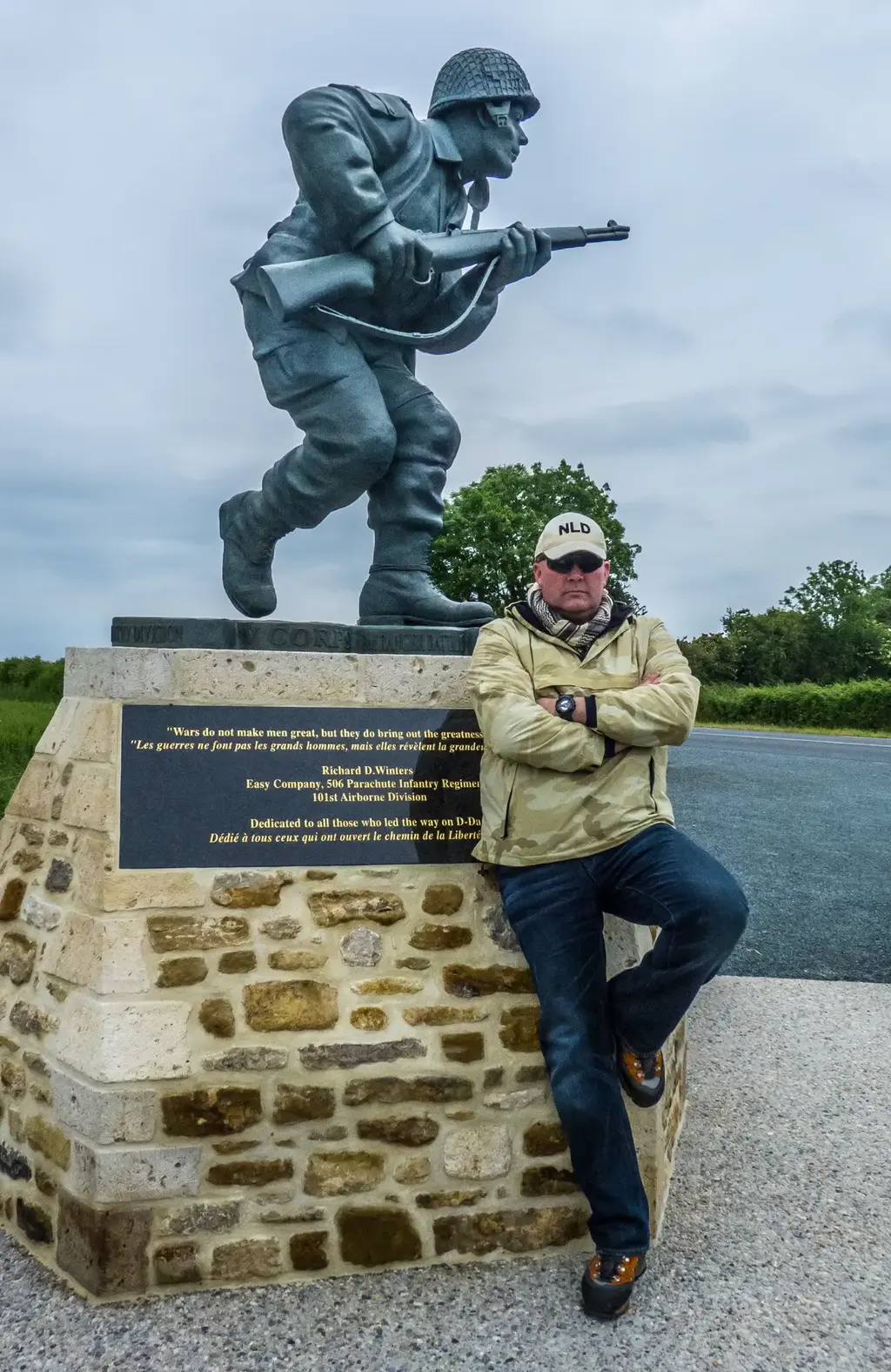
On June 6, 2012, the 68th anniversary of D-Day, the Major Dick Winters Leadership Monument was dedicated at Utah Beach in Normandy, France. The monument is a nine-foot bronze statue depicting Winters in combat jump gear, one foot stepping forward, rifle slung. The French government donated the site. Private donations funded the statue. The dedication ceremony was attended by surviving members of Easy Company, representatives of the U.S. Army, and local French officials.
The Major Dick Winters Leadership Project was founded in 2013 to preserve his writings, fund leadership scholarships, and support veteran mental health initiatives. The organization operates out of Pennsylvania and continues to distribute his nine leadership principles to educators and military programs.
The U.S. Military Academy at West Point continues to teach the Brécourt Manor assault as a case study. Winters’s after-action report is still in the curriculum.
Colonel Cole C. Kingseed, Winters’s memoir co-author, published a follow-up book, Conversations with Major Dick Winters: Life Lessons from the Commander of the Band of Brothers, in 2014. The book drew on additional taped conversations Kingseed had recorded with Winters in the final years of his life.
Dick Winters Complete Timeline
- January 21, 1918: Born Richard Davis Winters in New Holland, Pennsylvania.
- 1926: Family moves to Lancaster, Pennsylvania.
- 1937: Graduates Lancaster Boys High School.
- 1937: Enrolls Franklin & Marshall College, majoring in economics.
- June 1941: Graduates Franklin & Marshall College with B.S. in economics.
- August 25, 1941: Enlists in the U.S. Army as a private.
- July 2, 1942: Commissioned second lieutenant, Fort Benning OCS.
- August 1942: Arrives Camp Toccoa, Georgia. Assigned 2nd Platoon, Easy Company, 506th PIR.
- October 1942: Promoted to first lieutenant.
- September 1943: Easy Company arrives Aldbourne, England. NCO mutiny against Sobel.
- June 6, 1944: Parachutes into Normandy. Commands Brécourt Manor assault. Becomes acting Easy Company commander.
- June 12, 1944: Carentan assault. Grazed by bullet.
- July 1, 1944: Promoted to captain.
- July 2, 1944: Awarded Distinguished Service Cross by Lt. Gen. Omar Bradley.
- September 17, 1944: Jumps into Holland for Operation Market Garden.
- October 5, 1944: Leads the dike attack at Randwijk.
- November 1944: Promoted to executive officer of 2nd Battalion.
- December 19, 1944 – January 1945: Battle of the Bulge. Bastogne.
- March 1945: Promoted to major.
- April 27, 1945: Kaufering concentration camp discovery.
- May 5, 1945: 506th enters Berchtesgaden.
- May 8, 1945: V-E Day. In Kaprun, Austria, with 2nd Battalion.
- November 1945: Returns to the United States. Declines permanent Regular Army commission.
- 1946: Personnel manager, Nixon Nitration Works, New Brunswick, NJ.
- May 16, 1948: Marries Ethel Muriel Estoppey in New Brunswick, NJ.
- 1948: Moves to Hershey, PA. Founds R.D. Winters Inc., livestock feed business.
- 1951: Briefly recalled to active duty for Korean War training assignment, stateside.
- Early 1950s: Son Timothy born.
- Mid-1950s: Daughter Jill born.
- Late 1970s: Winters begins organizing Easy Company reunions.
- Mid-1980s: Stephen Ambrose interviews begin.
- 1992: Ambrose publishes Band of Brothers.
- 1998: HBO/DreamWorks miniseries announced.
- 2000: Meets Tom Hanks and Damian Lewis during production.
- September 9, 2001: HBO miniseries Band of Brothers premieres.
- 2006: Publishes Beyond Band of Brothers memoir with Cole Kingseed.
- May 16, 2009: Franklin & Marshall College confers honorary doctorate on 61st wedding anniversary.
- January 2, 2011: Dies in Campbelltown, PA, age 92.
- June 6, 2012: Major Dick Winters Leadership Monument dedicated at Utah Beach, Normandy.
- 2014: Kingseed publishes Conversations with Major Dick Winters.
Complete Awards and Decorations
Major Richard D. Winters’s military decorations and awards include the following.
- Distinguished Service Cross: for the Brécourt Manor assault, June 6, 1944. Presented by Lt. Gen. Omar Bradley, July 2, 1944.
- Bronze Star Medal: for actions during Operation Market Garden.
- Purple Heart: for the leg wound received at Carentan, June 1944.
- Army Good Conduct Medal
- American Campaign Medal
- European-African-Middle Eastern Campaign Medal with four campaign stars
- World War II Victory Medal
- Army of Occupation Medal
- Combat Infantryman Badge
- French Croix de Guerre
- Belgian Croix de Guerre
- Netherlands Orange Lanyard
- Presidential Unit Citation (as a member of the 506th PIR)
What Band of Brothers Changed About Dick Winters
Watch: what the HBO series got wrong about Private Blithe.
The HBO miniseries is one of the most faithful adaptations of a historical account Hollywood has ever produced. Costumes, weapons, tactics, and even dialogue were drawn from veteran interviews and archival sources. But compression was inevitable. Ten episodes cannot cover four years of war. Here are the most significant differences between the HBO portrayal and the documented historical record.
- The dike attack at Randwijk was compressed. The show condenses the October 5, 1944 action into a single compact scene. Winters himself considered this the best tactical action of his career, better than Brécourt. The book treats it more fully; the show treats Brécourt as the defining moment.
- Winters’s administrative work at Bastogne was not shown. HBO focuses on the line companies. Winters was in the battalion CP handling frostbite reports and ammunition resupply. His role at Bastogne was logistical, not combat.
- The Austrian rape investigation is absent. Winters personally handled a serious criminal investigation involving two American soldiers during occupation duty. The HBO miniseries does not include this.
- Winters’s religious life is barely shown. He was a serious Lutheran whose faith shaped his decisions throughout the war. HBO shows glimpses but not the depth.
- The Tom Hanks encounter is not dramatized. Winters’s firm objection to the profanity in the HBO scripts, and his quiet threat to withdraw cooperation, is a production-era story the show could not and did not include.
- Ethel and the civilian life are largely absent. The miniseries closes with brief title cards. The forty years of livestock feed sales to Amish farmers, the two children, the silent decades with Ethel, none of it fits into the narrative arc of a wartime show.
Books About or By Dick Winters
- Stephen E. Ambrose. Band of Brothers: Easy Company, 506th Regiment, 101st Airborne from Normandy to Hitler’s Eagle’s Nest. Simon & Schuster, 1992.
- Dick Winters and Cole C. Kingseed. Beyond Band of Brothers: The War Memoirs of Major Dick Winters. Berkley Caliber, 2006.
- Cole C. Kingseed. Conversations with Major Dick Winters: Life Lessons from the Commander of the Band of Brothers. Berkley Caliber, 2014.
- Larry Alexander. Biggest Brother: The Life of Major Dick Winters, the Man Who Led the Band of Brothers. NAL Caliber, 2005. (The authorized biography, written with Winters’s cooperation.)
Related Band of Brothers Stories
- Are any Easy Company members still alive?
- Ronald Speirs: What Band of Brothers Didn’t Tell You
- Why Dick Winters Almost Quit Band of Brothers Over Script Changes
- The Band of Brothers Eindhoven Liberation: What Really Happened in September 1944
Frequently Asked Questions About Dick Winters
When and where was Dick Winters born?
Dick Winters was born Richard Davis Winters on January 21, 1918, in New Holland, Pennsylvania. His family later moved to Ephrata and then to Lancaster.
When did Dick Winters die?
Dick Winters died on January 2, 2011, in Campbelltown, Pennsylvania, at age 92. The cause of death was complications from Parkinson’s disease. His death was not publicly announced until after his private burial.
Did Dick Winters receive the Medal of Honor?
No. Colonel Robert Sink actually recommended Winters for the Medal of Honor after Brécourt, but the 101st Airborne’s commander, General Maxwell Taylor, had decreed that only one Medal of Honor would be awarded to the division for the Normandy campaign. It went to Lieutenant Colonel Robert G. Cole of the 502nd, and Winters’s nomination was downgraded to the Distinguished Service Cross, which General Omar Bradley presented on July 2, 1944. Decades later, a drive to correct that decision gathered pace: a formal recommendation was endorsed by historians Cole C. Kingseed and Stephen Ambrose, and in 2005 Representative Curt Weldon introduced legislation, co-sponsored by the entire Pennsylvania delegation, asking the President to award Winters the Medal of Honor. The bill died in a House Armed Services subcommittee in 2007, and the upgrade was never granted.
Is the Brécourt Manor assault really taught at West Point?
Yes. The United States Military Academy at West Point has used the Brécourt Manor assault as a case study in small-unit tactics and leadership under pressure since the 1990s. It remains in the academy’s Combat Leadership curriculum.
Who was Dick Winters’s wife?
Ethel Muriel Estoppey Winters. Born in 1922, a graduate of Rutgers University, she met Dick Winters in New Jersey after the war while he was working for Nixon Nitration Works. They married on May 16, 1948, in New Brunswick, New Jersey. They were married for more than 62 years until Dick’s death in 2011. Ethel outlived him by two years.
Did Dick Winters have children?
Yes. Dick and Ethel Winters had two children: a son, Timothy (Tim) Winters, who earned a Master of Arts in English from Pennsylvania State University; and a daughter, Jill Winters, who earned a Bachelor of Arts from Albright College. Both grew up on the family farm near Hershey, Pennsylvania.
What did Dick Winters do after World War II?
Winters briefly worked as personnel manager at Nixon Nitration Works in New Jersey. In 1948 he moved to Hershey, Pennsylvania, and founded R.D. Winters Inc., a livestock feed business that sold a cattle-food additive made from Hershey Chocolate Company industrial byproducts (cocoa shells, sugar crumbs, waste dairy solids) to Amish and Mennonite dairy farmers in Lancaster County. He ran this business for nearly forty years.
Who played Dick Winters in Band of Brothers?
British actor Damian Lewis portrayed Major Dick Winters in the 2001 HBO miniseries Band of Brothers. Lewis was nominated for the Golden Globe for Best Actor in a Miniseries for the performance.
What rank did Dick Winters achieve?
Major. Winters finished World War II as executive officer of 2nd Battalion, 506th PIR. He declined a permanent Regular Army commission in 1945. He was briefly recalled during the Korean War in 1951 for stateside training duty and retained the rank of major at the time of his final discharge.
Where is Dick Winters buried?
Dick Winters is buried in Bergstrasse Evangelical Lutheran Church Cemetery in Ephrata, Pennsylvania, his boyhood community, next to his parents in the family plot. At his own request the funeral was private and unannounced, held on January 8, 2011. His headstone is deliberately simple, marked only “Richard D. Winters, WW II, 101st Airborne,” and does not list his decorations. His Find a Grave memorial records the site.
Is there a Dick Winters monument?
Yes. The Major Dick Winters Leadership Monument was dedicated on June 6, 2012, on the 68th anniversary of D-Day, at Utah Beach in Normandy, France. The bronze statue is approximately nine feet tall and depicts Winters in combat jump gear, mid-stride, rifle slung. The French government donated the site.
What was Dick Winters’s finest hour in the war?
Winters himself named the dike attack at Randwijk, not the Brécourt Manor assault, Holland, on October 5, 1944. With 35 men of Easy and Fox Companies, Winters launched a bayonet charge that routed two SS companies totaling roughly 300 men, saving the 506th regimental headquarters from being overrun. Easy Company’s losses were light, but Pvt. William Dukeman was killed.
Did Dick Winters write a book?
Yes. Beyond Band of Brothers: The War Memoirs of Major Dick Winters, co-written with Colonel Cole C. Kingseed, was published by Berkley Caliber in 2006. The book sold over a million copies. A companion volume, Conversations with Major Dick Winters, by Kingseed alone, was published in 2014.
What were Dick Winters’s leadership principles?
In Beyond Band of Brothers, Winters articulated nine principles: lead with character, competence, and courage; lead from the front; stay in top physical shape; develop your team; delegate responsibility; anticipate problems; remain humble; reflect on yourself daily; and understand that true satisfaction comes from getting the job done, not from rank or credit.
Was Dick Winters religious?
Yes. Winters was a serious Lutheran throughout his life. He read the Bible daily, attended services regularly, and did not drink alcohol, smoke, or curse. His faith was not performative but was a private discipline he maintained from college through the end of his life.
Sources
This biography was researched against primary and authoritative secondary sources. The book citations include chapter-level references where specific details were verified.
- Winters, Dick, and Cole C. Kingseed. Beyond Band of Brothers: The War Memoirs of Major Dick Winters. New York: Berkley Caliber, 2006, chapters 2–12 (early life through V-E Day); Chapter 13 (leadership principles).
- Ambrose, Stephen E. Band of Brothers: Easy Company, 506th Regiment, 101st Airborne from Normandy to Hitler’s Eagle’s Nest. New York: Simon & Schuster, 1992.
- Alexander, Larry. Biggest Brother: The Life of Major Dick Winters, the Man Who Led the Band of Brothers. New York: NAL Caliber, 2005. (The authorized biography.)
- Kingseed, Cole C. Conversations with Major Dick Winters: Life Lessons from the Commander of the Band of Brothers. New York: Berkley Caliber, 2014.
- Richard Winters: Hall of Valor citation (Military Times)
- Hero of Brécourt Manor: U.S. Department of Veterans Affairs
- Major Dick Winters: The Island In His Own Words: Warfare History Network
- Outstanding Veterans: Major Dick Winters: Reagan Library Blog, National Archives
- Dick Winters: Pennsylvania Center for the Book
Correction, October 25, 2026: An earlier version of this article said Damian Lewis won a Golden Globe (he was nominated), credited Winters alone with all four Brécourt guns, named First Sergeant William Evans as leader of the NCO protest, attributed the “company of heroes” line to Winters’s own grandson (it comes from Sgt. Mike Ranney), and reported no Easy Company deaths at the Crossroads (Pvt. William Dukeman was killed). It has been corrected against Stephen Ambrose’s Band of Brothers and Winters’s memoir. It also overstated the Brécourt force, said Speirs helped take the third gun, misdated Winters’s promotion to captain and his arrival at Berchtesgaden, listed three awards no source supports, and attributed the list to the Congressional Medal of Honor Society. It also described the source of the Ranney line as a newsletter; it was a letter Ranney wrote to Winters in January 1992.