Who Bombed Eindhoven in Band of Brothers?
The German Luftwaffe bombed Eindhoven on the night of September 19, 1944: one day after Easy Company and the 101st Airborne liberated the city during Operation Market Garden. The raid killed 227 Dutch civilians and wounded hundreds more, in retaliation for the Allied advance. HBO’s Band of Brothers Episode 4 (“Replacements”) shows the bombing aftermath but compresses the 24-hour timeline.
Band of Brothers Eindhoven: What Really Happened in September 1944?
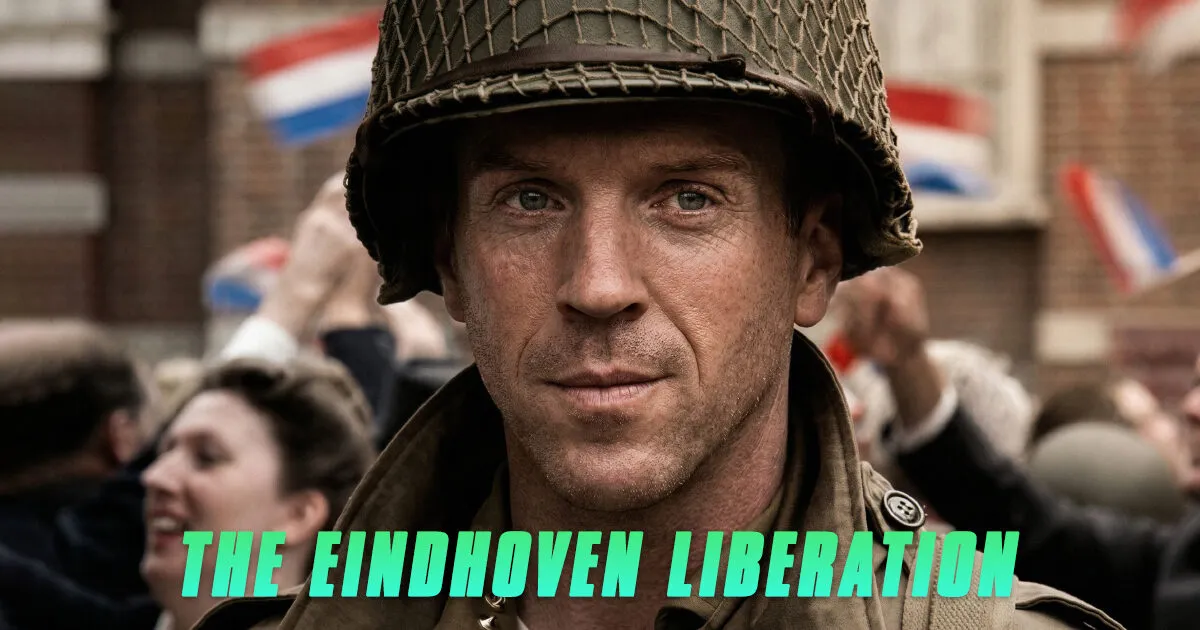
On September 18, 1944, Easy Company of the 506th Parachute Infantry Regiment entered Eindhoven as part of Operation Market Garden, the first major Dutch city liberated by the Allies. Crowds threw flowers, danced in the streets, and shaved the heads of women accused of collaborating with the German occupiers. The liberation lasted less than 24 hours of celebration before the German Luftwaffe bombed the city centre the following night, September 19. HBO’s Band of Brothers Episode 4, “Replacements,” compresses these events and softens the most disturbing aspect, the public humiliation of Dutch collaborators by their own neighbors. The real story is harsher than the show’s depiction.
Key Takeaway
On September 18, 1944, the 506th Parachute Infantry Regiment walked into Eindhoven and found a city exploding with joy. Dutch civilians who had endured four years of Nazi occupation poured into the streets, handing out tea and fruit. Some gave kisses to soldiers they’d never met. Twenty-four hours later, Luftwaffe bombs turned those same streets into burning rubble. 227 people were killed. Celebration turned to devastation overnight. The Band of Brothers Eindhoven liberation scene in Episode 4 (“Replacements”) captures both sides of this day. But how much of it actually happened? The answer, drawn from Dick Winters’ own memoir and multiple veteran accounts, is: almost all of it.
The Real Story Behind the Band of Brothers Eindhoven Liberation
Eindhoven was a footnote, really. In the bigger picture of Operation Market Garden, the largest airborne operation in military history, this city was just a stop on the road. One checkpoint on a 62-mile corridor of paratroopers and armor pushing from Belgium through the Netherlands toward Germany. The real targets were the bridges: Son, Veghel, Nijmegen, and the infamous “bridge too far” at Arnhem.
But for the people who lived there, it was the most important day of their lives.
The 101st Airborne Division, under Major General Maxwell D. Taylor, dropped north of the city on the afternoon of September 17, 1944. By the morning of September 18, elements of the 506th PIR pushed into Eindhoven itself. The Germans had already pulled back. And for the first time since May 1940, the people of this city saw Allied soldiers on their streets.
As Stephen Ambrose describes in Chapter 8 of Band of Brothers, the residents “lined the roads as if for a parade.” The paratroopers were met with deafening applause, orange flags. People dragged out chairs and handed over hot tea, milk, fruit.
Dick Winters, commanding Easy Company at the time, remembered the scene vividly. In Chapter 7 of his memoir Beyond Band of Brothers, he wrote: “When we entered Eindhoven, however, our biggest problem was pushing the troops through the crowds of people that greeted our men.”
That’s a sentence worth sitting with. The biggest problem wasn’t snipers or artillery. It was civilians who were so happy to see them that the soldiers couldn’t physically move forward.
Winters Hid His Rank and Carried an M-1 Rifle
Even amid the euphoria, Winters kept his guard up. He wasn’t the type to get swept away by a parade. In the same chapter, he reveals a detail that says everything about how he operated: “I tried as much as possible to look like just another GI. I deliberately turned up my collar to hide my rank, tucked my map case out of sight, and carried a standard M-1 rifle.”
He wasn’t trying to be humble. He was trying to avoid snipers. An officer with visible rank insignia and a map case was the first person a hidden German marksman would target. Winters had survived Normandy and Carentan by making himself invisible. Eindhoven’s celebration didn’t change that instinct.
“It just felt good knowing that I could take care of myself in all situations,” he reflected.
Years later, when asked to summarize the civilian reaction, Winters kept it simple: “It was just unbelievable.”
The Head-Shaving Scene: What the Show Changed
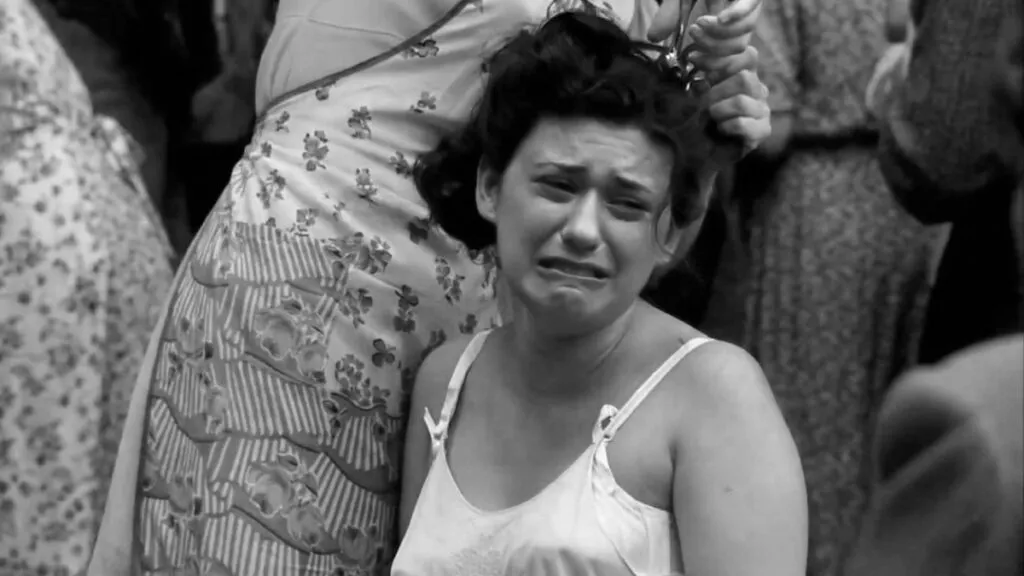
But while the celebration was happening, something uglier was going on in the same streets. This is where the show takes its biggest creative liberty.
In Episode 4, Easy Company soldiers watch as a group of Dutch women are dragged out and publicly shaved, punished for having relationships with German soldiers during the occupation. The scene shows officers like Winters and Nixon observing the spectacle, implying they witnessed it firsthand.
The head-shaving was real. Across the Netherlands, France, Belgium, and Norway, women accused of “horizontal collaboration” were subjected to public humiliation during liberation. In Dutch, they were called Moffenmeiden. Their heads were shaved, sometimes painted with swastikas, and they were paraded through jeering crowds. Approximately 120,000 NSB members and suspected collaborators were arrested across the Netherlands.
But here’s what the show moved around. According to Deliver Us From Darkness (Chapter 6), it was members of the Dutch resistance, known as PAN, who gathered outside the Catholic seminary to publicly shave the women. Fred Bahlau of the 506th watched the angry mob and privately felt it was a “bullshit thing for these people to do.”
And Buck Compton, one of Easy Company’s most prominent officers, directly contradicts the show’s depiction. In Chapter 16 of his memoir Call of Duty, Compton wrote: “I never actually witnessed anyone getting her head shaved. All I saw was a lot of people lining the streets and handing out food.”
David Kenyon Webster’s memoir Parachute Infantry confirms the historical reality of the punishments, noting conversations with locals who explained the women’s heads were shaved because “she made love to German soldiers.” But Webster’s account suggests these events were happening throughout the region, not necessarily directly in front of Easy Company officers.
The show compressed what was a widespread, multi-day phenomenon into a single scene witnessed by the main characters. Good drama. Historically, a composite.
Why Dutch Actors Were Told to Speak Broken English
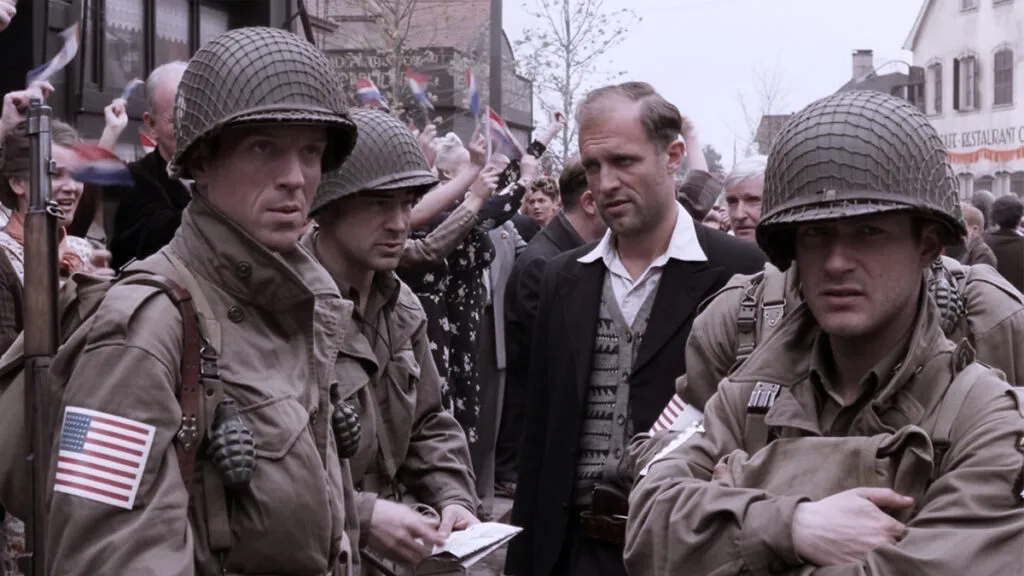
Here’s a production detail that most viewers missed entirely. It shows how far the production team went for accuracy.
The Dutch actors hired for the Eindhoven scenes spoke fluent English. The Netherlands has one of the highest English proficiency rates in Europe. These were professional actors who could deliver lines cleanly, with near-perfect pronunciation.
The directors told them to stop doing that.
In 1944, most Dutch civilians couldn’t speak English well. Four years of occupation had disrupted English education. English radio was banned. The younger generation had grown up hearing German, not English. While some Dutch, particularly in the resistance, could manage basic communication, the polished English of a modern Dutch actor would have been completely anachronistic.
So the instruction was specific: add mistakes. Pause mid-sentence. Fumble a word here and there. Speak with the hesitation of someone reaching for vocabulary they don’t quite have.
Some fans complained the Dutch dialogue sounded awkward. Yeah. That was intentional.
The Cameo Nobody Noticed
In the background of the liberation celebration, at a table where Sergeant Floyd Talbert is kissing a young Dutch woman, there’s an old man waving a flag.
That man is the real Edward “Babe” Heffron. An actual Easy Company veteran, on set as a cameo.
HBO brought several surviving veterans to the Hatfield Aerodrome set in England, where the large open field stood in for twelve different European towns, including Eindhoven. Heffron was there to verify accuracy. And at some point, someone decided to put him in the shot.
A real soldier who lived through the liberation of Eindhoven, standing in a recreation of the day, while actors pretended to be his friends. Most viewers will never notice him. But once you know, the scene carries a completely different weight.
“The Dutch Were Closing Their Shutters”: The Bombing of September 19
The celebration lasted exactly one day.
On the evening of September 19, the Luftwaffe launched a devastating bombing raid on Eindhoven. As Deliver Us From Darkness (Chapter 7) details, flares lit the sky “like a giant chandelier” before seventy German bombers targeted the British supply columns bottlenecked in the streets.
The destruction was catastrophic. Over 200 houses were gutted. More than 9,000 buildings sustained damage. 227 civilians were killed and over 800 wounded. Three men from the 506th’s headquarters were also killed.
The 506th PIR rushed into the burning city and pulled civilians from collapsed buildings. Soldiers who had been drinking with the Dutch that afternoon were now carrying their bodies out of the wreckage.
Winters recorded the emotional devastation in his memoir with a passage that remains one of the most haunting in the entire book: “As soon as we returned to Eindhoven, the German air force gave the center of the city a terrific pounding. The image of that aerial and artillery bombardment remains seared in my mind to this day. The Dutch, who, just that morning, had been so happy to be liberated, and who had cheered us as we marched out toward Helmond, were now inside, closing their shutters, taking down their flags, looking dejected. It was a sad sight. They obviously felt that we were deserting them in the face of a determined enemy advance.”
That passage, “closing their shutters, taking down their flags,” is the emotional core of the entire Eindhoven sequence. The show captures it in a single, devastating cut from celebration to devastation. But Winters’ own words hit harder than any camera angle.
What Band of Brothers Got Right (and Where It Took Liberties)
So did the show go too far with Eindhoven? If you check the primary sources, mostly no. With a couple of asterisks.
Historically confirmed:
- The overwhelming civilian celebration (confirmed by Winters, Ambrose, Webster, and Compton)
- The head-shaving of accused collaborators (documented across multiple sources)
- The Dutch resistance meeting the paratroopers (verified in operational records)
- The broken English direction for Dutch actors (production decision for accuracy)
- The Babe Heffron cameo (real veteran)
- The Luftwaffe bombing (227 civilians killed, extensively documented)
- Winters hiding his rank (from his memoir, Beyond Band of Brothers, Chapter 7)
Dramatized or compressed:
- Easy Company officers watching the head-shaving (Compton says he never saw it)
- Timeline compression (24-48 hours compressed into one sequence)
- The tone of Dutch reprisals (more aggressive than Dutch accounts suggest, closer to French-style punishment)
Sources
- Winters, Dick. Beyond Band of Brothers: The War Memoirs of Major Dick Winters. Chapter 7.
- Ambrose, Stephen E. Band of Brothers: E Company, 506th Regiment, 101st Airborne. Chapter 8.
- Compton, Lynn “Buck.” Call of Duty: My Life Before, During, and After the Band of Brothers. Chapter 16.
- Webster, David Kenyon. Parachute Infantry: An American Paratrooper’s Memoir.
- Gardner, Ian. Deliver Us From Darkness: The Untold Story of Third Battalion 506th PIR. Chapters 6-7.
Related Band of Brothers Stories
- Dick Winters: The Complete Biography of Easy Company’s Real Leader
- D-Day Paratroopers: Why the T-5 Jump Was a Nightmare
- Herbert Sobel: Band of Brothers’ Forgotten Captain
Frequently Asked Questions
Which episode of Band of Brothers shows the Eindhoven liberation?
Episode 4, titled “Replacements.” The Eindhoven liberation sequence begins after Easy Company parachutes into Holland as part of Operation Market Garden in September 1944.
Did the Dutch really shave women’s heads during liberation?
Yes. Women accused of relationships with German soldiers, called Moffenmeiden, were publicly humiliated across the Netherlands. Their heads were shaved and sometimes painted with swastikas. However, Buck Compton of Easy Company said he personally never witnessed it, suggesting the show placed its characters closer to the events than they actually were.
Why did the directors make Dutch actors speak broken English?
Because fluent English was rare in the occupied Netherlands in 1944. English education had been disrupted by four years of German occupation. The directors wanted the dialogue to sound like a real 1944 conversation, hesitant and imperfect, rather than polished modern English.
Was the real Babe Heffron in the Eindhoven scene?
Yes. Edward “Babe” Heffron appears in the background of the Eindhoven celebration as a cameo. He’s the old man waving a flag at a table where Sergeant Talbert is kissing a young Dutch woman. The filming took place at Hatfield Aerodrome in England.
Was Eindhoven bombed after liberation?
Yes. On September 19, 1944, just one day after liberation. Seventy Luftwaffe bombers hit Eindhoven’s city center. The attack killed 227 civilians, wounded over 800, gutted 200+ houses, and damaged 9,000 buildings. Dick Winters wrote in his memoir that the Dutch were “closing their shutters, taking down their flags, looking dejected.”